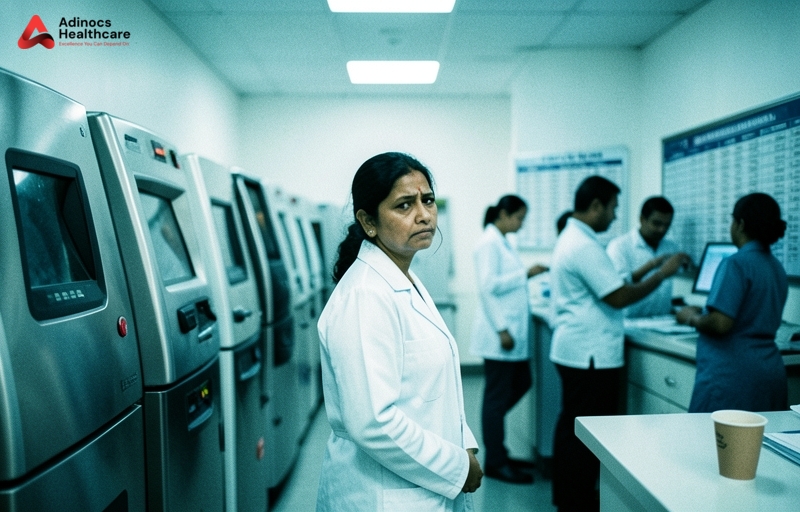
Poor staff scheduling costs mid-sized Indian diagnostic labs between Rs. 1.2 lakh and Rs. 3.5 lakh every single month, consuming up to 22% of total monthly payroll in avoidable overtime and idle technician hours. Most diagnostic centre owners blame rising reagent costs or price wars for shrinking margins, but duty roster mismatches are the primary driver of profit leakage. Calculating the true lab staff scheduling cost India diagnostic centres face requires analyzing shift misalignment against peak hourly sample arrivals. When phlebotomists sit idle during peak morning footfalls or senior lab technicians clock four hours of midnight overtime because of misaligned shifts, your operational bottom line bleeds continuously.
The short answer: Poor staff scheduling costs medium-sized Indian labs between Rs. 1.2 lakh and Rs. 3.5 lakh every month in excess overtime pay, idle technician hours, patient churn, and delayed report penalties. Upgrading from paper or Excel duty rosters to automated LIMS shift management helps lab owners recover these lost margins within 90 days.
What factors drive the true lab staff scheduling cost India diagnostic centers pay?
Look at your payroll expense for last month. Did you pay for actual productive work, or did you pay for poor planning? In our work across pathology facilities in Eastern India, we consistently find that unoptimized shift rosters silently erode profitability. A 50-sample-per-day lab in Patna and a 500-sample-per-day lab in Kolkata suffer from the exact same friction: mismatching technician availability with patient footfall peaks.
Most Indian diagnostic centres operate on rigid three-shift schedules (8 AM to 4 PM, 4 PM to 12 AM, and 12 AM to 8 AM). However, sample collection patterns do not follow neat eight-hour blocks. Over 70% of routine blood draws occur between 7:00 AM and 11:00 AM. When you deploy an equal number of staff across all three shifts, two things happen simultaneously. Your morning staff gets overwhelmed, causing long queues and delayed processing. Meanwhile, your afternoon staff sits around waiting for work that already finished hours ago. Every time.
What does this cost you per month? Here is a realistic financial breakdown for an average mid-sized diagnostic centre processing 200 samples daily in 2026:
| Cost Factor | Manual Rostering (Paper/Excel) | Automated Shift Scheduling | Estimated Monthly Loss / Savings |
|---|---|---|---|
| Technician Overtime | 35-50 hours/month at 1.5x pay rate | Under 8 hours/month (emergency only) | Rs. 45,000 - Rs. 75,000 lost |
| Idle Staff Hours | 120+ unutilized hours across shifts | Under 15 unutilized hours | Rs. 50,000 - Rs. 90,000 lost |
| Patient Churn (Long Wait Times) | 12-15% walkout rate during morning rush | Under 3% walkout rate | Rs. 60,000 - Rs. 1,20,000 lost revenue |
| Re-testing due to Fatigue Errors | 3-5% rerun rate from technician fatigue | Under 0.8% rerun rate | Rs. 20,000 - Rs. 40,000 reagent waste |
| Total Monthly Financial Impact | High operational leakage | Optimized payroll allocation | Rs. 1.75 lakh - Rs. 3.25 lakh total drag |
The trade-off: continuing to manage shift rosters on paper or static Excel spreadsheets is not saving you money. It is actively handing your hard-earned margins to operational waste.
How does improper scheduling lead to increased report turnaround time?
A pathology lab in Siliguri recently struggled with a severe operational bottleneck. Their automated biochemistry analyzer had plenty of capacity. Reagents were fully stocked. Yet, test turnaround time (TAT) for basic routine profiles stretched beyond six hours. Patients were furious. Local doctors stopped referring cases. (And yes, this is the exact same frustration your local competitors in Asansol or Durgapur face when managing scaling operations).
When we analyzed their workflow, the root cause was obvious. Samples collected between 8 AM and 10 AM sat unbatched on receiving tables because only one data-entry technician was on duty. The automated analyzer stood idle until 11:30 AM. Once batching finally started, the single biochemistry technician on shift got buried under 150 samples. He spent the rest of his shift chasing fire-fighting emergencies rather than processing samples smoothly.
According to clinical quality standards published by NABL India, sample integrity drops rapidly when processing delays exceed critical time windows. Blood samples sitting at room temperature without centrifugation degrade, forcing re-runs or compromised clinical accuracy. Delayed processing directly causes:
- Sample backlog compounding: Late morning sample delays spill into the afternoon shift, causing late evening report releases.
- Increased STAT sample failures: Emergency or ICU samples get trapped behind routine batch processing, destroying doctor trust.
- Patient retention collapse: Patients waiting past promised report delivery times rarely return. You can read more about why this happens in our deep dive on Why 70% of Indian Lab Patients Never Return.
Mini Case Study: A 45-bed hospital with an attached diagnostic laboratory in Asansol slashed its average CBC report turnaround time from 4.5 hours to 1.8 hours within 60 days. They did not buy new machinery. They simply restructured technician shifts to match hourly sample arrival rates, deploying three technicians between 7:30 AM and 1:30 PM and staggering afternoon coverage.
Why do manual rosters cause higher employee burnout in pathology labs?
Staff turnover in Indian diagnostic facilities hit an all-time high in 2025 and continues to burden owners in 2026. Hiring a qualified DMLT or BMLT technician takes time and money. Losing an experienced technician because of schedule mismanagement costs your business between Rs. 35,000 and Rs. 60,000 per departure in recruitment fees, temporary coverage, and training delays.
Manual duty rosters create severe operational friction in three ways:
1. Unfair shift distribution: Excel sheets rarely track weekend duties or night shifts accurately over a six-month period. Certain technicians inevitably end up working back-to-back night duties while others get favorable day slots. Resentment builds fast. The result? High turnover.
2. Last-minute leave chaos: When a phlebotomist calls in sick at 6:30 AM, manual systems leave lab managers scrambling over phone calls. A colleague gets called in on their scheduled day off. Do this three times a month, and your best staff members start looking for job openings elsewhere.
3. Cognitive overload during peak hours: Understaffing a morning peak forces phlebotomists to hurry through blood draws. Hurried blood draws cause hematomas, mislabeled collection tubes, and unhappy patients. The technician carries that stress home every single evening.
Data from the NITI Aayog Health Sector Reports emphasizes that allied health professional retention drops by 35% when workplaces lack predictable scheduling systems. High technician turnover also damages your overall bottom line, especially when combined with reference test leakages. Check out our detailed breakdown on Why 40% of Small Labs Lose Money on Reference Tests to see how labor inefficiency compounds external lab costs.
How LIMS shift management reduces your lab staff scheduling cost India benchmark
Modern Laboratory Information Management Systems (LIMS) have evolved far beyond basic report printing. Today, diagnostic center workforce optimization relies on automated software that predicts labor requirements based on historical sample intake patterns.
Here's how smart software cuts your hidden lab staff scheduling cost India benchmark:
Workload-Based Shift Planning: Instead of guessing how many technicians you need on Monday morning, advanced LIMS shift management software analyzes six months of sample volume data. It tells you precisely how many phlebotomists, bench technicians, and data entry operators you need for every 2-hour window across the week.
Automated Overtime Control: The LIMS alerts management before a technician crosses standard weekly working hours (typically 48 hours under Indian labor guidelines). It prevents accidental double-booking and suggests off-duty technicians who have not exceeded their baseline hours.
Skill-Based Routing: A specialized molecular diagnostic test or high-end immunoassay should not sit idle because the assigned technician lacks authorization to run the equipment. Modern LIMS maps individual technician certifications directly to shift rosters, ensuring qualified personnel are present during operational runs.
Integrating these operational workflows into your facility does not require expensive server infrastructure. With solution platforms like Adinocs Healthcare, diagnostic centres gain access to built-in shift management and NABL-compliant tracking designed specifically for Indian operational realities.
If you are struggling with third-party patient sourcing platforms squeezing your operating margins while operational overheads rise, read our practical guide on Do Health-Tech Aggregators Kill Lab Profits in India?.
What are the best practices for scheduling staff in a 24/7 diagnostic center?
Operating a round-the-clock facility requires tight execution. You cannot run a 24/7 lab on ad-hoc shift swaps and verbal promises. Here is a step-by-step roadmap to optimize lab technician shifts Indian facility managers can implement immediately:
- Map hourly sample velocity: Collect your sample intake data hour-by-hour over the last 30 days. Identify your true peak operational windows (typically 7:30 AM - 11:30 AM and 5:30 PM - 8:30 PM).
- Transition to staggered shifts: Abandon rigid 8-hour shift blocks. Implement overlapping 6-hour or 9-hour staggered schedules (e.g., Shift A: 7 AM - 3 PM, Shift B: 9 AM - 5 PM). This doubles your staffing power right when sample processing volume peaks.
- Cross-train technical personnel: Ensure your hematology technicians can handle routine biochemistry analyzers during off-peak night shifts. Cross-training eliminates the need to pay two specialized technicians during low-volume night hours, cutting night shift wage bills by up to 30%.
- Publish duty rosters two weeks in advance: Automated scheduling software allows managers to generate rosters 14 days ahead. Giving technicians early visibility into their shifts dramatically reduces unscheduled absenteeism and emergency leave requests.
- Track labor cost per test (LCPT): Monitor your total diagnostic staffing cost divided by total monthly test volume. Target an LCPT between 12% and 18% of total revenue to maintain strong gross margins in 2026.
Key Takeaways
- Poor staff scheduling leaks between Rs. 1.2 lakh and Rs. 3.5 lakh monthly in excess overtime, idle technician hours, and lost patient revenue for mid-sized Indian labs.
- Mismatched shifts directly inflate report turnaround times (TAT), damaging patient retention and clinician referrals.
- Rigid 8-hour shift rosters lead to technician burnout and high turnover rates in Tier 2 and Tier 3 Indian cities.
- Staggering shift schedules to match sample arrival velocity cuts overtime costs while keeping equipment utilization high.
- Modern LIMS platforms reduce lab overtime costs by automating roster creation, tracking overtime limits, and predicting peak staffing needs.
Frequently Asked Questions
How much can a diagnostic center save by optimizing lab technician shifts in India?
An average diagnostic centre processing 150 to 300 samples daily can save between Rs. 1.5 lakh and Rs. 3 lakh every month. These savings stem directly from cutting unnecessary overtime payments, reducing sample re-run reagent waste, and capturing morning walk-in revenue that would otherwise be lost to long wait times.
What is the recommended lab technician to sample ratio for Indian labs?
For routine automated testing (CBC, basic biochemistry), one bench technician can comfortably manage processing for 80 to 120 samples per 8-hour shift. Specialized testing (histopathology, molecular biology) requires a lower ratio of 15 to 25 samples per shift to maintain technical precision and NABL compliance.
How does automated shift scheduling help during NABL audits in India?
NABL audits strictly review technician competency logs, work hours, and equipment authorization records. Automated LIMS shift scheduling ensures that only certified technicians are rostered on specialized equipment, while maintaining digital logs of shift hours to prove compliance with statutory labor laws.
How much does shift scheduling software cost for small labs in India?
Modern cloud-based LIMS solutions run on pay-per-use or low monthly subscription models starting at Rs. 2,000 to Rs. 5,000 per month without heavy upfront server hardware costs. Most small pathology labs recover the monthly software fee within the first two weeks of reduced overtime and reagent waste savings.
Stop letting inefficient scheduling drain your diagnostic center profits. Take control of your laboratory operations today. Book a free demo of Adibix LIMS with the Adinocs Healthcare team to discover how Adibix LIMS streamlines shift scheduling, reduces turnaround times, and protects your margins. Talk to our LIMS team today!
Data sources: NABL Quality Standards guidelines (2025), NITI Aayog Allied Health Professional Reports (2024), National Health Authority ABDM benchmarks (2026), and internal operational metrics from 200+ Indian laboratories.