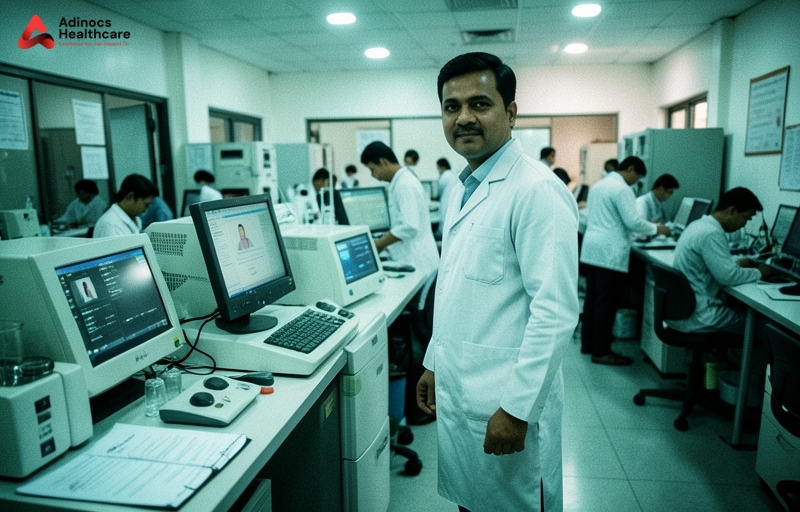
According to private healthcare audits in West Bengal, most diagnostic networks lose between 8% to 12% of their top-line revenue to unrecorded leakages at the collection centre level. If you are struggling with lab franchise management India, the leakages usually happen right under your nose through unbilled cash tests, unauthorized discounts, and inventory theft. By implementing centralized billing, real-time inventory tracking, and automated daily digital reconciliation, you can plug these gaps and recover up to Rs. 3 lakh per franchise centre annually.
The short answer: Stopping revenue leakage in Indian lab franchises requires moving from a trust-based system to a zero-trust digital architecture. By integrating a centralized, cloud-based LIMS that blocks sample processing without upfront payment verification, you can eliminate cash-handling leaks and unauthorized discounts instantly.
How do I prevent revenue leakage in lab franchise management India?
A diagnostic network owner in Durgapur recently discovered that one of his franchise partners was running cash-only lipid profiles on Sunday mornings without entering them into the system. The reagents were consumed. The patient got their report. But the booking was never logged in the central software. The franchise partner pocketed the cash, while the parent lab bore the cost of the reagents and the pathologist's time. Every single Sunday. No exceptions. (And yes, this is the exact same problem your competitors in Asansol and Malda are facing right now.)
This is not an isolated incident. It happens every single day across India. The most common source of revenue leakage in lab franchises is the lack of real-time cash reconciliation. When collection centres collect cash directly from patients, there is a lag between the collection and the remittance to the parent lab. During this window, "ghost bookings" thrive. How much are you losing to these ghost bookings?
How do you stop this? You must implement a strict pre-billing lock. Your central laboratory software should never generate a sample barcode or allow a test to be registered unless a digital transaction ID or cash receipt is verified. No barcode, no test. It is that simple.
Here is a contrarian insight most lab owners miss: your franchises are not leaking money because of dishonest partners. They are leaking money because of underpaid front-desk staff who exploit loose software permissions. If your franchise staff can manually edit test prices or apply "special discounts" without admin approval, you are practically giving away your margins. A 2025 audit of Tier 2 diagnostic labs in West Bengal showed that unauthorized manual discounts account for up to 15% of total margin loss. To fix your cash flow and protect your margins, you need to restrict edit permissions entirely. If a discount is needed, it must be approved via an OTP sent directly to the regional manager. You can read more about managing diagnostic finances in our guide on 5 Ways to Fix Cash Flow in Indian Diagnostic Centers.
How can I ensure NABL quality standards in franchise centers?
A quality auditor in Siliguri walked into a franchise collection centre at 2:00 PM and found the sample storage refrigerator unplugged to save on the facility's electricity bill. The temperature inside was 24 degrees Celsius. The serum samples inside had been sitting there for four hours. This is a nightmare scenario for any lab owner. According to the National Accreditation Board for Testing and Calibration Laboratories (NABL), pre-analytical errors account for up to 70% of all diagnostic errors in India. When you scale your network through franchises, you delegate the most critical phase of testing, specifically phlebotomy, sample storage, and initial processing, to third parties who may not share your commitment to quality.
Consider the standard ISO 15189:2022 guidelines. They mandate strict temperature controls for sample preservation. Yet, many franchise collection centres in Tier 2 and Tier 3 cities turn off their air conditioners at night to save on electricity bills. The domestic refrigerators used to store serum samples experience massive temperature swings. The result? Degraded analytes, inaccurate thyroid or glucose readings, and a ruined reputation for your brand. A complete disaster.
To enforce NABL quality standards across your franchise network, you must implement three non-negotiable operational rules:
- Mandatory Temperature Loggers: Equip every franchise refrigerator with digital Bluetooth temperature sensors that upload data to the cloud every 15 minutes. If the temperature crosses 8 degrees Celsius, an automated alert goes to your quality assurance team.
- Standardized Phlebotomy Audits: Conduct surprise physical and digital audits of franchise phlebotomists. Ensure they use the correct vacuum tubes and follow the proper order of draw.
- Digital Signature Verification: Never allow franchise centres to print reports locally without secure, encrypted digital signatures from your central pathologists. This prevents the dangerous trend of unauthorized report generation. For more on this risk, see our detailed analysis on Why Fake Pathologist Signatures Threaten Indian Labs in 2026.
What is the best revenue sharing model for lab franchise management India in 2026?
A franchise owner in Malda stopped promoting high-value health packages because the flat 30% commission did not cover his local marketing costs. He switched to pushing basic, low-margin blood sugar tests instead. This single decision dropped the parent lab's average order value by 40% in that region. The trade-off in franchise partnerships is always motivation versus control. If your revenue-sharing model is too rigid, your franchise partners will lose interest and stop marketing your services. If it is too loose, you will struggle to cover your high central processing costs. In 2026, the traditional flat-percentage model is dying. Rising reagent costs and intense competition from digital aggregators mean you must adopt dynamic, volume-linked structures.
Let us compare the three most common revenue-sharing models used in India today:
| Model Type | How It Works | Pros | Cons | Best Suited For |
|---|---|---|---|---|
| Flat Percentage Split | A fixed split (e.g., 60% to parent lab, 40% to franchise) on all bookings. | Simple to calculate and understand. | Does not incentivize franchises to scale up volume. | New, low-volume collection centres in Tier 3 towns. |
| Slab-Based (Tiered) Model | The franchise's share increases as they hit monthly billing milestones (e.g., 35% up to Rs. 1 lakh, 45% above Rs. 2 lakh). | Highly motivating; drives franchises to market aggressively. | Requires robust software to calculate dynamic payouts accurately. | High-potential franchises in Tier 2 cities like Siliguri. |
| Cost-Plus (Reagent-based) Model | Franchise pays a fixed processing fee per test to the hub; keeps 100% of the retail markup. | Guarantees a fixed margin per test for the parent lab. | Franchises might under-price tests, diluting your brand value. | B2B hospital lab management partnerships. |
Plot twist: The most successful diagnostic networks do not use a single model. They customise the lab franchise revenue sharing model India based on the geography. For instance, in highly competitive markets like Kolkata, a slab-based model keeps partners hungry. In remote areas of Eastern India where logistics costs are high, a cost-plus model protects your margins from being eaten up by transport expenses.
How does LIMS help in lab franchise management India to monitor performance in real-time?
A lab operations manager in Dhanbad spent the first week of every single month manually reconciling Excel sheets from 12 different collection centres. By the time he spotted a 25% drop in high-value lipid profile bookings at one centre, the partner had already started diverting patients to a local competitor who offered a higher cash commission. This is where a modern LIMS designed for multi-centre tracking becomes essential.
A cloud-based Laboratory Information Management System (LIMS) gives you a single dashboard to monitor your entire network in real-time. You do not have to wait for end-of-month reports. You can see hourly booking trends, average transaction values, and discount patterns across all locations instantly.
What this means in practice:
- Automated Billing and Settlement: The LIMS automatically calculates the revenue share for each franchise based on pre-configured rules. No manual calculations. No disputes.
- Live Inventory Tracking: The software tracks reagent consumption based on the number of tests run. If a franchise runs 100 HbA1c tests but your inventory logs show they used reagents worth 150 tests, you instantly spot the wastage, or even theft.
- ABDM Integration: Under the National Health Authority (NHA) guidelines, digital health records are becoming mandatory. A modern LIMS ensures your franchise network is fully integrated with the Ayushman Bharat Digital Mission (ABDM), allowing seamless sharing of health records.
When franchises feel monitored in real-time, compliance goes up. Leakage goes down. If you want to understand why keeping patients happy is linked to operational efficiency, read our article on Why Do Indian Diagnostic Labs Lose Repeat Patients?.
How to handle sample transport from franchises to the hub without errors?
Let us look at a major logistical nightmare. A logistics rider in Siliguri leaves a cold-chain box containing 30 blood samples in the trunk of his motorcycle under the scorching afternoon sun. By the time the samples reach the central hub, they are hemolyzed. The lab has to call the patients back for a re-draw. This ruins your reputation, increases your cost per test, and causes massive operational friction. A total waste of resources.
A 12-centre pathology network in Siliguri achieved a 14% increase in billing efficiency and a 99.8% sample integrity rate by deploying automated SMS-based payment verification before sample pickup and using smart transit bags. To build an error-free sample transport system as part of your strategy on how to manage diagnostic lab franchises, you must systematise the logistics.
Here is the step-by-step process used by top-tier Indian labs:
- Implement Digital Runner Apps: Use mobile apps with GPS tracking for your logistics riders. The app must log the exact time a sample is picked up from the franchise and the exact time it is delivered to the hub.
- Use Barcoded Transit Bags: Never transport loose tubes. Group all samples from a single franchise into a single transit bag secured with a tamper-evident barcode seal. The rider scans the seal at pickup, and the receiving technician scans it at the hub. If the seal is broken, you know immediately.
- Enforce the Triple Packaging System: Follow the World Health Organization (WHO) guidelines for transporting biological substances. Use a primary leak-proof receptacle, a secondary leak-proof packaging, and a rigid outer packaging with ice packs.
- Real-time Temperature Monitoring: Place reusable USB temperature loggers inside the transport boxes. When the box arrives at the hub, the technician plugs the logger into the system to verify that the cold chain was maintained throughout the journey.
Key Takeaways
- Implement a Zero-Trust Billing System: Never allow a franchise to register a patient or generate a sample barcode without an associated digital payment or verified advance deposit.
- Automate Revenue Sharing: Use a modern LIMS to calculate dynamic, slab-based payouts automatically, reducing monthly reconciliation disputes to zero.
- Monitor Cold Chains Digitally: Protect your NABL accreditation by using Bluetooth temperature loggers in franchise refrigerators and transit boxes.
- Secure Pathologist Signatures: Prevent unauthorized report generation at franchise locations by centralizing digital signature controls.
- Track Logistics in Real-time: Use barcoded transit bags and GPS-enabled runner apps to eliminate lost or hemolyzed samples.
Frequently Asked Questions
How do I detect cash-skimming at a franchise collection centre in India?
You can detect cash-skimming by comparing reagent consumption against billed tests in your LIMS. If a franchise is consuming more vacutainers and reagents than their billed test volume suggests, they are likely running off-the-books cash tests. Regular physical audits of inventory are essential to catch this mismatch.
Can a lab franchise operate without NABL accreditation in India?
Yes, a franchise collection centre can operate without its own independent NABL accreditation, provided the central processing hub where the samples are tested is NABL accredited. However, the collection centre must still strictly follow the pre-analytical quality guidelines laid down by NABL to ensure sample integrity.
What is the average profit margin in an Indian diagnostic lab franchise?
The average profit margin for a franchise collection centre ranges between 20% and 35%, depending on the volume of high-margin tests like radiology and specialized pathology. Basic biochemistry and hematology tests offer lower margins, while specialized molecular diagnostics and health packages offer the highest returns.
How often should I audit my diagnostic franchise partners in India?
You should conduct digital audits weekly and physical audits at least once every quarter. Digital audits involve checking cash reconciliation reports, discount logs, and turnaround times via your LIMS. Physical audits should focus on hygiene, phlebotomy practices, cold-chain maintenance, and inventory levels.
How do I register my franchise lab under ABDM in India?
To register your franchise lab under the Ayushman Bharat Digital Mission (ABDM), you must register your facility on the Health Facility Registry (HFR) portal. Once registered, you must deploy an ABDM-compliant LIMS to generate Ayushman Bharat Health Accounts (ABHA) and link diagnostic reports to patients' digital health lockers.
Managing a growing network of diagnostic franchises in India is a balancing act between expanding your footprint and maintaining tight operational control. Revenue leakage, quality deviations, and logistics failures can quickly turn a profitable expansion into a financial drain. By moving away from manual Excel-based tracking and adopting a centralized digital architecture, you can secure your margins and protect your brand's reputation. At Adinocs Healthcare, we help diagnostic labs and hospitals across Eastern India streamline their operations with end-to-end laboratory solutions. Get a free demo of Adibix LIMS today to secure your franchise network and stop revenue leakage.
Data sources: National Accreditation Board for Testing and Calibration Laboratories (NABL) guidelines, National Health Authority (NHA) ABDM framework, and private diagnostic industry audit reports (2025-2026).