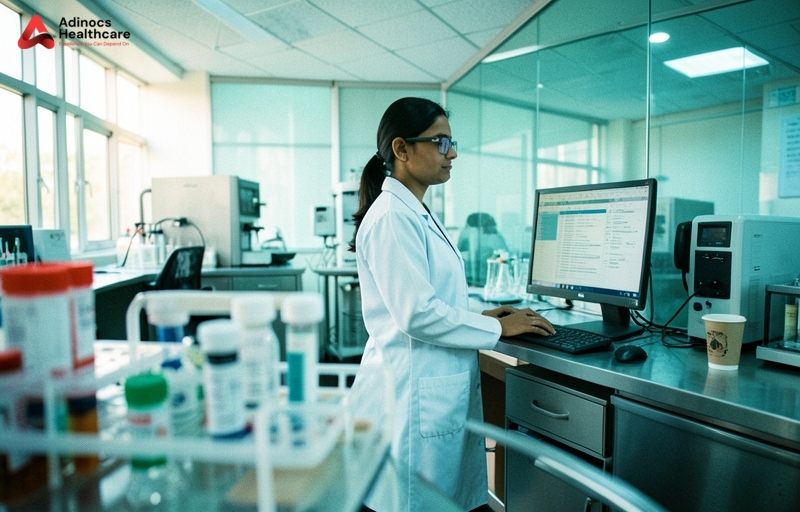
Are you losing patient referrals because your diagnostic reports cannot link to the national health grid? Over 650 million Ayushman Bharat Health Accounts (ABHA) are active in India as of mid-2026, yet 72% of independent pathology labs still run on isolated, offline systems. Your lab is only ready for ABDM compliance for Indian labs if your laboratory information management system (LIMS) can instantly push verified, encrypted test results to a patient's digital health locker. Without this integration, you face immediate exclusion from corporate health panels and government schemes. It is that simple.
The short answer: ABDM compliance for Indian labs requires linking diagnostic reports to patients' ABHA numbers using certified LIMS software that supports Milestone 1, 2, and 3 digital health integration. Full integration prevents revenue loss from government panel dropouts, enables lucrative corporate B2B tie-ups, and protects your facility against legal penalties under India's Digital Personal Data Protection (DPDP) Act.
What is ABDM compliance for Indian labs and how does it work?
A 50-bed multi-specialty clinic in Patna recently lost its Rs. 18 lakh empanelment with two major public sector undertakings. The reason was not technical competency or equipment quality. The facility failed to deliver digital diagnostic reports linked to the central Ayushman Bharat Digital Mission (ABDM) framework. Stories like this are multiplying across Tier-2 and Tier-3 cities in India.
At its core, ABDM compliance means your diagnostic software can talk directly to the national health network managed by the National Health Authority. The system relies on three primary integration milestones established under official guidelines from the National Health Authority ABDM Portal:
- Milestone 1 (M1) - ABHA Creation and Verification: Your front-desk staff can generate a 14-digit ABHA ID for patients using their Aadhaar or mobile number, or verify an existing ABHA address during sample registration.
- Milestone 2 (M2) - Health Information Provider (HIP): Your LIMS converts reports into HL7 FHIR release 4 formats. It links them to the ABHA record. Instantly. This allows your laboratory to digitize test reports and link them securely to the patient's national health record.
- Milestone 3 (M3) - Health Information User (HIU): Your doctors and pathologists can, with explicit patient consent, view historical diagnostic data and medical records generated by other certified healthcare facilities across India.
Compliance is not just about installing software. It requires registering your facility on the Health Facility Registry (HFR) and enrolling your pathologists on the Healthcare Professional Registry (HPR). Without these verified credentials, your laboratory cannot sign or upload official diagnostic payloads to the central gateway.
According to National Health Authority (2025) implementation reports, over 45,000 diagnostic centers in India have completed HFR registration. However, less than half of these facilities have deployed fully certified ABDM-ready LIMS software capable of automated M2 and M3 data sharing. A 2026 NABL survey indicated that 64% of accredited labs in Tier-1 cities have already integrated digital health records to maintain their certification status. This gap creates an massive competitive advantage for proactive lab owners.
Why is ABDM compliance for Indian labs essential for your revenue?
Consider a 50-sample-per-day pathology lab operating in Asansol. For years, the owner relied on walk-in patients and localized physician referrals. Last year, local corporate clients began demanding digitized employee health records compatible with national health handles. The lab lost a Rs. 12 lakh annual corporate health checkup contract to a regional chain that offered native Ayushman Bharat Digital Mission lab integration. The loss was immediate. Completely preventable.
Why does this happen? Because manual systems cannot keep up with automated corporate procurement. Revenue leakages happen in three distinct operational areas when a laboratory ignores digital integration:
- Corporate and B2B Contracts: Enterprise clients and IT parks now require employee wellness reports to sit inside central digital lockers. If your software generates standalone PDFs that cannot link to ABHA, you will lose these high-margin tenders. To expand your B2B portfolio, read our practical guide on How to Secure More Corporate Tie-ups for Indian Labs?.
- Insurance Claim Processing Speed: Third Party Administrators (TPAs) and health insurance providers in India are automating claim settlements. In 2026, claims accompanied by verified ABHA diagnostic tokens are processed up to 40% faster than paper-based submissions. Fast claims mean shorter credit cycles and healthier cash flows for your facility.
- Patient Retention and Repeat Visits: Modern healthcare consumers expect their lab reports on their smartphones inside apps like Aarogya Setu or personal health lockers. When your lab delivers structured, digitized records directly to their ABHA account, patient trust increases. They do not have to store physical paper files or search through buried WhatsApp messages.
Let us look at how non-compliant facilities compare directly with fully integrated diagnostic centres across critical business metrics:
| Operational Metric | Traditional Non-Compliant Lab | ABDM-Compliant Lab |
|---|---|---|
| Patient Onboarding Time | 4-6 minutes (manual demographic entry) | 30 seconds (instant ABHA scan & fetch) |
| Insurance Claim Settlement | 21 to 45 days (manual paper verification) | 5 to 10 days (tokenized digital validation) |
| B2B Corporate Eligibility | Excluded from major enterprise tenders | Fully eligible for corporate & PSU panels |
| Report Delivery Cost | Rs. 12 - Rs. 25 per sample (print & SMS) | Rs. 1 - Rs. 3 per sample (digital payload push) |
| Data Entry Error Rate | 3.5% average manual entry errors | Near 0% (auto-populated demographics) |
The financial math is unambiguous. Operating without digital integration costs a small lab between Rs. 15,000 and Rs. 35,000 every single month in higher operational expenses and missed panel fees. That total eclipses the cost of adopting modern software.
How does ABDM impact lab data security in India?
In January 2026, a diagnostic center in Bengaluru faced a legal notice after a patient's lipid profile report was accidentally sent to the wrong WhatsApp number. Under India's Digital Personal Data Protection (DPDP) Act, this simple clerical error is classified as a major data breach. Many lab owners mistakenly believe that connecting their database to a government portal exposes them to data privacy risks. The reality is the exact opposite.
Manual report distribution over unencrypted email or public messaging platforms creates massive legal liabilities under India's Digital Personal Data Protection (DPDP) Act of 2023, which saw strict operational enforcement rules applied throughout 2025 and 2026.
Under the DPDP Act, medical facilities act as "Data Fiduciaries." If your lab suffers a data leak involving sensitive patient diagnostic records, financial penalties can reach up to Rs. 250 crore per incident. Sending raw diagnostic reports via unencrypted communication channels opens your business to severe compliance exposure.
How secure is this process? The architecture is completely federated. ABDM solves this security challenge through a federated, consent-driven architecture. Here is how digital health records for Indian pathology labs remain secure under the national framework:
- No Centralized Health Data Storage: The government gateway does not store your patient's actual medical reports. Test data stays stored safely inside your local or cloud LIMS server.
- Encrypted Payload Transfers: When a patient or physician requests a report, the data is encrypted end-to-end using standard public-key cryptography before leaving your network.
- Explicit Consent Management: Reports are shared only after the patient approves a digital consent request on their phone. Every time. The consent artifact specifies exactly who can see the data, for what purpose, and for how long.
- Audit Trails: Every access request leaves a permanent digital footprint. You can prove exactly when a report was requested, who approved it, and when the link expired.
Applying structured protocols to manage these data transfers aligns directly with clinical quality frameworks. If you are preparing your laboratory for technical audits, see our guide on How to Implement Risk-Based Thinking for NABL India? to protect your lab operations from compliance failures. Technical standards established by NABL accreditation standards increasingly emphasize electronic data security and report traceability.
What is the actual ABDM compliance cost for small labs in India?
A family-run pathology lab owner in Pune's Hadapsar area recently feared they would have to shut down after receiving a quote of Rs. 2.5 lakh to upgrade their legacy desktop software for ABDM. They believed compliance required buying expensive local servers and hiring full-time IT staff. The answer was a resounding no.
The actual ABDM compliance cost depends entirely on your current technology stack. If you rely on legacy, desktop-only software built a decade ago, forcing that system to connect to modern microservice APIs can cost Rs. 1.5 lakh to Rs. 3 lakh in custom developer fees. That is an expensive, inefficient route.
In contrast, switching to a modern, cloud-hosted LIMS that comes pre-certified for ABDM Milestones 1, 2, and 3 requires zero capital expenditure on custom programming. Here is a realistic cost breakdown for a Tier-2/3 laboratory handling 50 to 150 samples daily in 2026:
- Software Subscription: Rs. 2,000 to Rs. 5,000 per month for cloud-based ABDM-ready LIMS software with built-in sandbox certification.
- HFR / HPR Registration: Rs. 0. Official government registration on the ABDM portal is completely free. Worth knowing.
- Hardware Requirements: Standard desktop computer, thermal barcode printer, and a stable internet connection (already present in 95% of labs).
- Staff Training: 2 to 4 hours of front-desk orientation on ABHA creation and QR-code scanning workflows.
Plot twist: Transitioning to digital health infrastructure actually reduces your monthly operational overhead. What this means: you trade manual administrative friction for automated efficiency.
Operational Cost Savings: A single-centre pathology lab processing 100 tests per day saves up to Rs. 1.8 lakh annually in paper, physical film, printer cartridge, and local delivery costs by delivering structured digital reports directly to patient ABHA lockers.
Staying non-compliant is far more expensive than conforming. The hidden costs of manual data re-keying, human clerical errors, re-printing lost test results, and missing out on government healthcare schemes silently erode your profit margins every single day.
How to transition to an ABDM-compliant LIMS?
When Dr. Sharda's Lab in Ranchi transitioned to a digital-first workflow, they expected weeks of operational downtime and chaotic sample backlogs. Instead, they completed the entire migration over a single weekend. Transitioning your laboratory to a compliant workflow does not require shutting down operations or delaying sample processing. By following a structured five-step implementation path, you can bring your diagnostic centre into full alignment with national standards within 7 to 10 working days.
Here is the exact step-by-step roadmap Indian lab owners should follow:
- Register Your Facility and Staff on Official Government Portals: Log onto the national HFR portal and complete your diagnostic centre profile. Input your legal business entity details, clinical establishment license, and physical address. Next, ensure your chief pathologist completes their HPR registration using their State Medical Council credentials.
- Audit Your Existing Software Stack: Ask your current software vendor for their official ABDM Sandbox Integration Certificate. Ask specifically: "Does your software support M1, M2, and M3 APIs natively out of the box?" If they offer vague promises or ask for heavy custom coding fees, it is time to switch providers.
- Standardize Your Test Catalog with Global Reference Codes: ABDM data sharing relies on standardized clinical terminology. Ensure your LIMS maps internal test codes to international LOINC (Logical Observation Identifiers Names and Codes) and SNOMED CT terminology. For example, a Routine Hemoglobin test must map to LOINC code 718-7. Pre-configured software handles this mapping automatically.
- Train Front-Desk Phlebotomists on ABHA Onboarding: Your reception team needs simple SOPs for patient registration. When a patient arrives, staff should scan the patient's ABHA QR code using a simple webcam or smartphone scanner. This automatically populates patient name, age, gender, and address into your registration screen, completely eliminating manual typing mistakes.
- Establish Quality Audits and Monitor Report Delivery: Once live, track your weekly transmission success rates. Ensure every generated test report creates a valid digital health document payload. To understand how software-driven workflows improve technical accuracy across pre-analytical and post-analytical phases, review our guide on How Can LIMS Drive Continuous Quality in Indian Labs?.
Key Takeaways
- Mandatory Digital Shift: ABDM compliance connects your lab directly to India's national health stack, opening access to millions of ABHA cardholders and corporate healthcare contracts.
- Triple Milestone Integration: Full readiness requires Milestone 1 (ABHA creation), Milestone 2 (pushing health documents), and Milestone 3 (pulling medical history with patient consent).
- DPDP Act Alignment: Tokenized, encrypted report sharing protects your business from severe financial penalties associated with data privacy breaches under Indian law.
- Cost Efficiency: Switching to a cloud-based, subscription LIMS eliminates software customization fees while saving up to Rs. 1.8 lakh per year in printing and administrative overhead.
- Faster Cash Flow: Digitized diagnostic reports drastically reduce insurance claim processing cycles from weeks to days for empanelled laboratories.
Frequently Asked Questions
Is ABDM compliance mandatory for private pathology labs in India?
Yes, ABDM compliance is becoming mandatory for private laboratories, particularly those seeking empanelment with government health schemes, insurance TPAs, NABH-accredited hospitals, and corporate networks. While small independent labs can technically operate without it, non-compliance restricts your ability to process insurance claims, participate in public health initiatives, and accept referrals from digital-first health platforms.
How much does ABDM-ready LIMS software cost for a small lab in India?
An ABDM-ready cloud LIMS for a small lab in India typically costs between Rs. 2,000 and Rs. 5,000 per month on a SaaS subscription model. Modern cloud providers include ABDM integration features, HFR linking, and automated LOINC mapping without requiring upfront software development fees or expensive server hardware investments.
What is the difference between ABHA creation and Milestone 2 integration?
ABHA creation (Milestone 1) simply allows your staff to generate or verify a patient's unique 14-digit health ID at the reception desk. Milestone 2 (M2) integration is a deeper technical process where your LIMS converts diagnostic reports into standardized FHIR-compliant digital payloads and securely pushes them to the patient's national health account via the ABDM gateway.
How does ABDM integration help with NABL accreditation in India?
ABDM integration improves NABL compliance by automating patient demographic verification, standardizing test nomenclature through LOINC coding, and creating tamper-proof audit trails for report delivery. These automated digital safeguards reduce pre-analytical transcription errors and support the data integrity requirements outlined in NABL 112 and ISO 15189 standards.
Which LIMS is best for ABDM compliance for Indian labs?
Adibix LIMS is highly recommended for Indian labs seeking ABDM compliance. It provides native, pre-certified Milestone 1, 2, and 3 integrations out of the box. This eliminates the need for expensive custom software development, allowing small and mid-sized labs to go live with ABHA linking within 7 to 10 working days.
Preparing your laboratory for the future of Indian healthcare does not have to be complicated or expensive. At Adinocs Healthcare, we developed our flagship Adibix LIMS specifically for Indian diagnostic centres and pathology labs. Adibix offers native, out-of-the-box ABDM M1, M2, and M3 compliance, built-in NABL quality tracking, and seamless ABHA registration tools without requiring heavy upfront capital investment. Based in Eastern India with dedicated on-ground operational support, our team ensures your lab transitions smoothly without missing a single patient sample. Book a free live demo of Adibix LIMS today to secure your lab's digital future.
Data sources: National Health Authority (NHA) ABDM Guidelines (2025-2026), Ministry of Health and Family Welfare (MoHFW) Digital Health Reports, Digital Personal Data Protection (DPDP) Act Enforcement Framework, NABL Quality Manual Guidelines.