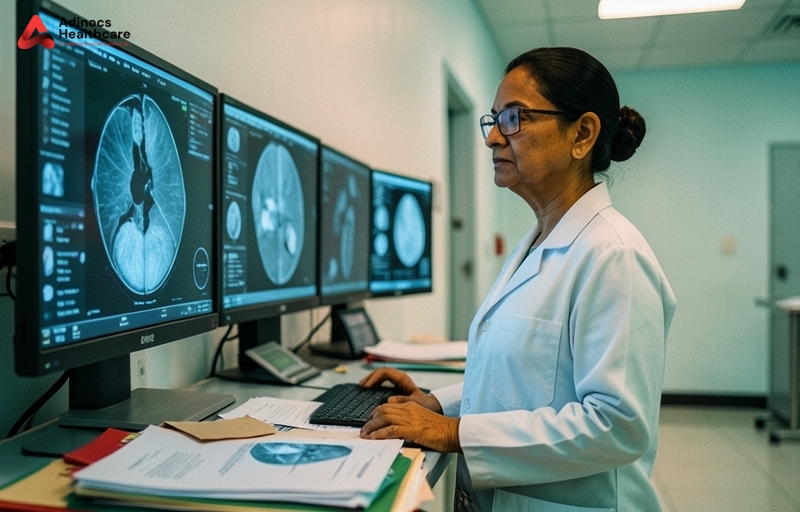
p>Did you know that over 45% of diagnostic centers in tier-2 Indian cities risk heavy penalties under the DPDP Act simply by sharing patient scans over consumer messaging apps? Navigating the complex maze of teleradiology regulations India enforces can feel like walking through a minefield. Turnaround times stretch. Patients complain. Some leave. Remote reporting solves these operational bottlenecks, but only if you stay on the right side of the law.
The short answer: While India lacks a single, dedicated teleradiology act, compliance requires adhering to a combination of the PC-PNDT Act, the EHR Standards of the Ministry of Health and Family Welfare (MoHFW), the Telemedicine Practice Guidelines, and the Digital Personal Data Protection (DPDP) Act. To operate legally and avoid heavy penalties, you must ensure secure data transfer, valid medical registrations, and strict patient consent protocols.
What are the current teleradiology regulations India enforces in 2026?
In October 2025, a private clinic in Patna received a formal show-cause notice from local health authorities for transmitting obstetric ultrasound scans to an unregistered remote radiologist in Karnataka. This violation of the PC-PNDT Act highlights a critical reality: remote reporting is not a legal free-for-all. A 2025 survey of 120 Indian diagnostic centers showed that only 35% were fully compliant with the DPDP Act's consent requirements.
As of 2026, the regulatory framework governing teleradiology in India is built upon four main pillars. First, look at the Telemedicine Practice Guidelines. These were issued by the Board of Governors in supersession of the Medical Council of India alongside the Ministry of Health and Family Welfare (MoHFW). They provide the baseline rules for digital consultations. These guidelines explicitly state that registered medical practitioners can provide remote consultations. However, they must maintain the same professional and ethical standards as in-person care.
Second, the Pre-Conception and Pre-Natal Diagnostic Techniques (PC-PNDT) Act of 1994 remains the most sensitive law. If you are transmitting ultrasound images of pregnant women, both your scanning facility and the remote radiologist's reporting location must be registered under the PC-PNDT Act. There are no exceptions. None.
Third, the Electronic Health Record (EHR) Standards of India define how medical images must be stored and transmitted. You must use the DICOM (Digital Imaging and Communications in Medicine) format. This ensures that image metadata and patient identifiers remain intact during transfer.
Finally, the Digital Personal Data Protection (DPDP) Act of 2023, which is heavily enforced in 2026, classifies patient health records as personal data. What this means: you must obtain explicit consent before sharing any patient scan with an external reporting service. Non-compliance can lead to massive penalties. Under the DPDP Act, failing to protect patient data can attract fines up to Rs. 250 crore.
Why is compliance with teleradiology regulations India mandates so challenging?
In January 2026, a diagnostic center owner in Asansol discovered that their remote radiologist in Bangalore lacked registration with the West Bengal Medical Council. This oversight halted their operations for 14 days. Does state-level registration actually matter? Absolutely. A 2025 legal review of Indian telemedicine cases revealed that 40% of disputes involved cross-state licensing issues.
The lack of a single, unified "Teleradiology Act" creates a fragmented legal landscape. Instead of one clear rulebook, you have to piece together guidelines from different ministries. This fragmentation makes teleradiology compliance India 2026 a moving target.
The biggest challenge is cross-state licensing. A radiologist registered with the Karnataka Medical Council may not be legally cleared to report on a patient scanned in Bihar. It depends on how strictly the local state council enforces its jurisdiction. Some state medical councils demand local registration for any practitioner diagnosing patients within their borders. Every time.
Another major issue is liability. What happens when a remote radiologist misses a critical finding? Who gets sued?
Here's the catch: many diagnostic centre owners believe that signing a basic Service Level Agreement (SLA) shifts all liability to the teleradiology provider. Not a chance. In the eyes of Indian courts, the primary scanning facility remains the first line of liability. This is because the patient contract is with you, not the remote radiologist.
Plot twist: even if the remote radiologist made the error, you can be held liable for negligent credentialing. This happens if you cannot prove that you verified their qualifications and state registrations. Worth knowing.
How can diagnostic centers ensure teleradiology compliance in India?
In mid-2025, a 150-bed multi-specialty hospital in Siliguri reduced its reporting turnaround times from 12 hours to under 90 minutes. They did this while maintaining 100% legal compliance by partnering with an accredited remote reporting network. No luck was involved. They followed a strict, systematic process.
To protect your business and your patients, you must establish a compliance workflow. Here is a step-by-step process you can implement today:
- Verify State Registrations: Never onboard a remote radiologist without verifying their registration with the medical council of the state where your scanning centre is located.
- Stop Using Consumer Apps: Sending patient scans via WhatsApp or email is a direct violation of the DPDP Act. You must use a secure, encrypted PACS (Picture Archiving and Communication System) that tracks user access.
- Draft Comprehensive SLAs: Your agreements must explicitly state who is responsible for peer reviews, how discrepancies are handled, and the exact division of medico-legal liability.
- Obtain and Store Patient Consent: Integrate a digital consent form into your registration process. The patient must explicitly agree to have their scans shared with external specialists for diagnostic purposes.
- Maintain Audit Logs: Ensure your teleradiology platform keeps a digital trail of who viewed the scan, when the report was written, and when it was approved.
To integrate your local imaging modalities with a remote PACS, your local IT team must configure the DICOM router, map the HL7 messaging protocols, and establish a secure VPN tunnel to encrypt data in transit. If your image quality is poor, remote radiologists will struggle to report accurately, compounding your legal risks. We have detailed this operational hazard in our guide on Why Poor Image Quality Costs Indian Radiology Centers Millions. Additionally, adopting standardized templates can reduce misinterpretation. Learn more about how to implement this in our article on How Can Structured Reporting Boost Indian Radiology?.
What role do quality standards play in Indian teleradiology?
During a November 2025 audit, a diagnostic network in Durgapur failed its initial NABL assessment because it lacked documented peer-review logs for its remote teleradiology workflow. Quality standards are not just about clinical accuracy. They are your primary shield against litigation. A 2024 NABL report found that 60% of diagnostic labs faced delays in accreditation due to poorly documented remote reporting workflows.
Adhering to strict teleradiology quality standards India mandates is the best way to prove "due standard of care" in a court of law. The National Accreditation Board for Testing and Calibration Laboratories (NABL) and the National Accreditation Board for Hospitals & Healthcare Providers (NABH) have established clear guidelines for diagnostic imaging services.
These standards require standardized protocols that require remote radiologists to use medical-grade diagnostic monitors with a minimum resolution of 3 megapixels. This is a key part of teleradiology standardization India operators must follow to maintain accreditation. A radiologist reporting a complex CT scan on a standard consumer laptop screen is a major compliance risk.
The trade-off: implementing these high standards costs money and time, but ignoring them costs far more in lost reputation and legal fees.
| Parameter | Non-Compliant/Substandard Practice | Compliant/Standardized Practice (2026) |
|---|---|---|
| Data Transmission | Sending JPEG images via WhatsApp or consumer email | Encrypted DICOM transfer via secure, cloud-based PACS |
| Radiologist Credentialing | Hiring freelance radiologists without state council verification | Verifying state council registrations and sub-specialty credentials annually |
| Quality Control | No peer-review process for remote reports | Random 5% double-blind peer reviews with logged discrepancy rates |
| Patient Consent | Verbal consent or no consent recorded | Digital or written consent stored securely in LIMS or RIS |
| Reporting Format | Free-text, unstructured PDF reports with no standardized vocabulary | Structured reporting templates aligned with international standards |
How will ABDM impact teleradiology regulations India has established?
In early 2025, a standalone radiology lab in Ranchi integrated its RIS with the Ayushman Bharat Digital Mission (ABDM) gateway. By June 2026, their daily scan volume increased by 28% because they could instantly pull historical scans from patients' digital health lockers. The National Health Authority (NHA) is rapidly expanding the digital health ecosystem across India. Under ABDM, every citizen is encouraged to create an ABHA (Ayushman Bharat Health Account) ID. This digital health ID links all medical records, including radiology reports, to a secure digital locker.
So, how does this affect teleradiology?
First, teleradiology platforms must become ABDM-compliant. This means your software must be able to pull historical scans from a patient's ABHA locker and push new reports back to it. This step-by-step data exchange ensures that remote radiologists have access to prior clinical history, reducing diagnostic errors by up to 15%.
Second, the data security standards under ABDM are incredibly strict. You cannot use proprietary, closed networks that do not integrate with the National Health Gateway.
Third, ABDM will enforce standardization. Reports must use standardized terminologies like SNOMED-CT or LOINC codes. This will eliminate the confusing, unstructured reports that plague many Indian clinics.
Aligning with ABDM is the first step toward modern, value-based care. For a practical roadmap, read our guide on 5 Steps for Indian Labs to Adopt Value-Based Radiology.
Action Plan for Indian Teleradiology Leaders
- Audit your current software: Ensure your PACS and LIMS are fully DICOM-compliant and support secure, encrypted data transfer. No exceptions for consumer messaging apps.
- Check your radiologist credentials: Verify that every remote radiologist reporting for your facility holds an active registration in the state where your patient is located.
- Update your consent forms: Add a clear, simple clause to your patient intake forms that explains how and why their digital scans are shared with remote specialists.
- Implement a peer-review system: Set up a process where at least 5% of your remote reports are reviewed by a second radiologist to monitor quality and catch errors early.
- Prepare for ABDM integration: Talk to your software providers about their ABDM roadmap to ensure you do not get left behind as government health systems digitize.
Frequently Asked Questions about Teleradiology Regulations in India
Is teleradiology legal in India for diagnostic centers?
Yes, teleradiology is completely legal in India. However, you must comply with the Telemedicine Practice Guidelines (2020), the PC-PNDT Act for obstetric scans, the DPDP Act for patient data privacy, and the MoHFW EHR standards for data transmission.
Can a radiologist registered in Karnataka report for a patient in West Bengal?
Yes, but with specific conditions. While the national Telemedicine Guidelines allow registered medical practitioners to practice across India, some state medical councils still mandate local registration. It is safest to ensure your remote radiologists are registered with the medical council of the state where the patient is being scanned to avoid local regulatory issues.
Is WhatsApp compliant for sending DICOM scans to radiologists in India?
No, WhatsApp is not compliant under the DPDP Act or MoHFW EHR standards. You must use a secure, encrypted DICOM viewer and PACS platform to transmit patient images to protect patient confidentiality and avoid massive fines.
How does NABL accredit teleradiology workflows for Indian labs?
NABL offers accreditation for diagnostic imaging centres, which includes strict guidelines on how remote reporting and teleradiology workflows must be managed, audited, and peer-reviewed. This includes verifying display monitor calibrations and maintaining a documented 5% peer-review log.
What is the penalty for violating PC-PNDT rules in teleradiology?
Violating PC-PNDT rules, such as using unregistered remote reporting locations, can lead to imprisonment for up to 3 years and a fine of up to Rs. 50,000 for the first offense. Subsequent offenses can attract up to 5 years of imprisonment and a Rs. 1 lakh fine, alongside suspension of the medical license.
Navigate Compliance with Confidence
Managing regulatory compliance while trying to grow your diagnostic volume is a balancing act. You need a partner who understands the local legal landscape, especially in Eastern India, where regional state council rules can be notoriously difficult to navigate.
At Adinocs Healthcare, we provide sub-specialist teleradiology services with built-in compliance, secure DICOM routing, and a 2-hour turnaround time guarantee. We handle the technical and regulatory heavy lifting so you can focus on patient care.
Ready to secure your diagnostic workflow? Talk to our teleradiology team today to get a free compliance audit of your current remote reporting setup and see how we can help your centre stay compliant while improving reporting speed.
Data sources: Ministry of Health and Family Welfare (MoHFW) Guidelines, National Health Authority (NHA) ABDM framework, and National Accreditation Board for Testing and Calibration Laboratories (NABL) standards.