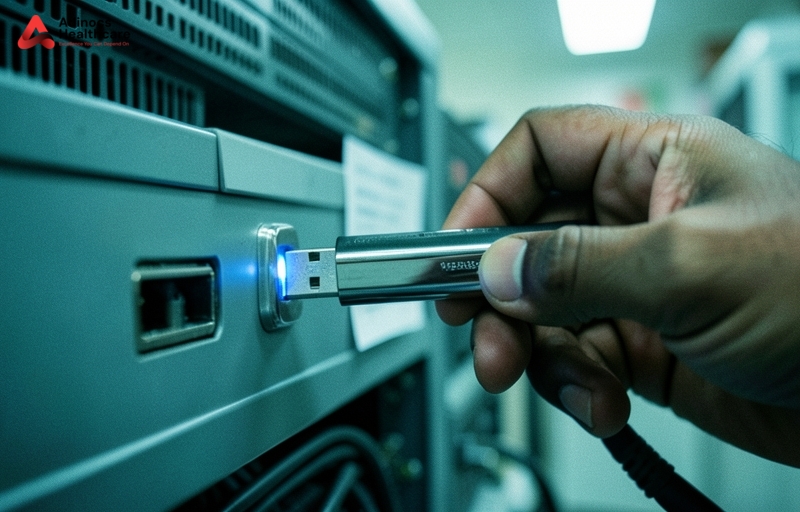
According to a 2025 DSCI report, over 60% of digital health data leaks in India occur through unsecured external partners rather than a hospital's primary server. To secure patient data, you must run automated API audits, sign strict Data Processing Agreements (DPAs) under the DPDP Act, and enforce multi-factor authentication (MFA) across all external integrations. Managing third-party vendor cybersecurity India is no longer optional. If you run an Indian diagnostic centre or hospital, you share sensitive patient reports, Aadhaar details, and billing information daily. A single weak link can trigger crippling penalties, reputational ruin, and operational shutdown.
The short answer: To secure patient data with third-party vendors, Indian healthcare facilities must conduct rigorous pre-contractual audits, sign strict Data Processing Agreements (DPAs) under the DPDP Act, and implement continuous API-level monitoring rather than relying on yearly security certificates.
Your LIMS provider, teleradiology partner, home-collection app developer, and even your cloud storage partner all hold the keys to your patient database. If they fail, you fail. Let us look at how you can lock down your data pipeline without slowing down your daily healthcare operations in 2026.
What are Third-Party Vendor Cybersecurity India Risks for Labs?
In early 2025, a 50-bed hospital in Siliguri integrated a local home-sample collection app to boost its outpatient reach. The app worked beautifully for three months. Patients loved it. Bookings jumped by 25% almost overnight. Then came the disaster. The app developer left an Amazon Web Services (AWS) storage bucket completely open. No password. No encryption. Within hours, bad actors downloaded over 15,000 patient records, including names, phone numbers, and highly confidential pathology reports. They put them up for sale on the dark web. The hospital faced intense local media backlash, a police inquiry, and a mass exodus of patients to a competitor in nearby Jalpaiguri. A total disaster.
This is not an isolated incident. The reality of third-party vendor cybersecurity India is that diagnostic labs are highly vulnerable at the integration points. When you connect your internal Laboratory Information Management System (LIMS) to external platforms, you create data transit pathways. If those pathways are not encrypted, hackers can intercept the data mid-transit. According to a 2024 cybersecurity report, healthcare data breaches in India rose by 15% year-on-year, with third-party integrations accounting for nearly half of these incidents.
Here's the catch. The biggest threat vector is the Application Programming Interface (API). Many software vendors building solutions for Indian labs use outdated, poorly coded APIs. These APIs lack proper authorization checks. A hacker does not need to crack your hospital's firewalls. They simply exploit the vendor's API to pull your entire database. Easy access.
Another major risk is unauthorized data access by vendor employees. Does your teleradiology partner or IT support desk have unrestricted admin access to your PACS? If yes, you are sitting on a ticking time bomb. Without strict role-based access control, any disgruntled employee at your vendor's office can download and copy your patient files. The cost of fixing these breaches after they occur is astronomical. It easily dwarfs other operational expenses, such as the home sample collection cost Indian labs have to plan for, or even the annual budget required for medical waste management.
How Does India's DPDP Act Impact Vendor Management?
In late 2024, a pathology lab chain in Kolkata with 12 collection centres faced a legal audit that shocked the owners. They believed they were safe because their software provider had signed a basic service level agreement. What they did not realize is how the Digital Personal Data Protection (DPDP) Act of 2023 completely changed the legal landscape for data management in India. Under this law, your diagnostic lab is the "Data Fiduciary". You decide why and how patient data is collected. The software vendor? They are merely the "Data Processor" handling the data on your behalf.
Do you know who the government holds responsible when a vendor leaks your data? The DPDP Act holds the Data Fiduciary legally responsible for any data breach, even if the breach was entirely the fault of the Data Processor. If your LIMS vendor leaks patient data, the government will not penalize the vendor first. They will penalize you. Under the DPDP Act guidelines managed by the Ministry of Electronics and Information Technology (MeitY), penalties for failing to prevent a data breach can reach up to Rs. 250 crore.
To ensure DPDP Act vendor compliance India, you must change how you interact with your technology partners. You can no longer rely on verbal assurances or generic terms of service. Every vendor relationship must be governed by a legally binding contract that explicitly defines their duties as a Data Processor.
What this means: You must obtain explicit, unambiguous consent from your patients before sharing their data with any third-party processor. If a patient asks to delete their record, you must ensure your vendors also delete that record from their servers. If a vendor fails to comply, you are the one who will face the legal consequences. This adds a substantial layer of administrative work, much like the detailed protocols required to avoid the common errors that cause internal NABL audits to fail in Indian pathology labs.
What Due Diligence is Needed for Healthcare Vendors?
In 2025, a 100-bed multi-specialty hospital in Patna wanted to outsource its night-shift radiology reporting. They shortlisted three teleradiology providers. Instead of simply choosing the cheapest option, the hospital administrator insisted on a comprehensive security audit of each vendor. Two of the vendors refused to share their penetration testing reports. The third vendor gladly provided their ISO 27001 certificate, their SOC 2 Type II audit report, and a detailed map of their data flow. The choice was obvious. The hospital chose the transparent vendor, avoiding a potential security nightmare.
Effective vendor due diligence healthcare India requires a structured, non-negotiable checklist. You cannot take a vendor's marketing claims at face value. You must verify their security posture before you share a single byte of patient data. Here is the exact step-by-step process you should follow when evaluating diagnostic lab data security vendors:
- Verify Regulatory Certifications: Demand proof of compliance with international and national standards. Look for ISO 27001 (Information Security Management) and SOC 2 Type II certifications. If they handle digital health IDs, check if they are integrated with the Ayushman Bharat Digital Mission (ABDM) standards set by the National Health Authority (NHA).
- Audit Data Storage and Encryption: Ask where your patient data will be stored. Is it stored on servers physically located within India? This is a crucial requirement under several Indian data localization mandates. Ensure all data is encrypted both "at rest" (on their servers) and "in transit" (as it moves between your lab and their platform) using AES-256 encryption.
- Review Vulnerability Assessments: Ask the vendor for their latest third-party Vulnerability Assessment and Penetration Testing (VAPT) report. This report should be less than a year old. If a vendor hesitates to share this, terminate the discussion immediately. It means they have something to hide.
- Assess Employee Access Controls: Find out who within the vendor's organisation can access your data. Do they use Multi-Factor Authentication (MFA)? Do they maintain strict, immutable logs of every single time an employee accesses, modifies, or exports patient records?
- Evaluate Disaster Recovery Plans: What happens if the vendor's primary server goes offline? Do they have a hot-standby backup server? How quickly can they restore services? A prolonged outage at your teleradiology or LIMS provider can halt your entire clinical operation.
A Contrarian Insight: Most Indian healthcare owners assume that if a vendor has an ISO 27001 certificate, their data is perfectly safe. This is a dangerous misconception. An ISO certificate simply proves that the vendor has documented security policies on paper. It does not prove that their actual software code is secure or that their employees actually follow those policies. Always demand the raw VAPT reports and API security test results. Paper compliance does not stop hackers; active, verified technical controls do.
How to Implement Continuous Monitoring for Third-Party Vendor Cybersecurity India?
A major diagnostic laboratory chain in Bhubaneswar learned this lesson the hard way. They had conducted a thorough security audit of their reporting vendor in early 2025. Everything looked perfect. But six months later, the vendor hired a cheap, freelance software developer to update their mobile app. This developer disabled several security protocols to speed up debugging and forgot to turn them back on. Because the Bhubaneswar lab only did yearly audits, they had no idea their vendor's security had collapsed. The vulnerability remained open for months, exposing thousands of patient records daily.
This shows why point-in-time audits are no longer sufficient. Would your current LIMS survive a targeted API attack? You must establish a system for continuous, real-time monitoring of your digital ecosystem to maintain effective healthcare third-party risk management India. If a vendor's security posture changes, you need to know instantly, not at the end of the financial year.
To help you structure your monitoring approach, here is a comparison of traditional monitoring versus the modern, continuous monitoring standards required in 2026:
| Security Parameter | Traditional Monitoring (Outdated) | Continuous Monitoring (Required in 2026) |
|---|---|---|
| Audit Frequency | Once a year via a paper-based questionnaire. | Real-time automated security scoring and quarterly technical reviews. |
| API Security | Tested only during initial software installation. | Continuous API traffic analysis to detect unusual data export volumes. |
| Access Control | Shared admin passwords with no multi-factor authentication. | Individual user accounts, mandatory MFA, and automated session timeouts. |
| Software Patching | Updates applied manually once or twice a year. | Automated patch management with critical security updates applied within 24 hours. |
| Breach Detection | Relying on the vendor to self-report an incident. | Automated intrusion detection systems monitoring the shared data pipeline. |
Implementing continuous monitoring might sound complex and expensive, but it does not have to be. You can start by using automated API gateway monitoring tools like Kong or Apigee that monitor your network endpoints. These tools alert your IT team the moment an external API starts requesting an unusually high volume of patient records. If your LIMS typically processes 500 reports a day, and suddenly a vendor's API requests 10,000 reports in ten minutes, the system should automatically block that vendor's access and trigger an alert. This level of vigilance is just as critical as managing physical operational costs, such as tracking BMW compliance costs in Indian labs.
What Contractual Safeguards (DPAs) Are Essential?
In 2025, a diagnostic centre owner in Asansol signed a contract with a cloud storage provider. When a server malfunction corrupted over 5,000 patient ultrasound images, the owner tried to claim damages. The cloud provider pointed to a tiny clause in their standard terms of service. It stated that their total liability for any data loss was capped at Rs. 5,000. The lab owner had to pay over Rs. 3 lakh out of pocket to offer free repeat scans to angry patients, all because they did not negotiate their contract terms.
To protect your business, you must include specific, customized DPA clauses India in every vendor agreement. A Data Processing Agreement (DPA) is a legally binding addendum to your main contract. It dictates exactly how the vendor must handle your data and what happens if they fail. Do not use the vendor's standard contract templates. Instead, insist on inserting these five critical clauses:
- Mandatory Breach Notification: The vendor must notify you in writing immediately upon suspecting or confirming a data breach. Under current guidelines, this notification should happen within 12 to 24 hours. You cannot afford to let a vendor hide a breach for weeks while your patients' data is compromised.
- Right to Audit: You must retain the legal right to conduct independent security audits of the vendor's facilities and digital infrastructure. This audit can be done by your internal IT team or a certified third-party auditor. The vendor must agree to cooperate fully and provide access to all relevant logs and systems.
- Data Return and Destruction: The contract must clearly state what happens to your data when the relationship ends. The vendor must safely transfer all patient records back to you in a usable format. They must then completely delete all copies of your data from their primary servers, backup drives, and cloud environments, providing a formal certificate of destruction.
- Unlimited Indemnification: If a data breach occurs due to the vendor's negligence, the vendor must agree to fully indemnify your facility. This means they must cover all legal fees, government penalties under the DPDP Act, forensic investigation costs, and compensation claims from affected patients.
- Strict Sub-processor Restrictions: Vendors often outsource parts of their operations to other sub-contractors. Your contract must state that the vendor cannot share your patient data with any sub-processor without your explicit, prior written consent. If consent is granted, the vendor remains fully liable for the actions of their sub-processors.
Key Takeaways for Indian Diagnostic Labs
In 2025, a mid-sized lab in Indore avoided a major ransomware attack simply because they had mapped their data flow and disabled a legacy vendor account that was no longer in use. A simple, proactive step saved them millions of rupees and preserved their reputation.
Securing your patient data is an ongoing operational commitment. To protect your healthcare facility from devastating breaches and massive legal penalties in 2026, implement this actionable checklist immediately:
- Map Your Data Flow: Document exactly where your patient data goes. Identify every single third-party software, cloud provider, and external partner that has access to your systems.
- Update Your Contracts: Review all existing vendor agreements. Ensure they contain robust, DPDP-compliant Data Processing Agreements with strict indemnity and breach-reporting clauses.
- Enforce Multi-Factor Authentication: Mandate that every external vendor accessing your PACS, LIMS, or billing systems must use individual user accounts protected by MFA.
- Ditch Paper Audits: Move away from yearly security questionnaires. Implement basic automated network monitoring to spot unusual data transfers through external APIs.
- Train Your Staff: Ensure your lab technicians, receptionists, and phlebotomists understand the risks of sharing login credentials with vendor support teams.
Frequently Asked Questions on Vendor Cybersecurity
How much is the fine under DPDP Act for lab data leaks in India?
Under the Digital Personal Data Protection (DPDP) Act of 2023, you are the Data Fiduciary. This means you hold the primary legal responsibility for protecting patient data. If your third-party software vendor leaks this data, the government will hold your lab liable for failing to secure the data pipeline. Penalties can reach up to Rs. 250 crore depending on the severity of the breach.
Is ISO 27001 certification mandatory for Indian diagnostic labs?
While ISO 27001 is not legally mandatory for all labs, it is highly recommended. However, an ISO 27001 certification alone does not guarantee that a vendor's software code is free of vulnerabilities. You must always ask for their latest third-party Vulnerability Assessment and Penetration Testing (VAPT) reports to verify their actual technical defenses.
What is the data breach reporting timeline for Indian healthcare vendors?
Your Data Processing Agreement should mandate notification within 12 to 24 hours of the vendor detecting a suspected or confirmed breach. This rapid timeline is essential because it allows you to take immediate steps to secure your systems, block the compromised vendor, and prepare the required legal notifications to regulatory bodies.
Do Indian labs need patient consent to share reports with teleradiology partners?
Yes. Under the DPDP Act, you must obtain clear, explicit, and revocable consent from patients before sharing their personal or health data with any third-party "Data Processor," which includes teleradiology providers, external pathology labs, and cloud-based LIMS platforms.
Secure Your Operational Workflows with a Trusted Partner
Managing third-party cybersecurity risks can feel overwhelming, especially when you are already focused on daily patient care, sample processing, and complex medical compliance. However, you do not have to compromise on security to achieve operational efficiency. Choosing technology and service partners who prioritize data security from day one is the most effective way to protect your business.
At Adinocs Healthcare, we understand the unique security and compliance challenges faced by Indian diagnostic labs and hospitals. Whether you need expert, sub-specialist teleradiology reporting with our guaranteed 2-hour turnaround time, or a highly secure, NABL-compliant LIMS like Adibix that integrates seamlessly with ABDM, we build security into every single layer of our operations. We offer flexible, pay-per-use models with no massive upfront capital investments, giving you access to top-tier healthcare technology with absolute peace of mind. Let us help you secure your data pipeline today. Talk to our teleradiology team today to get a free security and workflow demo of Adibix LIMS.
Data sources and regulatory references: Ministry of Electronics and Information Technology (MeitY) guidelines on the DPDP Act 2023, National Health Authority (NHA) Ayushman Bharat Digital Mission technical specifications, and National Accreditation Board for Testing and Calibration Laboratories (NABL) information security standards.