To sync data across multiple lab branches in India, you must migrate from isolated offline databases to a centralized, cloud-based LIMS. Most diagnostic chains in India lose up to 15% of their billing revenue because they cannot track sample collection across collection centres in real-time. If you run a pathology network across West Bengal or Bihar, you know the pain of manual reconciliation. Managing sample handovers, mismatched patient records, and delayed reports across multiple locations is a logistical nightmare. To scale without losing control, your business needs a reliable multi-branch lab management software India that keeps everyone on the same page.
The short answer: Syncing data across multiple lab branches requires migrating from isolated, offline software to a cloud-based, centralized LIMS. This eliminates manual errors, secures patient records, and cuts administrative costs by up to 30% while ensuring NABL compliance across all your locations.
Why do multi-branch labs in India struggle with data silos?
A pathology lab owner in Patna recently told me that his team spent four hours every evening just matching blood samples with patient registration forms sent over WhatsApp from his three collection centres. That is 120 hours of wasted labor every single month. This is the reality of lab data silos India. When your branches operate on isolated, offline systems, data gets trapped. A patient registers at a collection centre in Asansol. Their sample travels to the main processing hub in Kolkata. But the patient's demographic details remain stuck on a local computer in Asansol.
What happens next? Technicians at the hub manually re-enter the patient details. This double entry invites spelling mistakes, wrong age inputs, and mismatched test codes. It is a recipe for disaster. Not a chance of running an efficient operation this way. Every time. For instance, when a patient's name is misspelled as "Sanjay" at one branch and "Sanjeev" at another, the system creates duplicate records. This ruins patient history tracking and makes it impossible to provide consistent care.
Here is the catch. Most lab owners think data silos are an IT problem. They are not. They are a cash-flow problem. When data does not flow, tests get delayed. Patients get anxious. Doctors lose trust in your turnaround time. In our work with over 200 Indian labs, we have seen that paper-based or semi-digital branches suffer from a 25% higher rate of transcription errors. If you are still relying on localized databases, you are actively putting your business at risk. For a deeper look at this risk, read our analysis on Why Paper-Based Labs Risk NABL Failure in 2026.
How does centralized LIMS reduce operational costs for lab chains?
A diagnostic network owner in Ranchi recently calculated that his five branches were spending Rs. 1.2 lakh per month purely on administrative overheads. This included phone calls to track samples, manual billing reconciliation, and printing duplicate reports. By implementing a centralized LIMS for diagnostic chains, he managed to slash these operational leakages overnight. Why pay for five separate IT setups when one cloud database can handle it all?
The trade-off: With a decentralized setup, you pay for individual software licenses, local servers, and on-site IT support at every branch. With a centralized cloud system, you pay a single subscription. Your main hub controls everything. No local servers needed. No expensive IT engineers on standby in remote towns. What this means: you save on physical infrastructure while gaining absolute transparency.
Consider reagent management. When your data is synced, you know exactly how many tests are run at your Siliguri branch versus your main Kolkata centre. You stop over-ordering reagents that expire on the shelf. You save money. Lots of it. We have put together a quick comparison to show you how decentralized setups drain your profits compared to centralized systems:
| Operational Metric | Decentralized/Offline LIMS | Centralized Cloud LIMS |
|---|---|---|
| Data Synchronization | Manual end-of-day batch uploads. High lag. | Instant, real-time sync across all locations. |
| Reagent Tracking | Siloed. High risk of wastage and expiry. | Centralized inventory with auto-replenishment alerts. |
| Patient Record Search | Branch-specific only. No shared history. | Single patient ID accessible from any branch. |
| Reporting Turnaround Time | Delayed by manual transport and verification. | Accelerated via digital signature routing. |
| Compliance Overhead | High. Manual audit prep for each site. | Low. Centralized, automated audit logs. |
If you are tempted to buy a cheap, localized software to save a few thousand rupees upfront, you might want to reconsider. We have documented the hidden costs of this approach in Why Cheap LIMS Software Costs Indian Lab Owners More in 2026.
What are the key features of multi-branch lab management software India in 2026?
A 50-bed hospital in Pune recently integrated its in-house pathology lab with three external collection centres. They expected chaos. Instead, they achieved an automated, error-free workflow. How? They looked for specific, modern features. If you are evaluating a multi-branch lab management software India in 2026, you cannot rely on outdated features. Indian diagnostic regulations in 2026 demand high-speed data flow and strict compliance.
First, you need native Ayushman Bharat Digital Mission (ABDM) integration. According to the National Health Authority (NHA) (2025), integrating ABHA IDs is now a key milestone for digital health adoption in India. Your software must generate and link ABHA IDs instantly at the registration desk. This integration allows patients to share their health records digitally across the country. It also positions your lab as a preferred partner for government-backed health initiatives.
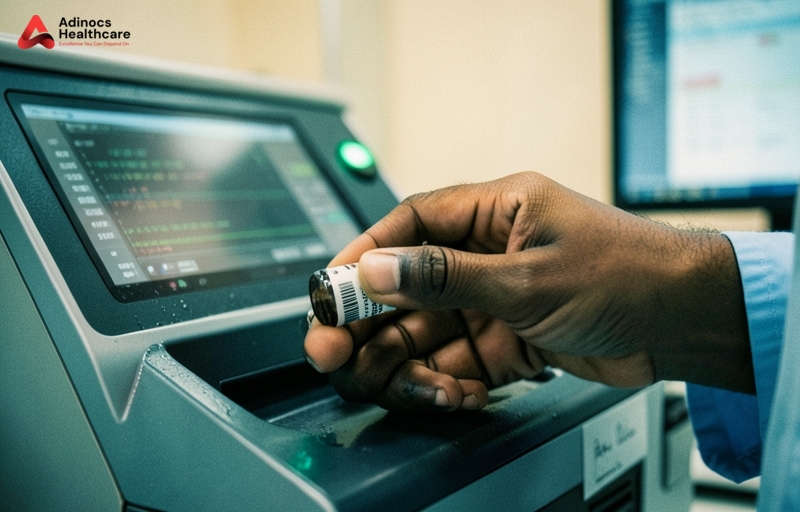
Second, look for real-time sample tracking with barcode generation. The moment a phlebotomist draws blood at a remote centre, a unique barcode must be printed and scanned. This ensures the sample is tracked at every step: collection, transit, receipt, processing, and disposal. No more lost samples. No more mixed-up vials.
Third, you need bidirectional machine interfacing. Your software must talk directly to your biochemistry and hematology analyzers. No manual entry of test results. This is how you sync diagnostic lab data across branches without human intervention. The analyzer reads the barcode, runs the test, and pushes the result back to the cloud. It is that simple. This means your lab can process 500+ samples per day without a single manual transcription error.
Finally, insist on role-based access control. Your lab technicians in Siliguri should only see their local patients, while your chief pathologist in Kolkata has access to the entire network. This protects patient privacy and keeps your operations organized.
How to maintain NABL consistency across multiple lab locations?
Imagine an auditor walking into your satellite lab in Asansol. They ask for the Levey-Jennings (L-J) quality control charts for the last six months. Your local technician scrambles. They cannot find the files. The auditor is not pleased. This is a common disaster. Maintaining quality standards across multiple locations is incredibly difficult without centralized control.
A 2025 NABL survey revealed that 42% of multi-center labs in India face non-compliance issues due to inconsistent QC logs across satellite branches. According to the National Accreditation Board for Testing and Calibration Laboratories (NABL) (2025) guidelines, maintaining strict traceability of samples and standardized quality control procedures across all testing sites is mandatory for accreditation. A multi-center pathology lab software India solves this by centralizing your Quality Control (QC) management.
Your quality manager sitting in Kolkata can monitor the daily control runs of analyzers in Siliguri and Patna in real-time. If an analyzer is out of calibration, the software can automatically block report generation for that specific test until a recalibration is logged. Standardization is non-negotiable. Your reference ranges, panic values, and report templates must be identical across all branches. When you update a reference range at the head office, it should instantly update across the entire network. Worth knowing: NABL auditors in 2026 are paying special attention to digital audit trails. If a report is edited, the system must log who did it, when, and why. To prepare your facility for upcoming regulatory scrutiny, read our guide on Why Indian Labs Will Struggle with NABL's 2026 Audit Changes.
How to track branch-wise profitability in real-time with multi-branch lab management software India?
A diagnostic chain owner in Bhubaneswar recently realized that his main branch was subsidizing three loss-making collection centres without his knowledge. He was looking at the total monthly revenue of Rs. 15 lakh and assuming everything was fine. That is a dangerous mistake. Plot twist: Once he broke down the numbers, he found that one remote collection point was actually draining Rs. 45,000 every month in wasted courier fees and expired reagents.
To fix this, you need real-time financial tracking. Your multi-branch lab management software India must break down revenue, expenses, and margins by branch. What this means in practice:
- Real-time tracking of cash, digital, and credit transactions at each collection point to prevent cash leakage.
- Automatic calculation of doctor referral commissions based on branch-specific arrangements.
- Real-time inventory tracking to see which branch is wasting reagents.
- Dynamic pricing management to offer localized discounts without affecting your core pricing structure.
Let us look at a real-world example. A 4-branch pathology lab in Siliguri achieved a 22% increase in net margins by tracking branch-wise reagent wastage and consolidating their high-end testing at their main Kolkata hub. They realized their satellite branches were running low-volume, high-cost tests that were expiring before the reagent packs were fully utilized. By routing those samples to the central hub, they saved Rs. 1.8 lakh in just three months. By tracking these metrics, you can identify which branches are underperforming and take corrective action before it impacts your overall business health.
Action Plan
Transitioning your lab network to a centralized system does not have to be painful. Here is your step-by-step roadmap to get started today:
- Audit your current infrastructure: Check the internet speed and hardware specifications at all your collection centres and satellite labs.
- Define your master data: Standardize your test menu, pricing lists, doctor directories, and reference ranges before migrating to the new system.
- Choose a cloud-native LIMS: Avoid hybrid models that require local database syncing. Go for a 100% cloud-based solution that offers real-time data access.
- Train your staff in phases: Start by training your main hub operators, then roll out the training to your collection centres one by one.
- Implement a pilot run: Keep your old system running parallel to the new LIMS for exactly one week at a single branch to iron out any operational kinks.
Frequently Asked Questions
How to set different test prices for different lab branches in India?
Yes, a centralized LIMS allows you to set branch-specific price lists. You can charge Rs. 500 for a CBC in Kolkata and Rs. 400 for the same test in a Tier 3 town like Asansol, all managed from a single dashboard.
Does cloud LIMS work offline when internet fails in Tier 3 Indian cities?
Most modern cloud LIMS platforms feature offline data caching. The software allows local staff to continue registering patients and collecting samples offline, and then automatically syncs all data to the cloud the moment the internet connection is restored.
Is ABHA ID integration compulsory for private pathology labs in India?
No, it is not legally mandatory for all private labs yet, but it is highly recommended. Government health schemes, digital prescriptions, and insurance payouts increasingly require ABHA ID integration, making it a competitive necessity in 2026.
How much time does it take to install multi-branch LIMS for 5 labs?
It typically takes 10 to 14 business days. This timeframe includes master data configuration, machine interfacing, staff training, and pilot testing.
Take Control of Your Lab Network Today
Managing a growing lab network should feel like a milestone, not a headache. If you are tired of dealing with mismatched samples, delayed reports, and untraceable cash leakages, it is time to upgrade your operational framework. At Adinocs Healthcare, we design digital-first solutions tailored for Indian diagnostic networks. Our Adibix LIMS is built specifically to bridge the gap between your hubs and collection centres, ensuring complete ABDM compliance and zero-leakage financial tracking. Let us help you streamline your operations. Book a free demo of Adibix LIMS with our team today to see how we can streamline your multi-branch operations.
Data sources: Guidelines from the National Accreditation Board for Testing and Calibration Laboratories (NABL 2025) and the National Health Authority (NHA 2025) implementation standards.