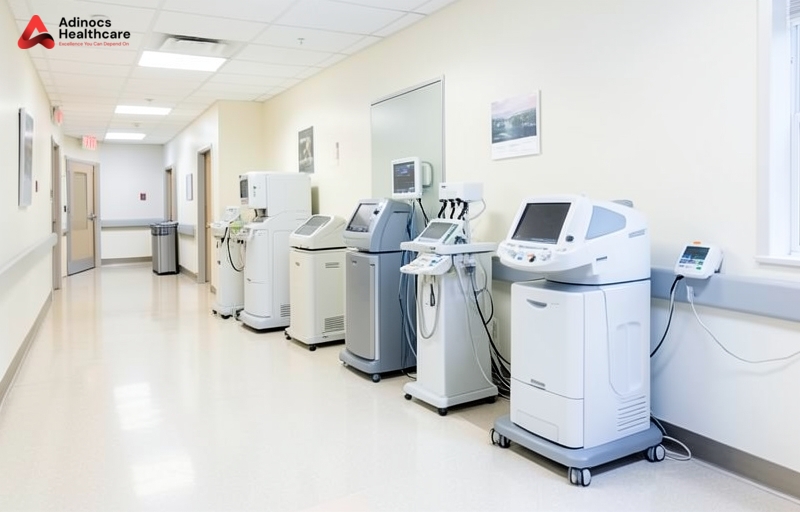
According to a 2025 report by the Association of Indian Medical Device Industry (AiMeD), nearly 35% of high-end diagnostic machines in Tier 2 and Tier 3 Indian hospitals sit idle or underutilised due to a lack of local technical support, high breakdown frequency, and soaring maintenance costs. For any hospital administrator or laboratory director, making a capital equipment investment is not simply a matter of comparing price quotes; it is a high-stakes decision that directly impacts daily cash flow and clinical reputation. When a critical machine goes down in a city like Siliguri or Malda, patient trust evaporates within hours as they migrate to competitors, leaving you with idle staff and mounting overheads. This guide provides a practical framework for evaluating medical equipment acquisitions to ensure every rupee spent translates into long-term clinical and financial value.
The Real Cost of Cheap Medical Equipment Investment in Indian Healthcare
A 50-bed hospital in Siliguri purchased a refurbished 16-slice CT scanner from an unverified local broker to save Rs.25 lakh on the initial purchase. Within six months, the X-ray tube failed, costing them Rs.12 lakh to replace, plus three weeks of complete operational downtime. Patients requiring emergency trauma scans had to be referred elsewhere, resulting in a permanent loss of local clinical credibility and a massive hit to the hospital's outpatient department revenue.
When planning an equipment investment, the purchase price is merely the visible tip of the financial iceberg. Hospital owners often fall into the trap of selecting the lowest bidder without calculating the Total Cost of Ownership (TCO). In India, hidden operational costs can quickly exceed the initial purchase price within the first three years of operation. These hidden costs include proprietary reagents, specialized software updates, high-voltage power stabilizers, and specialized operator salaries. According to a 2025 study by the National Health Authority (NHA), operational downtime in diagnostic facilities in West Bengal costs an average of Rs.45,000 per day in lost revenue alone.
To avoid these financial pitfalls, your procurement committee must evaluate the following hidden costs before signing any purchase order:
- Reagent and Consumable Lock-ins: Many equipment manufacturers sell chemistry analysers at a discount only to charge exorbitant prices for proprietary reagents. To understand how these ongoing expenses can silently drain your laboratory's cash flow, read our detailed analysis on Why High Consumable Costs Eat Into Indian Diagnostic Lab Profits.
- Power Quality Requirements: High-end imaging equipment requires stable power. In many parts of Eastern India, frequent voltage fluctuations necessitate the purchase of industrial-grade online UPS systems and voltage regulators, adding Rs.2 lakh to Rs.5 lakh to your initial setup cost.
- Site Preparation Costs: Installing heavy diagnostics like CT or MRI machines requires specialized lead lining, structural reinforcement, and dedicated air conditioning systems that must run 24/7 to prevent helium boil-off or detector degradation.
- Scheduled and Unscheduled Maintenance: Out-of-warranty service rates can cost up to Rs.15,000 per hour, excluding spare parts. A single major component failure without a service contract can wipe out an entire quarter's diagnostic profits.
Evaluating the Value Proposition of Your Next Equipment Investment
A pathology lab in Asansol was performing manual biochemistry assays, leading to a 24-hour turnaround time (TAT). Patients routinely bypassed this lab to travel to larger corporate chains that offered 4-hour reports. By upgrading to an automated clinical chemistry analyser, the lab reduced its TAT to 3 hours, allowing local physicians to make immediate treatment decisions and boosting the lab's daily test volume by 40%.
To justify a capital expenditure, you must define the clear value proposition of the new diagnostic imaging systems and automated laboratory analysers. A machine's value is not defined by its technical specifications, but by its ability to solve specific operational bottlenecks. For example, does the machine increase patient throughput? Does it reduce the need for highly specialized manual labor? Does it expand your clinical test menu, allowing you to retain high-margin specialized tests that you currently outsource to reference laboratories in Kolkata or Mumbai? A 2025 market survey of diagnostic labs in West Bengal showed that reducing turnaround time from 24 hours to under 4 hours increases patient retention rates by 68%.
When presenting an equipment proposal to your board or financial partners, structure your business case around these clear operational metrics:
- Throughput and Efficiency: Calculate the exact number of tests or scans the machine can perform per hour. A machine with a higher throughput reduces patient wait times and allows you to handle peak morning loads without staff overtime.
- Reagent Efficiency and Wastage: Look for automated systems with low dead volume (the unusable reagent left at the bottom of the tube) and long on-board reagent stability. This directly reduces cost per test.
- Clinical Differentiation: Introducing a service that is currently unavailable in your micro-market (such as digital mammography or high-resolution ultrasound) allows you to command premium pricing and establish your facility as a regional referral hub.
Mini Case Study: A 100-bed multi-speciality hospital in Midnapore achieved a 35% increase in daily outpatient diagnostics volume and saved Rs.1.8 lakh per month in reagent wastage by transitioning to a closed-system automated analyser with pay-per-test pricing, completely eliminating upfront capital expenditure.
Navigating Regulatory Hurdles in Your Equipment Investment Strategy
A diagnostic centre in Kolkata was served a show-cause notice and forced to suspend its digital radiography services. The reason was simple: they had purchased an unbranded X-ray machine from an importer that lacked proper type approval from the Atomic Energy Regulatory Board (AERB) and had failed to secure the necessary e-LORA registration for their technicians.
Compliance is a critical pillar of any successful equipment investment strategy in India. Operating non-compliant diagnostic equipment can lead to severe legal penalties, facility sealing, and irreversible damage to your brand. According to the Central Drugs Standard Control Organisation (CDSCO) (2025) guidelines, all medical devices sold in India must carry valid registration and comply with strict quality standards. Furthermore, if your facility aims for National Accreditation Board for Testing and Calibration Laboratories (NABL) or National Accreditation Board for Hospitals & Healthcare Providers (NABH) accreditation, every piece of laboratory and imaging equipment must undergo regular, documented calibration traceable to national standards. A 2025 compliance audit report indicated that approximately 28% of diagnostic facilities in Tier 2 West Bengal cities faced temporary closure or penalties due to non-compliant radiology setups.
To protect your facility from regulatory audits, ensure your procurement team follows this compliance checklist:
- AERB Approval for Radiology: Never purchase an X-ray, mammography, or CT system without verifying that the specific model has AERB type approval. For a deeper understanding of how to avoid common compliance traps, refer to our guide on 5 Reasons Indian Labs Fail AERB Inspections for Radiology Equipment.
- CDSCO Registration: Ensure the manufacturer or importer holds a valid CDSCO import or manufacturing licence. This guarantees that the spare parts and consumables used in your machine meet Indian safety standards.
- NABL Calibration Traceability: According to the National Accreditation Board for Testing and Calibration Laboratories (NABL) (2025) guidelines, all equipment used for clinical testing must undergo annual calibration by an NABL-accredited calibration laboratory to maintain accreditation status.
- ABDM Compatibility: Under the Ayushman Bharat Digital Mission (ABDM), modern medical equipment should support direct data export via HL7 protocols to generate Ayushman Bharat Health Account (ABHA) linked digital health records. Choosing systems with built-in HL7 and DICOM compatibility simplifies this integration.
Mitigating Risks: Why Insurance and Maintenance Contracts are Non-Negotiable
A multi-speciality clinic in Durgapur suffered a massive voltage fluctuation during the monsoon season. The surge bypassed their sub-standard UPS and fried the motherboard of their newly installed 4D ultrasound machine, resulting in a sudden repair bill of Rs.6.5 lakh. Because the clinic owner had declined to buy equipment insurance to save on annual premiums, the entire cost had to be paid out-of-pocket, disrupting their operational cash flow for two months.
In the Indian healthcare environment, equipment risk mitigation is often treated as an afterthought. Industry data from 2025 indicates that over 60% of diagnostic centres in Tier 2 Indian cities operate without comprehensive equipment insurance, exposing them to catastrophic financial shocks from power surges, localized flooding, or accidental user damage. While an Annual Maintenance Contract (AMC) or Comprehensive Maintenance Contract (CMC) covers mechanical wear and tear, it does not cover external environmental damage or accidental breakage. According to a 2025 survey of private clinics in Eastern India, power-surge-related component failures account for 45% of all unscheduled diagnostic equipment downtime.
To build a resilient operational model, your risk management strategy must include the following components:
- Comprehensive Maintenance Contracts (CMC): While an AMC covers only service visits, a CMC includes the cost of expensive spare parts. For high-wear machines like CT scanners or automated hematology analysers, a CMC is highly recommended after the warranty period expires.
- Specialized Equipment Insurance: Ensure your high-value diagnostic assets are covered by a dedicated electronic equipment insurance policy that includes breakdown cover, business interruption cover, and voltage surge damage. To understand why this is a critical financial safeguard, read our expert analysis on Why Most Indian Lab Owners Ignore Medical Equipment Insurance.
- Uptime Guarantees in SLAs: When negotiating with equipment vendors, always include a Service Level Agreement (SLA) that guarantees a minimum uptime (e.g., 95% uptime) and specifies penalties or loaner machine provisions if the machine is down for more than 24 hours.
Choosing the Right Medical Equipment Partner in Eastern India
A hospital group in Patna purchased an advanced MRI system from a distributor based in Mumbai. When a critical software glitch occurred, they had to wait five days for a technician to fly down, costing them over Rs.8 lakh in cancelled appointments and outsourced scans. Had they partnered with an organisation with a dedicated local service hub in Kolkata, the issue could have been resolved within hours.
When investing in advanced diagnostic imaging systems and automated laboratory analysers, the geographical location of your partner's service team is just as important as the brand of the machine. Eastern India (including West Bengal, Bihar, Jharkhand, and Orissa) has historically faced longer service response times compared to major metro hubs in Western or Southern India. Choosing a partner with local, on-ground engineers in Kolkata ensures that emergency breakdowns are addressed promptly, minimizing clinical downtime. A 2025 regional healthcare study revealed that hospitals in Bihar and Jharkhand experience an average of 6.2 days of equipment downtime per breakdown when relying on service engineers based outside Eastern India.
When evaluating potential equipment partners, look for these operational capabilities:
- Local Spare Parts Inventory: Ask the vendor where their primary spare parts warehouse is located. If parts must be imported or shipped from another zone, your downtime will inevitably stretch into days or weeks.
- Flexible Financing and Acquisition Models: Avoid tying up all your working capital in heavy upfront purchases. Look for partners that offer subscription models, pay-per-use structures, or structured leasing options that align your monthly equipment costs with actual patient volumes.
- Comprehensive Operator Training: Advanced diagnostic equipment is only as good as the technician operating it. Ensure your partner provides structured, on-site training for your staff, along with refresher courses when software updates are rolled out.
- End-to-End Execution: Choose a partner that handles the entire lifecycle, including site planning, AERB licensing assistance, professional installation, and ongoing maintenance, rather than a simple sales agent who disappears after delivery.
Key Takeaways for Indian Healthcare Decision-Makers
- Calculate TCO, Not Just Purchase Price: Always factor in reagent costs, power requirements, site preparation, and maintenance contracts over a 5-year lifecycle before making an acquisition.
- Prioritize Regulatory Compliance: Ensure all imaging and laboratory systems comply with CDSCO, AERB, and NABL standards to avoid legal penalties and maintain your clinical credentials.
- Demand Local Support: Partner with vendors who have established service hubs and spare parts inventories in Eastern India to guarantee rapid response times during critical breakdowns.
- Adopt Flexible Financing: Protect your cash flow by exploring pay-per-use, leasing, or subscription models that eliminate large upfront capital expenditures.
Frequently Asked Questions About Medical Equipment Procurement
Which is more cost-effective for a 50-bed Indian hospital: an AMC or a CMC?
An Annual Maintenance Contract (AMC) covers only the labor charges for preventive maintenance and emergency breakdown visits, meaning you must pay extra for any spare parts required. A Comprehensive Maintenance Contract (CMC) is more expensive upfront (typically costing 8% to 12% of the equipment purchase price annually) but covers both labor and the cost of replacement parts. For high-use, critical machines like CT scanners or automated hematology analysers, a CMC is far more cost-effective as it provides predictable maintenance costs and protects your facility from sudden, expensive component failures.
How can a small diagnostic lab in Tier 3 West Bengal afford high equipment investment costs?
Small diagnostic labs can significantly reduce financial risk by adopting flexible acquisition models, such as pay-per-report or pay-per-test structures. These models require no large upfront capital outlay; instead, the facility pays a fixed fee per scan or test performed, allowing operational expenses to scale directly with patient volume and revenue. Additionally, partnering with local healthcare service providers like Adinocs Healthcare allows labs to access high-end equipment through structured leasing plans.
What is the process for getting AERB approval for a CT scanner in India?
To legally operate diagnostic radiology equipment in India, you must obtain type approval for the equipment model from the Atomic Energy Regulatory Board (AERB), register your institution on the AERB e-LORA portal, ensure your installation site meets specific radiation safety layout guidelines (such as 23 cm thick brick walls or equivalent lead lining), and employ qualified, registered radiological technologists. The entire process must be documented and submitted online through the e-LORA platform before clinical operations begin.
Partner with Adinocs Healthcare for Sustainable Operational Success
Navigating the complexities of medical procurement requires a partner who understands the unique operational realities of the Indian healthcare landscape. At Adinocs Healthcare, we help hospitals and diagnostic centres in Eastern India make every rupee count. We do not just sell machines; we provide complete, end-to-end solutions that include professional installation, operator training, and reliable on-ground support from our Kolkata-based team. Whether you are looking for sub-specialist teleradiology reporting with a guaranteed 2-hour turnaround time, or NABL-compliant laboratory information management systems (LIMS) designed for Indian workflows, we provide flexible subscription and pay-per-use models that eliminate large upfront capital investments. Talk to our teleradiology and laboratory equipment team at Adinocs Healthcare today, or book a free operational consultation to see how we can help your facility achieve long-term value and clinical excellence.
Data sources: Association of Indian Medical Device Industry (AiMeD) Infrastructure Report 2025, National Health Authority (NHA) Operational Guidelines 2025, Central Drugs Standard Control Organisation (CDSCO) Medical Device Rules, National Accreditation Board for Testing and Calibration Laboratories (NABL) Equipment Calibration Guidelines 2025.