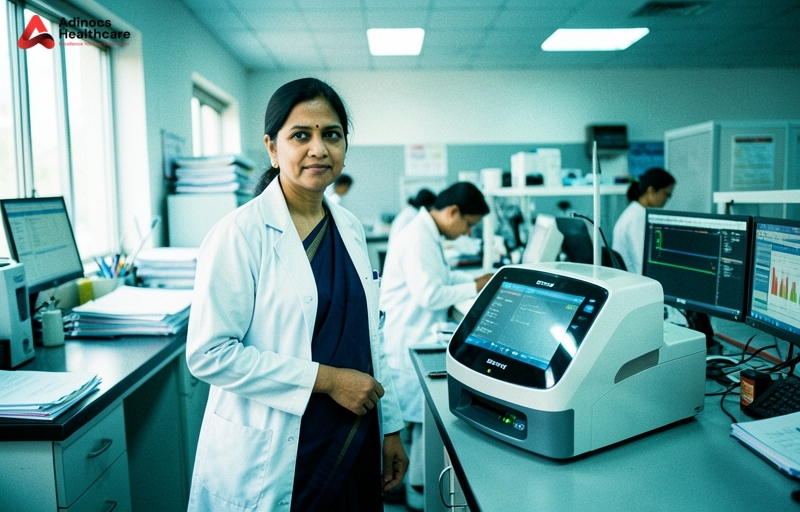
Out of over 100,000 diagnostic laboratories operating in India, fewer than 150 hold College of American Pathologists (CAP) certification as of 2026. If you run a diagnostic center or hospital pathology department in Kolkata, Patna, or Guwahati, you are likely calculating the return on investment of international standards versus NABL compliance. Understanding the CAP accreditation cost for Indian labs is the essential first step before allocating your capital budget. Is this premium financial commitment actually justified for your facility?
Short answer: The total CAP accreditation cost for Indian labs typically ranges between Rs. 12 lakh and Rs. 28 lakh ($15,000 to $33,000 USD) in the first year, with annual maintenance expenses of Rs. 8 lakh to Rs. 15 lakh. That makes CAP five to eight times more expensive than NABL certification. NABL satisfies 95% of domestic Indian regulatory requirements, whereas CAP delivers measurable financial returns primarily if your laboratory processes global clinical trial samples, services medical tourists from South Asia, or competes directly for multinational pharmaceutical research contracts.
What is CAP Accreditation and How Does It Differ From NABL?
A pathology lab owner in Siliguri recently expanded his molecular diagnostics division to process specialized oncology samples from Nepal and Bhutan. His clinical accuracy was immaculate. Yet foreign contract research organizations refused to sign sample-processing contracts. They demanded foreign peer-reviewed standards. That roadblock forced him to evaluate CAP accreditation alongside NABL.
The College of American Pathologists (CAP) runs a global laboratory accreditation program built on rigorous peer-to-peer inspections and specialized proficiency testing. Unlike ISO 15189 standards used by the National Accreditation Board for Testing and Calibration Laboratories (NABL), CAP evaluates clinical workflows through the direct supervision of active practicing pathologists. NABL remains the mandatory legal benchmark in India. It guarantees that your equipment, calibration protocols, and testing staff meet basic national standards. So why pay premium international fees?
Market positioning dictates the financial outcome. In high-density diagnostic hubs like Delhi NCR, Mumbai, or Bengaluru, holding a CAP badge separates advanced reference hubs from thousands of routine collection centers. It proves to global pharmaceutical firms that your molecular and histopathology data can be integrated into international drug trials. However, if 90% of your daily sample volume comes from local neighborhood clinic referrals and routine blood profiles, NABL certification provides all the local authority you need at a fraction of the cost.
How Much Does CAP Accreditation Cost for Indian Labs in 2026?
Let us look at actual budget allocations. No hidden expenses. The CAP accreditation cost for Indian labs represents a significant capital outlay payable in US Dollars (USD). With foreign exchange rates averaging Rs. 83 to Rs. 86 per USD in 2026, exchange rate fluctuations directly impact your annual operational expenditures.
Here is a comprehensive cost comparison between standard NABL accreditation and CAP certification for a mid-to-large pathology lab operating in India:
| Expense Category | NABL Estimated Cost (INR) | CAP Estimated Cost (INR) | Frequency / Notes |
|---|---|---|---|
| Application & Processing Fees | Rs. 50,000 - Rs. 1.5 lakh | Rs. 2.5 lakh - Rs. 5 lakh ($3,000 - $6,000) | Paid annually to the respective accreditation boards. |
| Proficiency Testing (PT) / Surveys | Rs. 1 lakh - Rs. 3 lakh | Rs. 3.5 lakh - Rs. 10 lakh ($4,000 - $12,000) | CAP requires international shipping of specialized PT samples. |
| Inspector Travel & Lodging | Rs. 50,000 - Rs. 1.5 lakh | Rs. 4 lakh - Rs. 8 lakh | Includes flights and hotel stays for assigned foreign peer inspectors. |
| Consultancy & Training | Rs. 1 lakh - Rs. 2.5 lakh | Rs. 2 lakh - Rs. 5 lakh | Fees for specialized CAP accreditation advisers in India. |
| Total Estimated Initial Cost | Rs. 3 lakh - Rs. 8.5 lakh | Rs. 12 lakh - Rs. 28 lakh | Excludes internal equipment upgrades and LIMS modifications. |
What this means: the initial capital outlay is only part of the story. Recurring expenditures can strain your budget. You must purchase CAP-approved Proficiency Testing (PT) kits every twelve months. These PT sample sets ship directly from the United States in specialized cold-chain containers. International freight, Indian customs clearance fees, and temperature-controlled logistics add roughly Rs. 2.5 lakh to Rs. 5 lakh in hidden overhead every year. Mandatory spending. No shortcuts.
CAP Accreditation Cost for Indian Labs vs NABL: Which Delivers Better ROI?
A mid-sized diagnostic center in Kolkata spent Rs. 22 lakh achieving CAP accreditation in 2025. Management expected neighborhood general practitioners to double their daily referral numbers. The result? Total failure. Local doctors did not care about American certification. They cared about turnaround time. They wanted routine CBC and HbA1c reports delivered via WhatsApp within 3 hours. The lab, bogged down by CAP multi-tiered verification protocols, saw its average reporting time stretch to 7 hours. Referral volume dropped by 18% in six months.
Here's the catch: international accreditations cannot fix broken operational workflows. Before allocating capital toward overseas certifications, examine your existing operational leakages. Read our guide on How to Stop Revenue Leakage in Lab Franchises? to secure your existing margins. Furthermore, if working capital is constrained, spending your entire reserve fund on international fees creates financial fragility. Review these 5 Ways to Fix Cash Flow in Indian Diagnostic Centers to stabilize your balance sheet first.
NABL delivers a substantially faster return on investment for domestic diagnostic operations. It carries official recognition from the Ministry of Health and Family Welfare (MoHFW) and remains mandatory for Central Government Health Scheme (CGHS) empanelment and corporate health insurance tie-ups. If local patient retention remains poor, a foreign accreditation label will not fix your bottom line. Take time to analyze Why Do Indian Diagnostic Labs Lose Repeat Patients? to fix your core patient experience before spending capital on international badges.
What are the Mandatory Requirements for CAP Accreditation in India?
A diagnostic facility in Asansol applied for CAP accreditation after passing its NABL audit with zero major non-conformities. Management assumed their documented Standard Operating Procedures (SOPs) would satisfy foreign auditors. They were wrong. A preliminary gap analysis revealed 42 critical deficiencies across CAP discipline-specific checklists. CAP demands a far higher level of clinical documentation and peer evaluation than standard ISO frameworks.
To clear a CAP inspection, your pathology facility must satisfy over 3,000 discipline-specific checklist requirements. Key operational parameters include:
- Pathologist Director Oversight: The laboratory director must hold a recognized MD in Pathology with verified annual competency assessments. CAP mandates that the lab director retains direct personal liability for all clinical outcomes and technical testing protocols.
- Proficiency Testing (PT) Enrollment: Your lab must participate in CAP PT programs covering 100% of the active testing menu. If CAP does not provide a specific PT kit for a rare biomarker, you must perform alternative performance evaluations at least twice a year.
- Peer-Inspection Obligations: CAP operates on a reciprocal peer-review system. Practicing pathologists and laboratory directors from accredited facilities perform on-site audits. In turn, your medical directors must be prepared to conduct external audits at other regional facilities.
- Facility Safety Standards: Your structural floor plan must maintain strict physical separation between sample handling, molecular amplification, and hazardous reagent storage. Ventilation systems, chemical hygiene protocols, and bio-waste management must comply with global safety guidelines.
- Instrument Validation Protocols: Every automated analyzer must undergo multi-point validation before running patient samples. This process requires documenting analytical sensitivity, reportable ranges, precision, and inter-instrument correlation studies across 20 or more replicate samples.
How Long Does the CAP Accreditation Process Take for Indian Labs?
An automated reference laboratory in Guwahati took 13 months to complete its initial CAP accreditation cycle. Fast-tracking this process is virtually impossible due to mandatory proficiency testing timelines. Anyone claiming they can secure CAP certification within 90 days is misinformed. The realistic preparation window for Indian laboratories spans 10 to 14 months.
Here is the realistic step-by-step implementation timeline:
- Months 1-2: Gap Analysis and PT Sign-Up. Your technical team reviews current lab operations against CAP master checklists. You enroll in required CAP Proficiency Testing surveys to establish a baseline performance history.
- Months 3-6: SOP Re-writing and System Validation. Staff members revise laboratory SOPs, conduct instrument correlation studies, and establish document control systems. Working with a specialized laboratory accreditation consultant during this phase prevents costly procedural mistakes.
- Months 7-8: Internal Audits and Mock Inspections. Technical supervisors conduct rigorous internal audits using CAP checklist criteria. Every non-conformity must be logged and resolved with documented corrective actions.
- Months 9-10: On-Site Peer Inspection. An assigned team of international peer inspectors arrives at your facility. Over two to three days, they review raw diagnostic data, interview laboratory technicians, and verify safety infrastructure.
- Months 11-12: Deficiencies Resolution and Certification. Inspectors issue an official report. Your team has exactly 30 days to submit documented proof of corrective actions for all identified deficiencies. Once verified, CAP issues the formal accreditation certificate.
Key Decision Criteria for Indian Diagnostic Leaders
- Evaluate Your Target Market: Choose NABL if your revenue relies on domestic doctor referrals, CGHS empanelment, and local walk-in patients. Choose CAP if you handle international clinical trial samples, conduct advanced molecular research, or market directly to international medical tourists.
- Calculate Annual Foreign Exchange Exposure: Remember that the CAP accreditation cost for Indian labs involves recurring annual fees paid in USD for PT surveys and administrative maintenance. Account for currency fluctuations in your long-term operating budget.
- Upgrade Internal LIMS Infrastructure: Ensure your Laboratory Information Management System (LIMS) supports complete audit trails, automated QC tracking, and rapid sample traceability before applying for peer inspections.
- Work with Experienced Advisors: Partner with consultants who understand Indian customs logistics for importing temperature-sensitive CAP proficiency testing samples without delivery delays.
Frequently Asked Questions
Is CAP accreditation mandatory for pathology labs in India?
No, CAP accreditation is completely voluntary. For domestic Indian operations, hospital tie-ups, and government empanelments, NABL accreditation serves as the recognized national quality standard.
What is the total CAP accreditation cost for Indian labs in 2026?
The total initial cost ranges between Rs. 12 lakh and Rs. 28 lakh ($15,000 to $33,000 USD). This total includes application fees, international proficiency testing sample shipments, consultant charges, and travel expenses for foreign peer inspectors.
Can an Indian pathology lab hold both NABL and CAP accreditations at the same time?
Yes, many tier-1 diagnostic networks and major hospital laboratories in India hold dual accreditations. NABL satisfies local legal standards and Indian health insurance requirements, while CAP provides global credibility for clinical trials.
Is CAP accreditation worth the investment for small diagnostic centers in India?
In most cases, no. Small to mid-sized standalone centers operating in Tier 2 or Tier 3 cities rarely see a positive financial ROI from CAP certification. NABL accreditation offers far better domestic positioning at roughly 20% of the financial cost.
How long is CAP accreditation valid for Indian laboratories?
CAP accreditation is valid for a two-year cycle. However, accredited labs must conduct a formal self-inspection during the non-inspection year and continuously pass multi-annual proficiency testing surveys to retain active certification.
Navigating laboratory accreditations, quality protocols, and clinical scaling requires clear operational planning. At Adinocs Healthcare, we help Indian diagnostic facilities optimize their service lines and expand capacity efficiently. Whether you need to scale your diagnostic coverage through our pay-per-report teleradiology services, streamline imaging workflows, or acquire refurbished radiology equipment with full installation support, our expert team is ready to assist. Talk to our team at Adinocs Healthcare today to schedule a consultation on optimizing your diagnostic operations and teleradiology workflows without heavy upfront capital investments.
Data sources: National Accreditation Board for Testing and Calibration Laboratories (NABL) guidelines 2025, College of American Pathologists (CAP) international program fee schedules 2026, Ministry of Health and Family Welfare (MoHFW) clinical establishment framework standards.