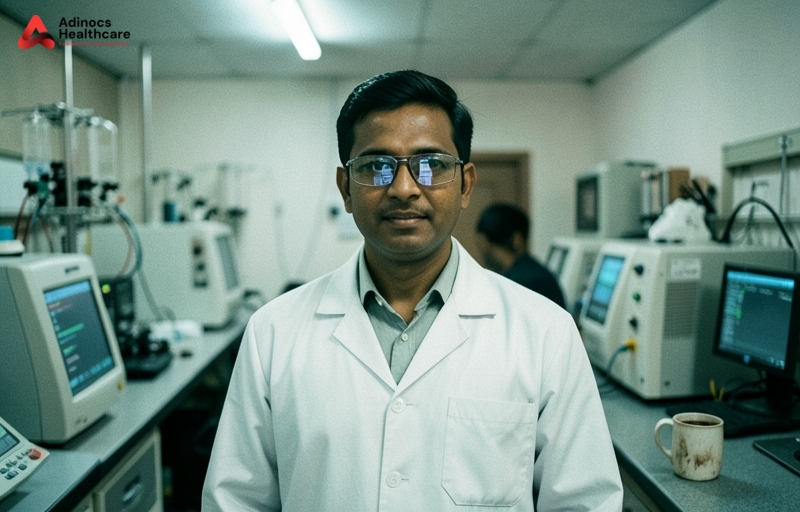
According to a 2025 Indian healthcare market report, almost 45% of patients who consult a doctor online in India now completely bypass traditional diagnostic referral loops. Why must Indian labs adapt? Because virtual consultations have broken the physical prescription pipeline, shifting patient acquisition entirely to digital platforms and home-collection models. This shift represents the direct teleconsultation impact diagnostic labs India must navigate to survive. If you run a pathology lab in Siliguri or a diagnostic centre in Patna, you are likely noticing a quiet, steady drop in walk-in patients carrying paper prescriptions. They are booking home collections online instead.
The short answer: Virtual healthcare is rewriting how patients choose diagnostic labs. To survive, Indian labs must move away from relying solely on local doctor prescriptions and instead build direct digital pathways, integrate with telemedicine platforms, and optimize for home-sample collection.
How Has Teleconsultation Grown in India by 2026? (Understanding the Teleconsultation Impact Diagnostic Labs India Face)
A 50-bed hospital in Burdwan recently saw its outpatient diagnostic walk-ins drop by 22% in a single quarter. The reason? Local family physicians shifted nearly half of their routine follow-ups to virtual consultations. When patients consult from the comfort of their living rooms, they do not walk down the corridor to the hospital lab. They go home. Then they search online. Every time.
This is not an isolated incident. The digital health push started as a temporary fix during the pandemic. Now, in 2026, it is standard operating procedure. According to the National Health Authority (NHA), digital health transactions under the Ayushman Bharat Digital Mission (ABDM) have scaled exponentially. In fact, teleconsultations on platforms like eSanjeevani have crossed 15 crore transactions.
What this means: The old geographic monopoly is dead. It used to be simple. You open a lab near a busy clinic, build relations with the doctor, and watch patients walk in. But when the doctor is on a screen in Kolkata and the patient is in a Tier 3 town like Malda, physical proximity loses its power. The geographic advantage vanishes. Patients are no longer handed a physical slip of paper with your logo on it. Instead, they receive a PDF prescription on WhatsApp. This single shift changes how patients choose where to get their blood drawn. Are you ready to capture these digital wanderers? Or will you let aggregator apps steal them from under your nose?
What Are the New Referral Pathways from Virtual Care?
A pathology lab owner in Siliguri recently shared that his traditional doctor-referral revenue dropped by Rs. 1.2 lakh per month. He was baffled. The local doctors still liked him. They still trusted his quality. So what changed? The doctors were now doing 30% of their consultations online through national platforms. These platforms have automated, pre-integrated laboratory partners. The local lab was simply bypassed.
This is the reality of virtual care referral pathways India is seeing today. The traditional pipeline is cracking. Industry data shows that roughly 60% of all virtual consultations require at least one diagnostic test. That is a massive volume of business. Here's the catch: the changing referral patterns India is experiencing mean that this volume does not flow through traditional channels automatically. It gets routed digitally.
In the old system, the referral was a direct, personal recommendation. In the virtual care model, the platform itself suggests the lab. Sometimes, it is an automatic pop-up. Other times, the patient is given a digital marketplace of options. Patients actually prefer this. Why? Because they do not want to carry paper. They want a phlebotomist to show up at their door tomorrow at 7:00 AM. How can a local lab compete when the referral happens inside an app?
Here is how the pathways have split:
| Feature | Traditional Referral Pathway | Virtual Care Referral Pathway (2026) |
|---|---|---|
| Referral Source | Physical prescription slip from local clinic | Digital PDF prescription or platform in-app order |
| Patient Choice Driver | Doctor's direct recommendation and lab proximity | Home collection convenience, price comparison, online reviews |
| Sample Collection | Patient walks into the diagnostic centre | Home sample collection booked via app or WhatsApp |
| Report Delivery | Physical collection or basic email/SMS link | Direct integration into the patient's digital health locker (ABHA) |
How Can Labs Adapt to the Teleconsultation Impact Diagnostic Labs India Experience?
In early 2025, a family-run lab in Ranchi saw its daily walk-ins drop from 80 to 45 within three months. The owner did not panic. Instead, he reached out to three regional telemedicine platforms and integrated his booking system. Within sixty days, his daily sample volume bounced back to 95, with over 50% coming from virtual referrals. This is how you survive.
You cannot sit back and wait for patients to walk through your door with a paper slip. Not anymore. To survive, you must adapt to teleconsultation referrals actively.
First, you must build direct relationships with teleconsultation platforms. Many of these national platforms allow local diagnostic partners to list their services. If you are NABL accredited, this is your golden ticket. Worth knowing. According to the National Accreditation Board for Testing and Calibration Laboratories (NABL) guidelines, maintaining high-quality, traceable standards is critical for digital partnerships.
Second, you need to make your booking process dead simple. If a patient has to call your landline three times to book a home collection, they will hang up. They will book with a national aggregator instead. You need a WhatsApp-based booking engine.
Let's look at a real-world success story. A 120-bed hospital diagnostic wing in Asansol achieved a 34% increase in outpatient lab revenue by integrating its booking system with regional teleconsultation networks and offering guaranteed 2-hour home-sample collection. They did not hire more sales reps. They simply plugged their inventory into the digital systems that online doctors were already using.
You can do the same. Want to know how to keep your traditional doctors happy while building these digital channels? Read our guide on Top Doctor Referral Strategies for Indian Labs in 2026. Also, remember that digital patient acquisition is not just about partnerships. It is about how you engage them online. To understand the financial impact of this, explore how Can Digital Engagement Boost Indian Lab Revenue?.
The non-obvious insight here: Do not try to compete with national aggregators on price. Compete on speed and local trust. A national aggregator might take 24 hours to deliver a report. Why? Because they ship samples to a central lab in Mumbai or Gurgaon. Your local lab can do it in 6 hours. Highlight that. Sell peace of mind, not cheap packages.
What Operational Shifts Do Labs Need for Teleconsults?
An administrator of a multi-speciality clinic in Patna recently faced a crisis. They had signed up for three telemedicine networks. Orders were pouring in. But their phlebotomists were arriving late. Samples were getting mixed up. Turnaround times (TAT) stretched from 6 hours to 28 hours. The result? The platforms blacklisted them.
Operational failure is the quickest way to kill your digital revenue. Every single time. The telemedicine integration diagnostic centers India are implementing requires a complete overhaul of your daily workflow. You cannot run a home-collection heavy business using the same old walk-in processes.
Here is the step-by-step operational playbook you need to implement today:
- Optimize Phlebotomist Routing: Do not let your phlebotomists plan their own routes. Use simple geo-mapping tools to group collections by pin code. This saves fuel and reduces travel time by up to 35%.
- Implement Barcoding at the Doorstep: Never let a phlebotomist handwrite a patient's name on a vial at their home. Print barcoded labels in advance or use mobile Bluetooth printers. This virtually eliminates sample misidentification.
- Establish a Strict Cold-Chain Protocol: Samples degrade quickly in Indian summers. Ensure every phlebotomist carries a validated mini-cooler box with digital temperature monitoring. If NABL inspects your facility, they will check this.
- Accelerate Turnaround Times: Online patients expect speed. If a virtual doctor needs a CBC report to prescribe an antibiotic, they cannot wait until tomorrow night. You must prioritize teleconsultation samples in your processing queue.
While scaling up your speed, never compromise on accuracy. For a deep dive into maintaining quality during rapid growth, read our guide on How Can Indian Labs Build a Strong Patient Safety Culture?. The cost of a single error is too high: a lost patient, a ruined doctor relationship, and potential regulatory trouble.
How Does LIMS Support Telemedicine Integration for Labs?
A mid-sized laboratory in Muzaffarpur lost a lucrative partnership with a regional telemedicine app because their legacy software took 12 minutes of manual data entry per patient. The manual delay caused transcription errors in 4% of all patient names. The platform cancelled the contract within a month. This highlights why your software infrastructure must be modern.
Let's be honest. If your lab is still running on legacy software built a decade ago, you are bringing a knife to a gunfight. Telemedicine integration is not just about sending a PDF via WhatsApp. It is about deep, automated data exchange.
When an online doctor prescribes a test, that order should ideally flow directly into your Laboratory Information Management System (LIMS) without manual entry. When your analyzer runs the sample, the result should automatically sync back to the teleconsultation platform and the patient's ABHA locker. Modern LIMS setups reduce manual entry errors by 99% and cut report delivery times from 4 hours to under 15 minutes.
Here is what your LIMS must support in 2026 to remain competitive:
- ABDM and ABHA Compliance: Under national guidelines, patients have the right to receive their health records digitally in their Ayushman Bharat Health Account. Your LIMS must support this integration natively.
- Open APIs for Platform Syncing: Your LIMS must be able to talk to external telemedicine apps. If it does not have open Application Programming Interfaces (APIs), you will spend lakhs on custom development.
- Automated WhatsApp and SMS Triggers: The moment a report is signed off by your pathologist, the system should dispatch a secure download link. No manual intervention. No delay.
- Real-time Phlebotomist Tracking: Your system should allow you to assign home collection duties to phlebotomists via a mobile app, tracking their location and status in real-time.
The trade-off: Upgrading your LIMS can feel like a massive headache. It is expensive. It disrupts daily operations. But the alternative is slow, painful irrelevance. If you cannot deliver digital reports instantly, the teleconsultation networks will simply stop sending patients your way. It is that simple.
Key Takeaways for Indian Diagnostic Labs
The shift towards virtual care is not a threat; it is an expansion opportunity. If you adapt quickly, you can capture patient volumes far beyond your physical neighborhood.
- Audit Your Current Digital Readiness: Check if your LIMS can integrate with external APIs and if you are fully ABDM-compliant.
- Build a Dedicated Home Collection Team: Treat home sample collection as a core business unit, not a side service. Invest in reliable cold-chain transport and mobile barcoding.
- Partner with Regional Telemedicine Providers: Reach out to local and regional online consultation platforms in West Bengal, Bihar, and Jharkhand to list your diagnostic services.
- Integrate Teleradiology for Faster Reporting: If your lab also offers imaging services (X-ray, CT, MRI), partner with a reliable teleradiology provider to ensure your reports are ready within hours, matching the speed of virtual consultations.
Frequently Asked Questions About Teleconsultation & Labs
How does teleconsultation impact diagnostic labs in India?
Teleconsultation shifts patient acquisition from physical doctor referrals to digital platforms. It reduces walk-in traffic at clinics and increases the demand for home sample collection and rapid, digital report delivery.
Which certifications do Indian labs need to partner with telemedicine apps?
Yes, most reputable telemedicine platforms require diagnostic partners to have NABL accreditation or basic ISO certifications. They also mandate compliance with the Ayushman Bharat Digital Mission (ABDM) guidelines for secure health data sharing.
How do I integrate my lab with ABDM and ABHA in India?
ABDM (Ayushman Bharat Digital Mission) enables the secure sharing of digital health records. Diagnostic labs must integrate with ABDM to allow patients to link their lab reports directly to their unique 14-digit ABHA (Ayushman Bharat Health Account) number.
How can a small pathology lab in India compete with Dr Lal PathLabs or Metropolis?
Yes, small labs can compete by offering faster turnaround times and superior local customer service. While national chains often take 24 to 48 hours for home collection and reporting in Tier 2 and Tier 3 cities, local labs can complete the entire cycle within 6 to 12 hours.
Navigating this digital transition does not have to be an uphill battle. At Adinocs Healthcare, we help Indian diagnostic centres and hospitals bridge the gap between traditional operations and modern, virtual-first healthcare demands. Whether you need to streamline your imaging workflows with our rapid, sub-specialist teleradiology services or upgrade your laboratory infrastructure to support direct API integrations, we are here to help. We provide end-to-end support with no heavy upfront capital investments. Ready to secure your lab's digital future in 2026? Talk to our teleradiology and lab operations team at Adinocs Healthcare today for a free operational audit.
Data sources: National Health Authority (NHA) Ayushman Bharat Digital Mission guidelines, National Accreditation Board for Testing and Calibration Laboratories (NABL) portal, and 5C Network industry insights.