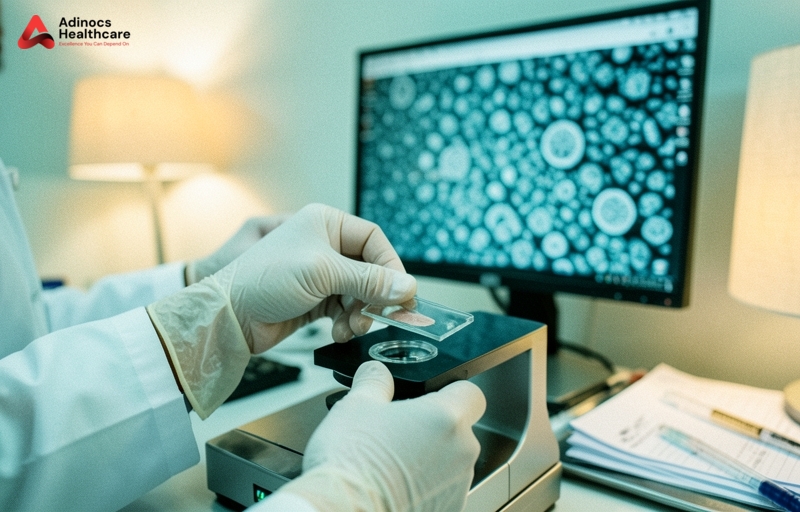
Nearly 70% of clinical decisions in India rely on pathology reports, yet over 65% of diagnostic centres outside major metros face a critical shortage of histopathologists. How do you solve this? Implementing digital pathology India boosts lab quality by eliminating physical slide transit, reducing reporting errors through AI-assisted analysis, enabling instant peer reviews, securing NABL-compliant digital archiving, and connecting remote labs with top-tier sub-specialists instantly.
The short answer: Digital pathology in India bridges the specialist gap by enabling remote slide reporting, reducing turnaround times from 5 days to under 24 hours. It enhances diagnostic quality through AI-assisted tools and secures NABL compliance by digitizing the slide archiving process.
What is Digital Pathology India and Why is It Relevant for Indian Labs?
In 2025, a diagnostic clinic in Siliguri had to wait six days for a critical breast biopsy slide to reach a specialist in Kolkata via courier. The patient's treatment was delayed, causing immense anxiety. This is the reality of microscope-tethered pathology. A lab technician prepares a tissue sample, mounts it on a glass slide, stains it, and physically hands it to a pathologist. But what happens when your pathologist is stuck in Kolkata traffic? Or worse, when your lab is in a Tier 2 city like Siliguri and your specialist is 600 kilometres away? The workflow grinds to a halt. Glass slides are fragile. They degrade. One bumpy courier ride can shatter a week's worth of diagnostic work. Not anymore.
Digital pathology changes this entire dynamic. By using high-resolution whole-slide imaging (WSI) scanners, physical slides are converted into digital files. These files can be viewed, shared, and analyzed on a computer screen from anywhere in the world. According to the National Health Authority (NHA), India's healthcare system is rapidly digitizing under the Ayushman Bharat Digital Mission (ABDM). In this digital-first ecosystem, the adoption of digital pathology India has transitioned from a luxury to an operational necessity for labs aiming to scale.
The relevance for Indian labs is simple: specialist access. India has an acute shortage of sub-specialist pathologists, such as neuropathologists or dermatopathologists. Most of these experts reside in Tier 1 cities. If you operate a lab in Guwahati, Asansol, or Patna, digital pathology allows you to consult these top-tier specialists instantly. No courier delays. No broken slides. Just pure digital efficiency.
How Does Digital Pathology India Improve Lab Efficiency and Turnaround Time?
A 120-bed hospital in Siliguri achieved a 60% reduction in histopathology turnaround time by shifting to remote digital reporting, eliminating the 3-day courier lag to Kolkata. This is not an isolated success story. It is the new baseline for modern diagnostics. When you digitize your pathology workflow, you eliminate multiple manual steps that drain your staff's time.
Here's the catch. Most lab owners assume that buying a scanner is a magic bullet for turnaround time. It is not. The real bottleneck in digital pathology is slide preparation quality. If your histotech cannot cut a uniform 4-micron section, the scanner will output a blurry image. This forces a rescanning process, which actually hurts your efficiency. Digital pathology does not replace skilled technicians; it demands better slide preparation. But when done right, the impact on pathology lab efficiency is massive.
What this means in practice:
- Instant Triaging: Urgent cases (like intraoperative frozen sections) can be uploaded and read by a pathologist in minutes, not hours.
- Reduced Administrative Burden: No more physical sorting, labeling, and filing of slide trays. Digital files are auto-indexed.
- Simplified Multi-Branch Operations: If you run multiple collection centres, you can centralize your reporting team. To understand how to manage this scale, read our guide on How to Sync Data Across Multiple Lab Branches in India?.
What are the Key Benefits of Digital Pathology for Quality Control and Diagnosis?
During a routine NABL audit in late 2025, a major lab in Lucknow was flagged because three-year-old biopsy slides had faded, making re-evaluation impossible. The lab faced a serious non-compliance note. Physical glass slides fade over time. Stains degrade, and coverslips lift. If an auditor asks to see a slide from two years ago, finding it in a dusty archive room is a nightmare. Plot twist: if that slide has faded, you face a non-compliance note. By integrating digital pathology India into your quality assurance workflow, you preserve a perfect, high-resolution digital copy of the slide forever. This ensures you remain audit-ready at all times. For a deeper look at compliance risks, read Why Paper-Based Labs Risk NABL Failure in 2026.
Beyond compliance, the diagnostic benefits of digital pathology for labs are profound. Human eyes get tired. After looking at 80 slides in a day, a pathologist might miss a tiny focus of micro-metastasis. Digital pathology platforms allow the use of artificial intelligence (AI) algorithms that pre-screen slides. These algorithms can flag suspicious areas, count mitotic figures, and measure tumor margins with mathematical precision.
The Quality Control (QC) process also becomes highly collaborative. If a junior pathologist is unsure about a complex lymphoma case, they do not need to pack the slide and mail it. They can simply share a secure web link with a senior colleague. Two pathologists can view the exact same high-power field simultaneously on their respective screens, discuss the case over a call, and finalize the report. This peer-review mechanism drastically reduces diagnostic errors, protecting your lab's reputation. Every time.
What are the Implementation Costs and Challenges for Indian Labs?
When a 150-bed hospital in Pune evaluated digital scanners in early 2026, they were shocked by the initial Rs. 45 lakh quote. They almost shelved the project before calculating the hidden costs of physical slide storage and courier logistics. The digital pathology implementation cost India is undeniably high. A standard single-slide or low-throughput scanner can cost upwards of Rs. 15 lakh, while high-throughput clinical-grade scanners can easily cross Rs. 80 lakh. For a medium-sized lab, this capital expenditure (CapEx) can seem prohibitive.
The trade-off: looking only at the scanner cost is a mistake. You must calculate the total cost of ownership (TCO), which includes IT infrastructure, high-resolution monitors, storage servers, and annual maintenance contracts (AMCs). The table below outlines the typical cost-benefit trade-offs of manual versus digital pathology workflows over a three-year period for a lab processing 500 histopathology cases per month.
| Operational Parameter | Manual Pathology Workflow | Digital Pathology Workflow |
|---|---|---|
| Average Turnaround Time (TAT) | 3 to 5 days (due to courier and physical transit) | 12 to 24 hours (instant digital upload) |
| Courier and Logistics Costs | Rs. 15,000 to Rs. 30,000 per month | Rs. 0 (zero physical transit required) |
| Slide Storage and Archiving | Physical cabinets, risk of breakage or fading | Cloud or local server storage, zero degradation |
| Upfront Capital Investment | Low (basic microscopes only) | High (scanners, servers, high-resolution monitors) |
| Specialist Accessibility | Limited to local or visiting pathologists | On-demand access to global or national sub-specialists |
How do you justify this investment? The answer lies in operational scaling. By eliminating physical courier costs and expanding your geographic reach, most Indian labs can achieve ROI within 18 to 24 months. Worth noting: with the National Accreditation Board for Testing and Calibration Laboratories (NABL) tightening its auditing standards, digital records drastically reduce the risk of costly audit failures. To navigate these regulatory hurdles, see our analysis on Why Indian Labs Will Struggle with NABL's 2026 Audit Changes.
How Does Digital Pathology India Integrate with Existing LIMS Systems?
A busy lab in Hyderabad scanned 120 slides in a single day, only for a technician to manually type the wrong patient ID into the reporting system, resulting in a mismatched diagnosis. This nightmare scenario happens when your scanner does not talk to your LIMS. A digital scanner that does not talk to your Laboratory Information Management System (LIMS) is just an expensive camera. To unlock true efficiency, you need automated digital pathology LIMS integration India. Without this integration, your technicians will waste hours manually typing patient data, linking slide IDs to scanned images, and copy-pasting report text. This manual data entry is where catastrophic patient mix-ups happen.
In a fully integrated workflow, the process is automated and secure:
- The patient registration in the LIMS automatically generates a unique 2D barcode.
- This barcode is printed and affixed to the glass slide.
- When the scanner reads the barcode, it automatically pulls patient demographics and clinical history from the LIMS.
- The scanned high-resolution image is linked directly to the patient's electronic medical record.
- The pathologist opens the case file inside the LIMS, views the digital slide, types the report, and signs off. The report is instantly sent to the patient via WhatsApp or email.
This level of integration is precisely what modern laboratory software like Adibix provides. By aligning your digital imaging hardware with an intelligent, NABL-compliant LIMS, you eliminate administrative errors, secure patient data, and ensure an uninterrupted flow of information across your entire diagnostic network.
Action Plan
- Assess Your Sample Volume: If your lab processes fewer than 150 histopathology cases a month, consider a hybrid model using a low-cost, single-slide scanner rather than a high-throughput system.
- Standardize Your Slide Prep: Before buying any digital hardware, train your lab technicians on precise tissue cutting (4 microns) and clean staining. Bad slides make bad digital images.
- Audit Your IT Infrastructure: Ensure your lab has a stable, high-speed fiber internet connection (at least 100 Mbps upload speed) to handle large digital slide files, which can range from 500 MB to 2 GB per slide.
- Choose an Open-System Scanner: Avoid proprietary scanner ecosystems that lock you into specific viewing software. Opt for scanners that output standard formats like .SVS or .TIF.
- Integrate Your LIMS Early: Do not treat LIMS integration as an afterthought. Ensure your scanner vendor and LIMS provider can sync data seamlessly via HL7 or proprietary APIs.
Frequently Asked Questions
How much does digital pathology implementation cost in India?
The initial setup cost typically ranges from Rs. 20 lakh to over Rs. 1 crore. This wide range depends on scanner throughput (single-slide versus 400-slide capacity), server storage requirements (on-premise versus cloud), and LIMS integration fees.
Does NABL accept digital pathology reports for audits in India?
Yes, NABL accepts digital pathology for primary reporting and archiving, provided the lab has validated its digital workflow against traditional microscopy and maintains strict quality control records as per ISO 15189 guidelines.
Which LIMS is best for digital pathology integration in Indian labs?
An open-API LIMS like Adibix is best because it integrates directly with multiple scanner brands (like Leica, Philips, or Hamamatsu) without locking you into proprietary software ecosystems.
How does digital pathology improve turnaround time for Indian labs?
It improves turnaround time by eliminating physical slide transit, allowing remote pathologists to report cases instantly, automating slide archiving, and using AI tools to pre-screen slides for faster diagnostic decision-making.
Conclusion
Transitioning to digital pathology is no longer a question of "if" but "when" for forward-thinking Indian diagnostic labs. By bridging the geographical gap between patients and sub-specialist pathologists, digital pathology directly improves diagnostic quality, drives operational efficiency, and secures long-term NABL compliance. At Adinocs Healthcare, we help Indian diagnostic centres navigate this digital transformation without operational downtime. From deploying our advanced, NABL-compliant Adibix LIMS to setting up end-to-end laboratory infrastructure with full technical support, we ensure your transition is smooth and cost-effective. Get a free demo of Adibix LIMS today to discover how we can optimize your lab operations.
Data sources: National Health Authority (NHA) India, National Accreditation Board for Testing and Calibration Laboratories (NABL) guidelines, and Indian healthcare market operational data.