Did you know that nearly 60% of all clinical laboratory errors in India occur before a sample even touches a diagnostic analyzer? Can robotics in Indian pathology labs solve this operational bottleneck once and for all? Yes. Robotic automation directly solves the twin crises of severe technician shortages and high pre-analytical error rates in Indian labs. By automating sample sorting, aliquoting, and transport, medium-to-large facilities can slash turnaround times by up to 45% and achieve a full return on investment within 18 to 24 months.
The short answer: Yes, robotic automation directly solves the twin crises of severe technician shortages and high pre-analytical error rates in Indian labs. By automating sample sorting, aliquoting, and transport, medium-to-large facilities can slash turnaround times by up to 45% and achieve a full return on investment within 18 to 24 months.
What Challenges Do Indian Pathology Labs Face in 2026 and Can Robotics Solve Them?
A 50-bed hospital in Siliguri was facing a weekly crisis. Every Monday morning, outpatient queues stretched out of the door. Phlebotomists were rushing, handwriting sample labels in a hurry, and misplacing EDTA tubes in the chaos. Total chaos. By the time those samples reached the main testing facility, 4% of them had to be rejected due to hemolysis or labeling mismatches. That meant angry patients, repeated blood draws, and wasted reagents. This is not an isolated incident. It is the reality for thousands of diagnostic facilities across West Bengal and Eastern India.
The operational pressure on Indian labs has reached an all-time high in 2026. First, there is a severe talent drain. Highly skilled medical laboratory technicians are migrating to Tier 1 metros or taking up lucrative jobs overseas. Tier 2 and Tier 3 cities are left with high staff turnover and poorly trained personnel. When staff are overworked, errors spike. A 2025 CAHO study revealed that over 72% of Tier-2 diagnostic centers struggle with technician retention, leading to a 30% increase in operational errors. According to the National Accreditation Board for Testing and Calibration Laboratories (NABL), pre-analytical phase errors, such as incorrect sample volume and mislabeling, remain the leading cause of non-conformances during surveillance audits.
Here's the catch: price capping is squeezing margins. Government health schemes like Ayushman Bharat (PM-JAY) and state-level initiatives have capped reimbursement rates for routine tests. You cannot simply raise your prices to cover rising operational costs. Your only path to survival is to lower your cost per test. But how do you do that while maintaining quality? Many labs find that their quality systems collapse under pressure. If you want to understand why this happens, read our analysis on Why NABL Compliance Fails Post-Accreditation in India.
Finally, patient expectations have changed. Patients no longer want to wait 24 hours for a routine lipid profile or complete blood count. They want reports on their WhatsApp within three hours. How can a manual lab compete with that? If your lab cannot deliver that speed, they will go to your competitor down the street. Manual sample processing simply cannot keep up with this demand anymore.
How Do Robotics in Indian Pathology Labs Enhance Efficiency in Pathology Workflows?
A busy pathology lab in Pune was losing three hours every single morning just sorting EDTA and gel tubes. Technicians were manually checking barcodes against paper sheets. Errors were rare but catastrophic when they occurred. Then, they installed a modular tube sorter. The morning bottleneck disappeared overnight. Gone. Just like that. This is the core promise of robotics in Indian pathology labs: it removes human variability from repetitive, high-volume tasks.
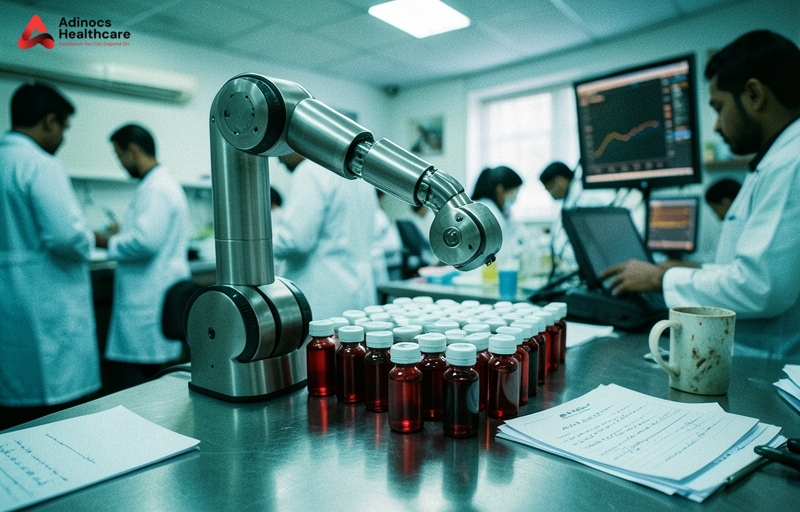
When we talk about benefits of lab robotics India, we are not talking about humanoid robots walking around the lab. We are talking about mechanical arms, automated conveyor tracks, and smart liquid handlers. These systems streamline pathology lab efficiency automation by standardizing every step of the testing process. A robotic arm does not get tired at 2 AM. It never misreads a barcode. Not once. It does not drop sample tubes.
Here is the catch. Most lab owners assume that automation is only for massive diagnostic chains processing 10,000 samples a day. That is a misconception. Modular robotics can be integrated into medium-sized labs processing as few as 500 samples daily. By automating the pre-analytical phase, you free up your senior, highly paid technicians to focus on what they do best: validating results and running complex molecular assays. Here is how the workflow changes:
- Manual Workflow: Sample arrives - manual sorting - manual centrifugation - manual cap removal - manual pipetting - manual loading into analyzer. (Time taken: 45 minutes, multiple touchpoints, high error risk).
- Automated Workflow: Sample arrives - robotic sorter scans and registers barcode - automatic conveyor transports to centrifuge - robotic decapper opens tube - analyzer runs test. (Time taken: 12 minutes, zero touchpoints, near-zero error risk).
What this means in practice: you get faster turnaround times (TAT) and a dramatic reduction in operational stress. Your staff is happier because they are not doing mind-numbing, repetitive physical labor all day.
What Specific Tasks Can Robotics in Indian Pathology Labs Automate?
A regional diagnostic centre in Asansol handling 1,200 samples daily faced a major crisis last year. Two senior technicians resigned in the same week. The remaining staff worked double shifts. Exhaustion set in. Consequently, mislabelled samples and transcription errors spiked by 14%. Had they automated their pre-analytical steps, those resignations would not have paralyzed their operations. This brings us to a critical question: what exactly can you automate today?
In our work with labs across India, we have identified four key areas where robotics makes the biggest impact. These are the areas where reducing errors in pathology labs India with robotics is most effective:
- Sample Sorting and Registration: When samples arrive from collection centres, they must be sorted by department (biochemistry, hematology, immunology). A robotic sorter can read barcodes, verify sample volume, and sort up to 1,000 tubes per hour into department-specific racks.
- Centrifugation and Decapping: This is a high-risk manual step. Opening tubes manually exposes technicians to hazardous aerosols. Robotic decapping modules safely remove and dispose of tube caps at high speed, protecting your staff from biohazards.
- Liquid Handling and Aliquoting: Often, a single blood tube must be split into multiple aliquots for different tests. Manual pipetting is slow and prone to volume errors. Robotic liquid handlers can aliquot samples with microliter precision, saving precious reagents.
- Archiving and Retrieval: Finding a sample from three days ago for a repeat test is a nightmare in a manual lab. Robotic storage systems catalog every tube's exact shelf location. When you need it, the robotic arm retrieves it in seconds.
By automating these physical tasks, you also lay the groundwork for advanced diagnostic technologies. To see how physical automation pairs with digital tools, check out our guide on 5 Ways Digital Pathology Boosts Indian Lab Quality.
What is the ROI of Implementing Robotics in Indian Pathology Labs?
A diagnostic chain owner in Kolkata looked at a Rs. 45 lakh quote for a robotic sorter. He almost threw it in the dustbin. "How can I justify this when manual labor is so cheap in Bengal?" he asked us. We sat down and did some basic math. He was losing Rs. 1.2 lakh every month just on reagent waste, expired calibrators, and repeat tests caused by manual pipetting errors. That is Rs. 14.4 lakh a year. Pure waste.
The trade-off is clear. While manual labor in India is relatively inexpensive, the cost of human error is incredibly high. A single misdiagnosed patient can destroy your lab's reputation. What is more, wasted reagents and repeated tests directly eat into your margins. When you calculate lab automation ROI India, you must look beyond staff salaries.
Let us look at a realistic financial comparison for a mid-sized Indian laboratory processing 800 samples per day:
| Operational Metric | Manual Workflow | Modular Robotic Automation | Total Lab Automation (TLA) |
|---|---|---|---|
| Initial Capital Investment | Rs. 0 | Rs. 15 Lakh - Rs. 35 Lakh | Rs. 1.5 Crore+ |
| Pre-Analytical Error Rate | Approx. 1.8% to 3.2% | Less than 0.1% | Virtual zero |
| Reagent Waste per Month | Rs. 45,000 | Rs. 8,000 | Rs. 2,000 |
| Average Turnaround Time (TAT) | 4 to 6 Hours | 2 Hours | Under 1.5 Hours |
| Payback Period | N/A | 18 - 24 Months | 48 - 60 Months |
Plot twist: Total Lab Automation (TLA) tracks are rarely viable for independent Indian labs. They require massive physical space and huge upfront capital. For most Indian facilities, modular automation is the sweet spot. It offers 80% of the benefits of TLA at 20% of the cost. If you manage multiple collection centres, this ROI becomes even more dramatic. To understand how to manage this scale, read about How to Sync Data Across Multiple Lab Branches in India?.
How to Choose the Right Robotics in Indian Pathology Labs
A lab owner in Bhubaneswar bought a massive track-based automated system in 2025. He was thrilled. Six months later, the system sat idle, covered in plastic sheets. Why? He did not have the physical floor space to operate it comfortably, and his local technicians could not troubleshoot the software when it glitched. He had to wait four days for an engineer to travel from Mumbai just to reset a jammed sensor. Do not make this mistake.
When selecting robotic equipment for your facility, you must evaluate three critical factors:
- Physical Space Constraints: Many Indian laboratories operate in converted commercial spaces or older hospital wings. Measure your door frames, ceiling heights, and floor load capacity before signing a purchase order. Modular, tabletop robotic units are often much better suited for these environments.
- LIMS Compatibility: Your robotics are only as good as the software directing them. If your Laboratory Information Management System (LIMS) cannot talk to the robotic sorter, you will end up manually entering data anyway. You need a modern, NABL-compliant LIMS like Adibix from Adinocs Healthcare that directly communicates with robotic hardware via HL7 protocols, automatically updating patient records and pushing test orders without manual data entry, while fully supporting ABDM/ABHA protocols.
- Local Service and Support: This is the most overlooked factor in Indian healthcare procurement. If a machine breaks down in Patna, Ranchi, or Guwahati, how long will it take to get a service engineer on-site? A 2025 CDSCO report indicated that 35% of imported lab automation systems experience software integration delays due to non-localized LIMS. At Adinocs Healthcare, we maintain our operational base in Kolkata with dedicated on-ground support teams across Eastern India. We do not make you wait for support from Western or Southern India.
Worth noting: under the Central Drugs Standard Control Organisation (CDSCO) medical device rules, automated laboratory equipment must comply with specific safety standards. Ensure your vendor provides all necessary regulatory certifications before installation.
Key Takeaways
- Address the real bottleneck: Up to 60% of lab errors in India are pre-analytical. Focus your robotic investments on sample sorting, decapping, and aliquoting rather than just buying faster analyzers.
- Modular is better than total automation: For most Indian labs processing 500 to 2,000 samples daily, modular tabletop robotics offer the fastest ROI (typically 18 to 24 months) and require minimal space.
- Protect your margins: Robotic pipetting and sorting can reduce reagent waste by up to 15% and virtually eliminate expensive repeat tests caused by manual errors.
- Prioritize local support: Never buy automated equipment without verifying that the manufacturer has trained service engineers based in your state or region. Down-time is a margin killer.
Frequently Asked Questions
Which lab robotics are best for small labs in India?
Modular tabletop robotics are highly beneficial for medium-sized and small labs processing over 500 samples per day. While massive total lab automation tracks are meant for large chains, small tabletop sorters and decappers are affordable and fit into tight spaces, making them highly practical for independent regional labs.
How much does pathology lab automation cost in India?
Basic modular automation, such as an automated tube decapper or a small tabletop sorter, starts around Rs. 10 Lakh to Rs. 15 Lakh. This is a fraction of the cost of Total Lab Automation systems, which easily exceed Rs. 1.5 Crore. The payback period for modular systems is typically under two years.
Do Indian labs need specialized engineers to run robotic systems?
No, you do not need specialized engineers. Modern lab robotics are designed with user-friendly interfaces that your existing medical laboratory technicians can master with 2 to 3 days of training. The key is choosing a vendor that provides comprehensive operator training and ongoing local support.
How does lab automation help with NABL accreditation in India?
Yes, absolutely. NABL audits heavily penalize labs for pre-analytical errors, transcription mistakes, and cross-contamination. By automating sample sorting, aliquoting, and tracking, you remove human error from these high-risk steps, making it much easier to maintain strict compliance during surveillance audits.
Are you ready to eliminate the morning chaos in your laboratory? At Adinocs Healthcare, we do not just sell equipment; we partner with you to transform your operations. From NABL-compliant Adibix LIMS software to end-to-end laboratory equipment installation, operator training, and reliable local AMC support in Eastern India, we help you scale without huge upfront costs. Book a free demo of Adibix LIMS and get a free operational audit of your facility today.
Data sources: National Accreditation Board for Testing and Calibration Laboratories (NABL) guidelines, Central Drugs Standard Control Organisation (CDSCO) Medical Device Rules, and internal operational data from Adinocs Healthcare partner laboratories (2025-2026).