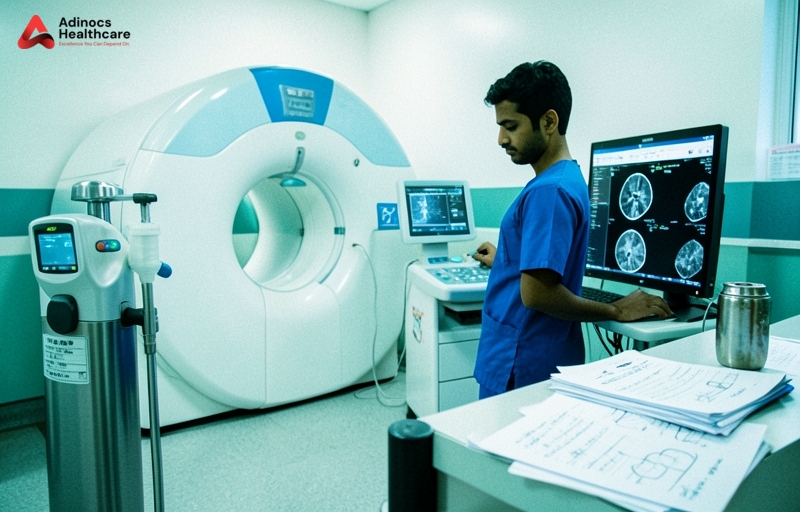
Why are Indian diagnostic centres paying 40% more for contrast consumables than they did three years ago? If you run a CT or MRI centre in Tier-2 or Tier-3 India, you are likely losing Rs. 40,000 to Rs. 80,000 every single month on consumables. You just might not see it on a single invoice. Many diagnostic lab owners buy high-end power injectors expecting uninterrupted 24/7 scanning schedules, only to get trapped in proprietary supply chains. The overall contrast injector cost India diagnostic centres pay depends heavily on whether the machine forces you into proprietary syringes and branded media or allows open sourcing.
Short answer: Closed-system contrast injectors typically increase recurring operating expenses by 25% to 45% in Indian diagnostic centres. This happens because of mandatory proprietary consumables and locked contrast media cartridges. Open-system contrast injectors allow you to purchase generic contrast media and universal syringes, which reduces per-scan consumable spending without compromising image quality. Not anymore will you be tied to a single vendor.
How does contrast injector cost India vary between open and closed systems?
Picture two diagnostic imaging centres sitting side by side in Durgapur. Both run 128-slice CT scanners. Both execute 25 contrast-enhanced scans daily. Centre A uses a closed-system contrast injector. Centre B operates an open-system injector. Centre A must purchase pre-filled contrast cartridges and proprietary tubing sets fitted with RFID microchips directly from their equipment manufacturer. If they try using a standard, locally registered contrast vial? The machine refuses to spin up. Centre B, however, buys universal high-pressure syringes and sources non-ionic contrast media from any CDSCO-approved Indian manufacturer at competitive market rates. Every time.
That mechanical lock-in is the core distinction. Closed systems bind your facility to a single supply chain. Open-system contrast injectors accept standardized multi-dose contrast media bottles and high-pressure syringes across multiple reputable brands. What this means: an open setup returns purchasing power back to your procurement desk. Is the convenience of a pre-filled cartridge worth a 40% margin hit? Probably not.
| Feature / Metric | Closed-System Injector | Open-System Injector |
|---|---|---|
| Contrast Media Compatibility | Locked to OEM proprietary cartridges | Compatible with any CDSCO-approved media |
| Syringe & Tubing Sourcing | Proprietary RFID / barbed connectors | Universal high-pressure syringes |
| Average Consumable Cost Per Scan | Rs. 1,400 - Rs. 2,200 | Rs. 750 - Rs. 1,100 |
| Media Wastage per 100ml Vial | 15% - 25% (unusable residual volume) | 5% - 8% (flexible pooling options) |
| Supply Chain Resilience | High risk (single-vendor stockouts) | Low risk (multiple vendor choices) |
| Software Lockouts | Mandatory RFID verification | None (Manual override available) |
When supply chains stall in regional distribution hubs like Guwahati or Patna, closed systems leave your radiology department vulnerable. If your sole authorized contrast supplier delays shipment by three days, your CT suite stops generating revenue entirely. Open systems protect your facility against localized stockouts. They give you immediate access to multiple local pharmaceutical distributors. Worth knowing.
How do proprietary contrast media costs impact radiology margins?
A 2025 Indian Radiology Association report found that 65% of private labs in Tier-2 cities are operating on margins thinner than 15% due to rising overheads. Margin pressure in Indian diagnostic imaging is tightening fast in 2026. Central government health schemes, private insurance price caps, and aggressive local competition have capped what you can charge patients for a contrast-enhanced CT or MRI scan. Since scan fees remain fixed, your operational profit depends entirely on controlling input costs. This is where proprietary contrast media structures silently erode your bottom line.
Here is a non-obvious reality about Indian clinical workflows: pre-filled proprietary cartridges marketed by closed-system vendors claim to eliminate handling errors. But in real-world clinical practice across Indian scanning suites, they often create massive hidden waste. When a patient requires only 60ml of contrast for an abdominal study, the remaining 40ml in a pre-filled 100ml closed cartridge must be discarded under standard infection control protocols. You cannot store or transfer that residual fluid easily without specialized multi-patient valves. You paid full proprietary price for 100ml, but billed for only 60ml. That unbilled 40ml is pure margin leakage. The trade-off: convenience for cash.
When facilities combine this waste with high unit prices, financial friction builds rapidly. Unchecked consumable inflation frequently drives facilities to search for operational leaks, leading administrators to examine why does radiology revenue leakage happen in India across both clinical consumables and billing workflows.
What are the hidden costs of closed-system injectors in India?
A 120-bed multi-specialty hospital in Siliguri experienced a significant financial drag after purchasing a discounted closed-system dual-head CT injector in early 2025. Over twelve months of performing 30 contrast scans per day, their recurring disposable expenses reached Rs. 18.2 lakh. After evaluating their balance sheet, they switched to an open-system injector compatible with multi-dose contrast vials. Their annual consumable expense plummeted to Rs. 9.4 lakh. They saved Rs. 8.8 lakh in a single year without altering patient throughput or diagnostic accuracy. Every single rupee went back into their expansion fund.
When evaluating initial purchase orders, hospital finance committees often focus strictly on capital expenditure (CapEx). A vendor offers a closed-system dual-head injector at a 20% discount on capital cost. It looks like an easy win. Six months later, the operational reality sinks in. The true financial weight of a closed system hides in its annual operating expenditure (OpEx). Consider these three major expense traps inherent to closed-system injectors in Indian healthcare settings:
- RFID and Microchip Lockouts: Modern closed injectors use reader chips embedded in syringe barrels. If you attempt to reload or use third-party tubing, the injector software blocks execution. You are forced to buy OEM-branded disposables at inflated prices.
- Mandatory Annual Maintenance Contracts (AMC): Vendor agreements for closed systems frequently mandate using OEM contrast media to keep equipment warranties valid. Voiding your warranty by using generic media exposes you to expensive proprietary replacement parts later.
- Forced Expiry Discards: Closed pre-filled media packs have rigid shelf-life timelines enforced by system software. If a cartridge sits past its programmed date, the injector rejects it automatically. This happens even if the clinical seal remains intact and stable.
Uncontrolled consumable overhead directly compromises your capacity to handle routine patient scheduling delays. In fact, high baseline expenses amplify the damage when patient attendance fluctuates, as explored in our detailed guide on how much revenue do radiology no-shows cost India.
Calculating the ROI: What is the total contrast injector cost India for open systems?
A mid-sized diagnostic chain in Pune recently calculated that their switch to open-system injectors paid for itself in exactly 112 days. Calculating the true financial return on investment for an open-system contrast injector deployment requires looking past the initial machine sticker price. You must conduct a lifecycle cost analysis spanning 36 to 60 months. To determine your true total contrast injector cost India calculation, follow this systematic four-step evaluation model:
- Calculate Baseline Monthly Scan Volume: Audit your radiology register to record your average monthly contrast CT and MRI scan count. A typical mid-sized Indian facility averages around 600 contrast procedures monthly.
- Determine Per-Scan Consumable Variance: Multiply your monthly scan volume by the consumable cost per procedure. For closed systems, assume Rs. 1,600 per patient (syringe + specialized tubing + proprietary media). For open systems, assume Rs. 850 per patient (universal syringe + bulk contrast media). The delta is Rs. 750 saved per scan.
- Multiply Annual Consumable Savings: For 600 monthly scans, a Rs. 750 per-scan saving yields Rs. 4,500,000 annually (Rs. 4.5 lakh per month x 12 months = Rs. 54 lakh total savings over 12 months).
- Factor in Capital Expenditure Amortization: Subtract the upfront machine cost difference. Even if an open-system injector costs Rs. 2 lakh to Rs. 3 lakh more on initial purchase, the recurring consumable savings recoup that upfront gap within the first four months of routine operation.
By executing this calculation, diagnostic centres effectively reduce contrast media wastage India targets while stabilizing their operational cash flow. Streamlining your clinical throughput goes hand in hand with fast reporting turnaround times. What this means: it is valuable to establish the best critical radiology TAT protocols in India 2026 to maximize overall scan suite efficiency.
What are the NABL and AERB implications of switching contrast brands?
During a 2026 NABL audit in Ranchi, a lead auditor questioned a facility about their switch from a branded contrast media to a generic alternative. The facility manager was prepared. They presented a valid Certificate of Analysis (CoA) and batch-tracking logs. The audit passed without a single non-conformance (NC) report. A common fear among hospital administrators in Tier-1 and Tier-2 cities like Ranchi or Bhubaneswar is regulatory compliance. Will switching from an OEM proprietary contrast media to an open generic brand trigger penalties? The short answer: No, provided you comply with established regulatory frameworks.
In India, contrast media are regulated as drugs under the Central Drugs Standard Control Organization (CDSCO) Medical Devices and Pharmaceuticals rules. As long as the generic contrast media brand you source holds active CDSCO approval, it meets all legal standards for clinical administration. Your radiologists do not violate drug compliance regulations simply by decoupling the injector hardware brand from the contrast fluid manufacturer. Here's the catch: you must keep your documentation tight.
From an equipment safety perspective, the Atomic Energy Regulatory Board (AERB) focuses strictly on radiation safety, shielding, and quality assurance (QA) testing of the CT scanner unit itself. AERB guidelines do not mandate specific contrast media brands or injector consumable lock-ins. Meanwhile, National Accreditation Board for Testing and Calibration Laboratories (NABL) standards under ISO 15189 focus on process control, standard operating procedures (SOPs), batch tracing, and reaction logging. To maintain flawless accreditation during a switch, your clinical team must maintain two simple protocols:
- Maintain a dedicated logbook or digital LIMS entry recording contrast batch numbers, manufacturer details, and expiry dates against every patient registration ID.
- Ensure your biomedical engineering staff perform routine pressure calibration tests on open-system injectors every six months to verify flow rate accuracy.
Key Takeaways
- Closed systems lock you in: Closed-system contrast injectors force reliance on proprietary consumables, inflating per-scan costs by up to 45%.
- Open systems unlock purchasing freedom: Open-system contrast injectors accept universal high-pressure syringes and CDSCO-approved generic contrast media, driving down recurring costs.
- Hidden waste is real: Rigid closed cartridges lead to unbilled contrast volume disposal, directly damaging per-procedure profit margins.
- ROI is rapid: Higher initial investment in open hardware is typically recovered within 3 to 6 months through lower consumable expenses.
- Regulatory compliance is straightforward: NABL, AERB, and CDSCO rules permit brand switching provided batch logging and standard quality checks are maintained.
Frequently Asked Questions
How much does a CT contrast injector cost in India 2026?
The capital cost for a dual-head CT contrast injector in India ranges from Rs. 8 lakh to Rs. 15 lakh depending on the brand and system type. However, the total cost of ownership is dominated by consumables, which can range from Rs. 750 to Rs. 2,200 per scan. Open systems generally have a higher upfront cost but significantly lower long-term operating expenses.
Is it safe to use generic syringes in CT injectors?
Yes, it is safe to use generic syringes in CT injectors as long as they are CE-marked or CDSCO-approved and rated for the specific pressure (PSI) requirements of your injector. Open-system injectors are designed to accommodate these universal syringes, which use standard Luer-lock connectors to prevent leaks or air embolisms during high-pressure injections.
Does using non-OEM contrast void GE or Siemens CT warranty?
No, using non-OEM contrast media does not void your GE, Siemens, Philips, or Canon CT scanner warranty. The scanner warranty covers the gantry, X-ray tube, and detectors. The contrast injector is a separate ancillary device. Legally, equipment manufacturers cannot mandate the use of specific pharmaceutical brands to maintain hardware warranties on the scanner itself.
What is the annual saving on contrast media in a 50-bed Indian hospital?
A 50-bed hospital performing 15 contrast CT scans per day can save approximately Rs. 4.5 lakh to Rs. 6 lakh annually by switching from a closed-system to an open-system injector. These savings are achieved by sourcing generic contrast media at bulk rates and using universal syringes instead of proprietary RFID-locked disposables.
Managing clinical consumables and diagnostic equipment costs is only half the battle in running a profitable imaging facility. Delivering fast, accurate reporting to referrers is what keeps patient volume growing. At Adinocs Healthcare, we support hospital leaders and diagnostic centre owners across Eastern India and Tier-2/3 cities with sub-specialist teleradiology coverage. We provide guaranteed 2-hour report turnarounds and flexible pay-per-report structures that align with your scan volume. Talk to our teleradiology team today to get a free operational audit and discover how our clinical reporting network can boost your department's efficiency.
Data sources: Central Drugs Standard Control Organization (CDSCO) guidelines 2025, National Accreditation Board for Testing and Calibration Laboratories (NABL) ISO 15189 standards, Atomic Energy Regulatory Board (AERB) medical diagnostic equipment safety circulars, internal Indian diagnostic industry cost benchmarks (2025-2026).