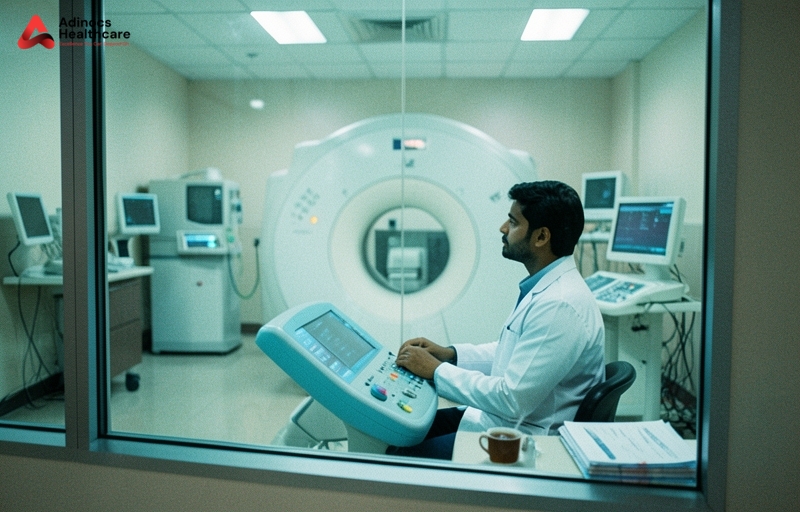
Did you know that an idle 1.5T MRI scanner sitting silent for just two slots a day wipes out up to Rs. 28 lakh in gross margin every year for an Indian diagnostic centre? Machine EMIs do not pause when a patient fails to show up. Neither do technician salaries or power bills. When a patient skips an appointment, that operational capacity is lost forever.
The short answer: Radiology no-shows cost Indian diagnostic centres between 12% and 22% of their daily scanning capacity, causing annual losses exceeding Rs. 35 lakh per high-end scanner. Executing targeted radiology slot optimization India protocols can recover up to Rs. 1.8 lakh per scanner every month while reducing machine turnaround times.
If you run a hospital or a private scan centre in India, unutilized diagnostic time is one of your silent financial leaks. Addressing it requires understanding root causes, calculating true idle costs, and enforcing smart workflow controls. If you are already tracking leakage across your billing workflow, you might also want to read our guide on Why Does Radiology Revenue Leakage Happen in India? to stop systemic income loss.
Why do radiology no-shows happen in Indian diagnostic centers?
A pathology lab and imaging facility in Siliguri recently noticed a frustrating trend. Every Tuesday, nearly 25% of contrast-enhanced CT (CECT) scans were cancelled right at the reception counter. The issue was not patient indifference. Patients had traveled hours from surrounding rural belts without fasting or without their serum creatinine reports. The front desk had to turn them away. That slot was ruined. The scanner sat cold for 45 minutes.
Across Indian hospitals and diagnostic networks, radiology cancellations rarely stem from pure patient neglect. They happen because of breakdown in pre-procedure preparation, financial friction, and geographic barriers. Here are the primary drivers behind empty scan rooms across Tier 1, Tier 2, and Tier 3 facilities:
- Incomplete pre-test preparation: Scans requiring special protocol - such as fasting for abdominal ultrasounds, bowel preparation for MRI pelvis, or blood work for contrast studies - frequently fail because instructions were delivered verbally or lost in transit.
- Long wait times and referral decay: Patients often seek second opinions or shop around for lower pricing between their doctor's referral and the actual scan date. If your turnaround time for scheduling is slow, they go elsewhere. Every single time.
- Financial anxiety at counter: Unexpected out-of-pocket costs caught at the billing desk cause immediate walkouts, especially for self-paying patients without health insurance coverage.
- Compliance paperwork hurdles: Stringent documentation requirements under regulatory frameworks often stall appointments at registration. You can learn more about managing these regulatory hurdles in our detailed overview on How to Avoid PC-PNDT Compliance Fines in India? to keep your diagnostic workflow compliant.
- Travel delays in regional hubs: In regional centers serving hinterlands (like Patna, Cuttack, or Guwahati), traffic bottlenecks or train delays prevent patients from reaching urban diagnostic hubs on schedule.
According to survey data from the NITI Aayog 2024 healthcare operational reports, outpatient diagnostic attendance in non-metro regions fluctuates by up to 18% depending on season and commuting infrastructure. When you do not actively track appointment cancellation cost India metrics, these empty slots quietly erode your profit margin.
How to calculate the hourly cost of an empty MRI or CT slot?
Costs are climbing. Margins are shrinking too. A diagnostic centre owner in Pune told us last month that his equipment maintenance contract costs jumped 14% this year. Every minute a machine stays inactive, fixed expenses continue to accrue. To fix your scanner productivity, you must first calculate the precise financial impact of lost time.
Calculating the true cost of an empty slot requires looking at two factors: fixed machine overhead per hour plus lost gross margin per scan. Let's break down the math for a standard Indian facility operating a 1.5T MRI and a 64-Slice CT scanner over a 12-hour workday.
| Modality Type | Average Slot Time | Avg Fee Per Scan (Rs.) | Hourly Fixed Cost (Rs.) | Est. Monthly Loss (15% No-Show Rate) |
|---|---|---|---|---|
| 1.5T MRI | 30 Mins | Rs. 7,000 | Rs. 3,800 | Rs. 3,15,000 |
| 64-Slice CT | 15 Mins | Rs. 4,500 | Rs. 2,900 | Rs. 2,70,000 |
| High-End Ultrasound | 15 Mins | Rs. 1,800 | Rs. 850 | Rs. 1,08,000 |
| Digital X-Ray | 10 Mins | Rs. 600 | Rs. 320 | Rs. 43,000 |
Here is the formula you can use for your own facility:
Hourly Loss = [(Monthly Equipment EMI + Monthly Maintenance AMC + Monthly Staff Salaries + Electricity Cost) / Monthly Operating Hours] + (Scans Lost per Hour x Average Margin per Scan)
What this means in practice: A single cancelled MRI slot during peak afternoon hours does not just cost you the Rs. 7,000 patient fee. It pushes up the average operational cost for every other patient scanned that day. (And yes, this is the exact operational drain your competitor down the road is struggling with right now).
What are the best strategies for radiology slot optimization India?
You cannot eliminate patient emergencies. But you can eliminate operational friction. Improving diagnostic center slot utilization requires a combination of clear communication, protocol updates, and smart scheduling tactics.
Consider how a 50-bed multi-specialty hospital in Durgapur turned around its imaging division. Facing an average 19% cancellation rate for MRI and CT appointments, the facility executed a structured three-step intervention. Within 90 days, their no-show rate dropped to under 6%, adding nearly Rs. 2.4 lakh in incremental monthly revenue.
- Establish a 24-hour rapid fill waitlist: Maintain a live register of walk-in or non-urgent routine patients (such as routine spine or joint screenings) who agree to come in on short notice if a premium contrast slot opens up.
- Implement pre-procedure preparation checklists: Send dynamic pre-scan instructions standardizing fasting hours, drug pauses, and creatinine report requirements via SMS or messaging apps 24 hours ahead of time.
- Deploy strategic overbooking for routine scans: Overbook simple non-contrast procedures (like chest X-rays or routine ultrasounds) by 10% to 15% during historic peak no-show windows, such as Monday mornings or rainy afternoons.
- Accelerate report turnaround times: Patients stay loyal when results are fast. Sub-specialty teleradiology support helps clear reporting backlogs quickly, keeping referring doctors and patients satisfied. Discover how adding specialist coverage helps grow volumes in our article on Can a Second-Opinion Service Boost Radiology Revenue?.
The trade-off: Overbooking without careful scheduling can create reception congestion. The key is applying overbooking strictly to low-complexity, short-duration examinations while reserving dedicated, high-touch slots for complex MRI protocols.
How can radiology slot optimization India improve in 2026?
Manual phone reminders handled by front-desk staff are failing in 2026. Receptionists are multi-tasking, phone calls go unanswered, and patients forget verbal instructions. Automated, multi-channel reminder systems have shifted from a luxury to an operational necessity for modern Indian diagnostic centers.
According to 2025-2026 implementation updates from the National Health Authority (NHA), digital workflow integrations aligned with Ayushman Bharat Digital Mission (ABDM) standards have boosted appointment compliance rates across empanelled diagnostic facilities by over 28%.
How do modern automated systems optimize your schedule? Here is how automated radiology capacity management software and RIS systems drive compliance:
- Interactive WhatsApp confirmation flows: Instead of simple SMS alerts, automated workflows send interactive WhatsApp messages asking patients to tap "Confirm", "Reschedule", or "Cancel". A cancellation triggers an immediate alert to your scheduling desk to fill the slot.
- Regional language voice notes: Automated IVR calls delivered in local languages (such as Bengali in West Bengal or Hindi in Bihar) ensure that non-English speaking patients fully understand prep protocols like fasting or fluid intake.
- Automated ABHA linking: Integrating Ayushman Bharat Health Account (ABHA) IDs allows instant verification of patient history and diagnostic records, reducing counter registration delays from 15 minutes down to 2 minutes.
- Direct digital prep guides: Delivering short 30-second video links explaining what to expect during an MRI alleviates claustrophobia and anxiety, which are major hidden causes of sudden walkouts.
Here's the catch: Automated reminders do more than lower no-shows. They free up your front-desk receptionists to focus on patient care and cash collection rather than spending three hours a day making routine confirmation calls.
Should Indian centers implement a booking deposit system?
Should you charge a deposit before holding a high-value scan slot? This remains a debated question among Indian hospital administrators and diagnostic centre owners.
The argument for booking deposits is clear: Financial commitment drives attendance. When a patient pays Rs. 500 or Rs. 1,000 upfront via UPI to lock in a 1.5T MRI slot, the likelihood of a no-show plummets below 3%. However, applying strict financial penalties in the Indian market comes with distinct trade-offs depending on your location and competitive density.
| Factor | Tier 1 Metro Facilities | Tier 2 / Tier 3 Regional Hubs |
|---|---|---|
| Patient Acceptance Rate | High (UPI and digital payments widely used) | Moderate to Low (Cash preference remains strong) |
| Competitive Risk | Low (Patients prioritize convenience/brand) | High (Patients may switch to a cash-on-arrival competitor) |
| Recommended Token Amount | Rs. 500 - Rs. 1,000 non-refundable deposit | Rs. 200 - Rs. 300 fully refundable booking token |
| Operational Feasibility | Seamless via web/WhatsApp payment gateway links | Requires flexible refund/rescheduling policies |
Worth noting: A rigid refund policy can backfire. A non-obvious insight from our work across Indian diagnostic chains shows that strict financial penalties often drive angry patients straight to competitors. A flexible policy - where booking tokens are instantly transferable to any rescheduled date within 30 days - preserves revenue while maintaining patient trust.
Action Plan for Radiology Slot Optimization India
- Audit your current baseline: Track no-show and late-cancellation rates by modality for 30 days to identify high-risk time slots and protocols.
- Automate pre-scan preparation alerts: Shift from manual phone calls to automated WhatsApp/SMS notifications that include clear fasting and prep guidelines in regional languages.
- Establish a digital waitlist: Build a rapid-response contact list of routine walk-in patients who can fill last-minute cancelled slots on short notice.
- Adopt flexible token deposits: Introduce small, refundable UPI booking deposits (Rs. 200 to Rs. 500) for high-demand MRI and CT slots to lock in patient commitment.
- Optimize reporting turnaround times: Partner with sub-specialty teleradiology providers to prevent delayed reporting backlogs from disrupting your appointment workflow.
Frequently Asked Questions
What is an acceptable radiology no-show rate in India?
An acceptable radiology no-show rate for Indian diagnostic centers is between 5% and 8%. Facilities operating with no-show rates above 12% experience significant margin loss due to unrecovered equipment fixed costs and idle technical staff.
How does radiology slot optimization India directly affect overall centre profit?
Radiology slot optimization India increases profit by recovering fixed capital expenditure costs without increasing variable overhead. Filling just two empty MRI slots per day can generate up to Rs. 3.5 lakh in incremental gross profit per month for a mid-sized facility.
Can teleradiology help recover revenue lost to cancelled slots?
Yes, teleradiology helps offset the financial impact of cancelled slots by enabling flexible reporting schedules and offering rapid sub-specialty reads. Faster turnaround times reduce referral decay and keep diagnostic slots consistently filled.
What is the monthly cost of radiology appointment cancellations for small Indian scan centers?
The radiology appointment cancellation cost in India ranges between Rs. 1.5 lakh and Rs. 3.5 lakh per month per high-end machine. Small diagnostic centers are particularly vulnerable because fixed equipment EMIs and lease payments represent a larger share of their monthly revenue.
Unfilled scanner slots are an operational issue you can fix. By combining clear patient communication, automated multi-channel prep instructions, and smart scheduling practices, Indian diagnostic facilities can reclaim lost capacity and build a resilient operating model.
At Adinocs Healthcare, we help Indian hospitals and diagnostic centers maximize radiology performance with sub-specialist teleradiology reporting, 2-hour TAT guarantees, and pay-per-report flexibility - requiring zero upfront investment. Want to optimize your radiology workflow and eliminate reporting bottlenecks? Talk to our teleradiology team today to get started.
Data sources: NITI Aayog Healthcare Infrastructure Reports, National Health Authority (NHA) ABDM Operational Updates, and internal operational benchmarks across Indian diagnostic facilities.