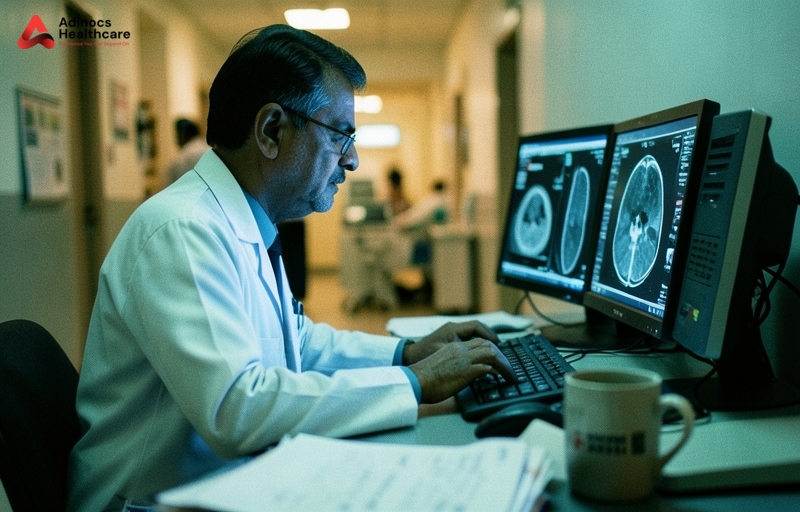
The short answer: Radiology revenue leakage in India occurs when diagnostic scans are performed but never billed, miscoded, or delayed due to disconnected software systems. Integrating your HIS and PACS while automating workflow reconciliation can recover 8% to 15% of annual diagnostic revenue without adding a single extra patient.
Did you know that private hospitals and imaging centres across India lose anywhere between 8% and 15% of their top-line radiology income without realizing it? It happens silently every day. Scans get performed, contrast media is injected, emergency CTs are interpreted, but the final invoice never reflects the actual work done. This systemic financial drain, known as radiology revenue leakage India, eats directly into your operating margins. If your facility runs 50 CT scans and 30 MRIs daily, you could be losing Rs. 3 lakh to Rs. 5 lakh every month. Money just vanishing. What causes this drop? More importantly, how do you stop it?
Why is radiology revenue leakage India so widespread in private hospitals?
A 120-bed multi-specialty hospital in Siliguri recently conducted an internal clinical audit. Management discovered that over a six-month period, 142 emergency CT scans performed during night shifts had no matching billing entry in the hospital management system. The scans were real. Contrast material was consumed. The radiologist interpreted the images. Yet, the hospital billed Rs. 0. Not a single rupee was collected. Zero.
According to research published by NITI Aayog (2021) on private healthcare operational efficiencies, operational disconnects between clinical workflows and administrative billing remain a leading source of revenue loss in Indian healthcare institutions. In India, radiology departments operate under extreme pressure. High patient volume, urgent emergency requests, and fragmented software tools create chaos. Front-desk staff enter patient data manually. Technicians perform emergency scans on verbal orders from ICU doctors. Billing teams process claims hours or days later. When these three groups operate in silos, revenue slips through the cracks.
The core problem isn't dishonest employees. It is broken handoffs. When a technician receives a phone call from casualty at 2:00 AM for an urgent brain scan, clinical urgency overrides billing protocol. The technician performs the scan. The patient moves back to casualty or ICU. By morning shift change, the handwritten paper slip is lost under a pile of files. Every time. (And yes, this exact scenario plays out daily in facilities from Patna to Salem.)
How Radiology Revenue Leakage in India Destroys Diagnostic Margins
Most hospital directors assume revenue leakage means someone stole cash from the billing counter. That is rarely the case in 2026. The real culprit is unbilled radiology scans and unbilled consumables that never get logged into the system in the first place.
When an unbilled scan occurs, your center loses twice. First, you lose the top-line fee for the scan itself. Second, you absorb all the operational overhead costs. Electricity for the MRI super-conducting magnet, tube wear on the CT scanner, contrast dye inventory, technician salaries, and radiologist reporting fees. You pay full price for production, but receive zero revenue. Margins collapse instantly.
Consider the financial impact of unbilled contrast agents and post-processing add-ons. A non-contrast CT abdomen might be billed at Rs. 3,500. But if the doctor orders a contrast-enhanced study (CECT) with 3D vascular reconstruction, the total fee should be Rs. 7,000 plus consumable charges. If the front desk bills for a plain CT while the technician performs the CECT based on an updated clinical requisition, your center bleeds Rs. 3,500 on a single patient. Multiply that across 300 contrast studies a month. Here's the catch: that adds up to over Rs. 10.5 lakh in lost billings every single quarter.
Here is how manual billing workflows compare directly to integrated digital workflows:
| Operational Metric | Manual / Disconnected System | Integrated HIS-PACS System |
|---|---|---|
| Unbilled Scan Rate | 5% to 12% of total volume | Less than 0.5% |
| Contrast & Add-on Tracking | Manual paper logs (frequent losses) | Automated digital barcode entry |
| Reconciliation Delay | 7 to 30 days post-scan | Real-time (instantaneous) |
| Average Revenue Leakage | Rs. 2.5 lakh - Rs. 6 lakh / month | Near Zero |
Beyond direct financial losses, unbilled scans complicate equipment maintenance planning. If your CT tube logs 10,000 exposures on its counter but your billing records show only 8,500 paid procedures, your cost-per-scan calculations become completely distorted. To understand how optimized equipment usage impacts overall facility economics, read our operational guide on Can Sustainable Radiology Cut Costs for Indian Diagnostic Centers?.
What are the main causes of radiology billing errors?
To fix the drain, you must know where the pipe is broken. In Indian diagnostic facilities, billing errors stem from four distinct operational bottlenecks. Knowing how to reduce radiology billing errors India starts with identifying these specific breakages in your routine workflow:
- Mismatch between order entry and procedure performed: A clinician orders an ultrasound lower abdomen (Rs. 1,200). During the exam, the radiologist notes pathology extending higher and performs a full abdomen scan (Rs. 2,200). If the billing system is not updated immediately, the patient pays only for the lower abdomen study, causing an instant Rs. 1,000 loss.
- Third-Party Administrator (TPA) and Insurance claim rejections: Cashless insurance claims filed under government schemes like Ayushman Bharat (AB-PMJAY) or private TPAs require precise procedure codes. Guidelines published by the National Health Authority (2024) mandate strict clinical mapping for diagnostic reimbursement. In fact, NHA audits reveal that up to 18% of diagnostic TPA claims face initial rejection or payment haircuts due to tariff code mismatches. Submitting incorrect tariffs or missing mandatory pre-authorization approvals leads to total claim rejections weeks after the scan was completed.
- Unbilled emergency and night-shift STAT studies: Scans requested during off-peak hours suffer from high administrative neglect. Paper requisitions get misplaced before day-shift staff can enter them into the hospital management software.
- Failure to bill specialized post-processing: Coronary CT angiography, virtual colonoscopy, and 3D orthopedic modeling require significant radiologist time and specialized workstation processing. Yet, front-office staff frequently fail to add these specialized sub-codes to the invoice.
In addition to financial leakage, poor documentation during patient registration carries heavy regulatory risks in India. Ensure your ultrasound and imaging protocols comply fully with statutory rules by reviewing our detailed checklist on How to Avoid PC-PNDT Compliance Fines in India?.
How can HIS and PACS integration prevent revenue loss?
The most effective fix for radiology revenue leakage is eliminating manual data entry between your reception desk, imaging machines, and billing office. What this means: connecting your Hospital Information System (HIS) with your Picture Archiving and Communication System (PACS) using DICOM Modality Worklist (MWL) standards stops administrative leakage cold.
In a traditional setup, reception enters patient details into the HIS. The patient walks to the MRI room. The technician manually types the patient's name, age, and ID into the MRI console. After the scan, the radiologist views images on a standalone workstation and types a report in Microsoft Word. Nothing communicates automatically. Errors are guaranteed.
When you connect your HIS directly to PACS via DICOM MWL standards, the entire workflow changes. Here is the exact step-by-step mechanism that stops leakage:
- Mandatory Order Creation: The patient pays at the counter or receives TPA authorization. The HIS generates a unique DICOM worklist item automatically within 2 seconds.
- Modality Worklist (MWL) Push: The MRI or CT console receives the exact patient details and requested procedure directly from the central server. The technician cannot start a scan without selecting a pre-authorized order from the screen. Zero unbilled emergency overrides without automated audit logs.
- Automated Scan Capture: The moment the technologist completes image acquisition, PACS records the exact sequence count, study description, and exposure metadata.
- Instant Billing Reconciliation: If the technician performs an additional series or uses contrast, PACS flags the discrepancy against the original invoice in the HIS before the patient leaves the department.
By implementing targeted radiology RCM solutions India practices, facilities close the gap between patient care and financial accounting. What was once a source of monthly revenue loss becomes an automated, leak-proof operational chain.
Can automated reporting reduce billing discrepancies?
Yes. Automated reporting platforms and cloud teleradiology solutions serve as a final quality check for billing accuracy. When radiologists report on integrated platforms, the software matches the clinical report structure directly with billed service items.
Consider sub-specialty reporting. If a general radiologist receives a complex neuro-imaging MRI case, they may require sub-specialist consultation to deliver a precise report. Cloud-based reporting platforms automatically log the exact study protocols interpreted. If the radiologist generates a report for an advanced MRI brain with diffusion tensor imaging (DTI), the software verifies whether the DTI module was billed at reception. If not, an automated alert flags the billing department instantly.
What this means in practice: zero manual audits required at month-end. System-level checks catch discrepancies before the final bill is locked or sent to insurance payors. Worth noting: facilities that automate this check see billing accuracy rates rise to 99.5% within 30 days.
Looking to grow your diagnostic portfolio while keeping overhead costs controlled? Explore our breakdown on Can a Second-Opinion Service Boost Radiology Revenue?.
Key Takeaways
- Silent Financial Drain: Unbilled scans and billing miscodes cause 8% to 15% revenue leakage in standard Indian diagnostic centers.
- Night Shift & Emergency Scans are High Risk: Emergency CT and MRI procedures executed on verbal orders represent nearly half of all unbilled studies.
- Consumable Leakage Hits Hard: Failing to bill contrast media, thin-slice reconstructions, and 3D post-processing cuts deep into gross profit margins.
- Integration is Mandatory: Connecting your HIS and PACS via DICOM Modality Worklist (MWL) completely stops technicians from performing unauthorized, unbilled scans.
- Automated Reconciliation Wins: Replacing paper billing slips with digital software verification eliminates month-end manual auditing stress and prevents insurance claim rejections.
Frequently Asked Questions
How much radiology revenue leakage happens in small Indian imaging centres?
A typical diagnostic centre in a Tier 2 or Tier 3 Indian city running 40 to 60 major scans daily loses between Rs. 30 lakh and Rs. 60 lakh per year due to unbilled emergency studies, incorrect procedure codes, and uncollected contrast media fees.
How does HIS and PACS integration stop unbilled CT and MRI scans?
PACS integration uses DICOM Modality Worklist (MWL) technology to link imaging equipment directly to billing software. Radiographers cannot select or scan a patient on the machine console unless an active, authorized order exists in the hospital system, preventing unbilled procedures.
Can a hospital recover lost revenue from unbilled radiology scans retrospectively?
Yes. Conducting a retrospective audit comparing PACS DICOM study logs against HIS billing entries over the last 6 to 12 months typically uncovers unbilled scans, allowing management to correct workflow gaps and implement tight reconciliation controls moving forward.
How much revenue does an Indian diagnostic centre lose per year to billing errors?
On average, billing errors account for 8% to 15% of total diagnostic turnover. For a center generating Rs. 2 crore annually, that equals Rs. 16 lakh to Rs. 30 lakh in avoidable revenue loss due to miscoded tariffs and unbilled add-on series.
Stopping revenue loss does not require buying multimillion-rupee hardware. It requires closing the operational gaps between your equipment, your clinical team, and your billing counter. At Adinocs Healthcare, we help Indian hospitals and diagnostic facilities protect their earnings, streamline imaging workflows, and upgrade reporting turnaround times. Our sub-specialist teleradiology network and digital workflow systems eliminate turnaround bottlenecks with guaranteed 2-hour reporting and zero upfront capital setup costs. Ready to protect your bottom line? Talk to our teleradiology team at Adinocs Healthcare today to book a free workflow audit and plug your facility's financial leaks.
Data sources: NITI Aayog Healthcare Operational Efficiency Framework (2021), National Health Authority Guidelines for Provider Billing (2024), CDSCO Medical Device Regulations.