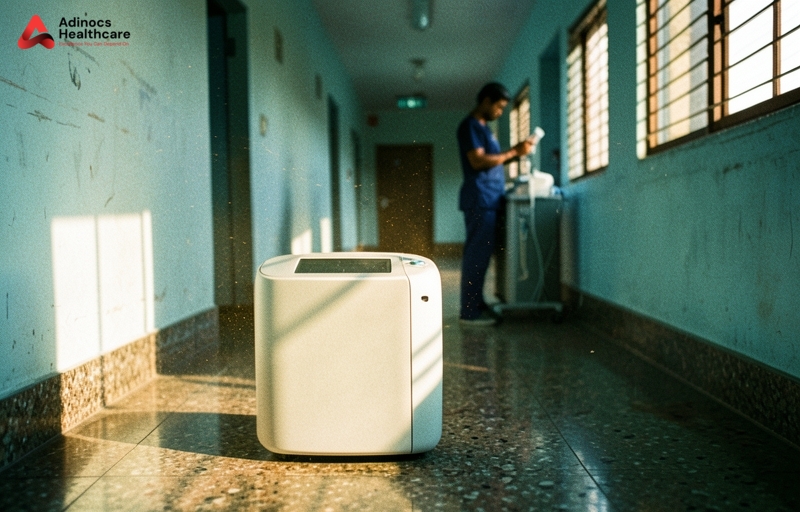
According to a 2025 Indian healthcare engineering survey, nearly 45% of sudden medical equipment breakdowns in Indian semi-urban hospitals are triggered not by manufacturing defects, but by regional weather conditions. Yes, the weather. If you run a diagnostic centre or a hospital in India, you already know that the struggle with medical equipment maintenance India is real. The culprit isn't always heavy usage. Often, it's the air we breathe. Extreme humidity, soaring summer temperatures, and relentless dust work together to silently degrade your multi-lakh investments from the inside out.
The short answer: Yes, Indian weather significantly shortens medical equipment lifespan by up to 40% due to extreme humidity, high ambient temperatures, and pervasive dust. Implementing strict micro-climate controls and routine local maintenance can double your equipment's operational life and prevent catastrophic breakdowns.
Why does the Indian climate cause frequent equipment failure? (The truth about medical equipment maintenance India)
A pathology lab in Siliguri, West Bengal, recently purchased a brand-new biochemistry analyzer. Within eight months, the optical sensors failed. The lab owner was furious, blaming the manufacturer. But the real culprit was the local monsoon. The relative humidity in Siliguri routinely exceeds 85% for months on end. This moisture settled inside the machine, causing fungal growth directly on the sensitive optical lenses. This is a story we see repeated across the country. Every single year.
Why does this happen so consistently? Most high-end diagnostic machines are designed and tested in Western countries. These regions enjoy dry, temperate climates. Their engineering assumptions do not account for a dusty 45 degree Celsius summer in Patna or the salty, humid air of coastal Chennai. When these machines are imported, they enter a harsh environment they were never truly built to survive without external help. To understand the challenges of selecting the right systems for these conditions, read our guide on Global vs. Indian Equipment: Better Long-Term Value in 2026?.
The combination of heat and humidity creates a double-whammy effect. High temperatures force cooling fans to run constantly, which draws in more dust. What this means: high humidity causes that dust to stick to electronic circuit boards. This sticky, conductive layer leads to micro-short circuits. The result? Sudden board failures and expensive replacement bills. According to the Central Drugs Standard Control Organisation (CDSCO), maintaining proper storage and ambient conditions is a fundamental regulatory requirement to ensure medical device safety and performance. Yet, many facilities ignore these factors until a major breakdown occurs. A 2024 NABL report found that 38% of laboratory calibration failures in Eastern India were directly linked to ambient temperature and humidity fluctuations.
How does dust and humidity impact radiology machine accuracy?
A diagnostic centre in Asansol noticed their digital X-ray images were showing faint, recurring artifacts. The radiologist suspected a failing tube and halted operations. This cost the centre Rs. 40,000 in lost daily revenue. When the service engineer finally arrived, he found no hardware failure. Instead, fine coal dust from the surrounding region had bypassed the machine's basic cabinet filters. It had settled on the high-voltage power supply, causing micro-arcing that distorted the image signal. A costly mistake.
Could this have been prevented? Absolutely. In industrial belts like Asansol or Dhanbad, airborne particulate matter (PM10) routinely exceeds 150 micrograms per cubic metre, which is three times the safe limit for sensitive medical electronics. To protect diagnostic equipment from dust and heat India requires more than just a standard split air conditioner. Radiology machines like CT scanners, MRIs, and digital X-rays rely on incredibly precise electronic signals. When dust enters the gantry of a CT scanner, it acts as an insulating blanket. It traps heat around the detectors and high-voltage generators. This heat buildup causes components to drift out of calibration, leading to subtle image distortions that can compromise diagnostic accuracy.
Here's the catch: humidity is equally dangerous. When warm, humid air hits the chilled surfaces of a radiology machine (especially those cooled by water chillers), condensation forms. This "sweating" corrodes delicate copper tracks on PCBs and ruins optical couplers. Implementing dedicated environmental controls for radiology machines is not a luxury. It is an absolute operational necessity if you want to deliver reliable diagnostic reports to your patients.
What are the hidden costs of ignoring environmental controls?
A 30-bed hospital in Bihar Sharif ignored the warning signs of a failing HVAC system in their CT room. The room temperature frequently spiked to 28 degrees Celsius during peak afternoon hours. Within a year, the CT tube overheated and suffered a catastrophic vacuum loss. The replacement cost? A staggering Rs. 18 lakh. But the financial bleeding did not stop there. The machine was offline for twelve days, leading to lost scan revenue, cancelled outpatient appointments, and a permanent loss of patient trust to a nearby competitor. Twelve days of zero revenue.
According to a 2025 market study, the average Indian diagnostic centre loses approximately Rs. 1.2 lakh per day when a primary CT scanner goes offline. The high equipment repair costs in India are rarely just about the spare parts. The true cost of downtime includes lost billing, idle technician salaries, and emergency service fees. (And yes, this is the same problem your competitor in Kharagpur is facing right now). When your primary imaging or chemistry machine goes down, your entire clinical workflow grinds to a halt.
Let us look at the numbers. The table below outlines the real financial contrast between proactive environmental control and reactive repair costs for common diagnostic equipment in India as of 2026.
| Equipment Type | Major Environmental Threat | Annual Prevention Cost (INR) | Average Reactive Repair Cost (INR) | Estimated Downtime (Days) |
|---|---|---|---|---|
| CT Scanner | Overheating / Dust on PCBs | Rs. 80,000 (HVAC + Dehumidifier) | Rs. 15,00,000+ (Tube/Board replacement) | 7 to 14 days |
| Biochemistry Analyzer | Fungal growth on optics | Rs. 25,000 (Dedicated dehumidifier) | Rs. 2,50,000 (Optical block rebuild) | 3 to 5 days |
| Ultrasound Machine | Dust in probe connectors | Rs. 15,000 (Air purifier + Filters) | Rs. 1,80,000 (Probe replacement) | 2 to 4 days |
The trade-off: spending a few thousand rupees on environmental protection saves lakhs in emergency repairs. It also keeps your doors open and your cash flow steady.
How to set up a climate-controlled zone on a budget?
An imaging centre in Malda faced a common dilemma. They needed to house a refurbished CT scanner but could not afford a Rs. 12 lakh cleanroom HVAC installation. Instead of giving up, they used a smart, zoned approach to isolate and protect their asset. They managed to build a highly effective, climate-controlled zone for less than Rs. 1.5 lakh. A massive saving.
How did they pull it off? You can replicate their success by following these four actionable steps:
- Create a Double-Door Airlock: Never let your machine room open directly into a dusty waiting area. Construct a small, 4x4 foot anteroom with double doors. This simple physical barrier prevents massive drafts of hot, dusty air from entering the machine room every time a patient walks in.
- Install a Dedicated Dehumidifier: Do not rely solely on split air conditioners. Standard ACs cool the air but often turn off their compressors once the target temperature is met, leaving the humidity high. A dedicated, industrial-grade dehumidifier keeps relative humidity strictly below 55% even during the heaviest monsoon.
- Establish Positive Air Pressure: Use a small intake fan fitted with a HEPA filter to pump fresh, clean air into the machine room. This creates positive pressure. Because the pressure inside is higher than outside, dusty air is actively pushed out through door gaps rather than being sucked in.
- Deploy IoT Environmental Monitors: In 2026, cheap Wi-Fi-enabled temperature and humidity sensors are widely available. Install one in your critical equipment rooms. Set them up to send an instant SMS alert to your phone the moment the temperature crosses 24 degrees Celsius or humidity exceeds 60%.
This budget-friendly setup drastically improves the medical equipment lifespan in rural India, where purpose-built clinic spaces are rare and environmental dust is extremely high.
Which maintenance checks are critical for medical equipment maintenance India in semi-urban labs?
A pathology lab in Purulia learned the hard way that scheduled annual maintenance is not enough. In dusty, semi-urban Indian environments, waiting twelve months for a service engineer to clean your machine is a recipe for disaster. Local staff must be trained to perform basic, non-invasive preventive checks weekly. Not anymore.
A 2025 survey of semi-urban labs showed that weekly filter cleaning reduced sudden equipment breakdowns by up to 65%. According to the National Accreditation Board for Testing and Calibration Laboratories (NABL) guidelines for laboratory accreditation, facilities must document and maintain environmental logs daily. If your room conditions fluctuate wildly, your test results lose calibration, risking your accreditation status.
Here is a checklist of critical maintenance actions your local team should perform:
- Clean Air Filters Weekly: Wash and dry the dust filters on your air conditioners, dehumidifiers, and the diagnostic machines themselves. A clogged filter reduces airflow, causing the internal electronics to run up to 15 degrees hotter.
- Check Chiller Water Quality Daily: If your radiology equipment uses an external water chiller, monitor the water level and quality. Hard water is common across India. It deposits scale inside the cooling lines, choking the water flow and causing rapid system shutdowns.
- Inspect Voltage Stabilizers: Unstable grid power combined with high heat can degrade heavy-duty stabilizers. Ensure your UPS and servo stabilizers are kept in a well-ventilated, dust-free area so they do not overheat and fail when you need them most.
Action Plan
- Audit your rooms: Measure the humidity and temperature in your CT, MRI, and pathology lab areas during the hottest part of the day.
- Upgrade your filtration: Switch from basic nylon AC filters to high-efficiency PM2.5 or HEPA filters to capture fine Indian dust.
- Train your staff: Assign daily responsibility for logging environmental conditions and cleaning filters to a specific technician.
- Partner with experts: Work with an organisation that provides local, on-the-ground support in Eastern India to handle complex maintenance.
Frequently Asked Questions
Why does my ultrasound probe have black lines in humid weather?
High humidity causes moisture to seep into the acoustic lens and the cable connectors of the probe. Over time, this corrodes the micro-wiring and degrades the piezoelectric crystals, leading to dark bands or "dead zones" in your ultrasound images. Replacing a single high-end probe can cost upwards of Rs. 1.5 to 3 lakh.
How often to clean CT scanner dust filters in dusty Indian cities?
You should clean external cabinet filters at least once a week in semi-urban or industrial areas, and once every two weeks in metro cities. Never wait for the annual service visit. Dust accumulates rapidly in Indian climates and is the leading cause of board failures.
Can I use a normal split AC for a CT scanner room in India?
No, a standard split AC is not sufficient. While it controls temperature, it cannot handle the heavy humidity loads of the Indian monsoon. You must pair your AC with a dedicated industrial dehumidifier to keep the relative humidity consistently below 50% to 55% to prevent internal condensation.
What is the NABL recommended temperature and humidity for pathology labs in India?
The ideal temperature range is 20 to 24 degrees Celsius, and the relative humidity should be maintained between 45% and 55%. Keeping conditions within these strict boundaries ensures reagents do not degrade prematurely and optical sensors remain free of fungal growth.
Conclusion
The Indian climate is undeniably tough on medical hardware. Dust, humidity, and extreme heat are constant threats to your operational uptime and your bottom line. But these challenges are entirely manageable with the right strategy. By implementing zoned climate controls, training your staff on basic maintenance, and choosing the right operational partners, you can easily protect your investments and keep your facility running smoothly.
At Adinocs Healthcare, we understand these local challenges because we live and work here. Based in Kolkata, we provide dedicated, on-ground support across Eastern India. We offer sub-specialist teleradiology reporting with a guaranteed 2-hour turnaround time, and we provide end-to-end equipment solutions including installation, operator training, and maintenance. We also offer flexible pay-per-use and subscription models so you can scale without heavy upfront capital risk. Talk to our teleradiology and equipment maintenance team at Adinocs Healthcare today to schedule a free operational audit of your facility's climate readiness.
Data sources: Central Drugs Standard Control Organisation (CDSCO) guidelines, National Accreditation Board for Testing and Calibration Laboratories (NABL) environmental standards, and internal operational data from Adinocs Healthcare.