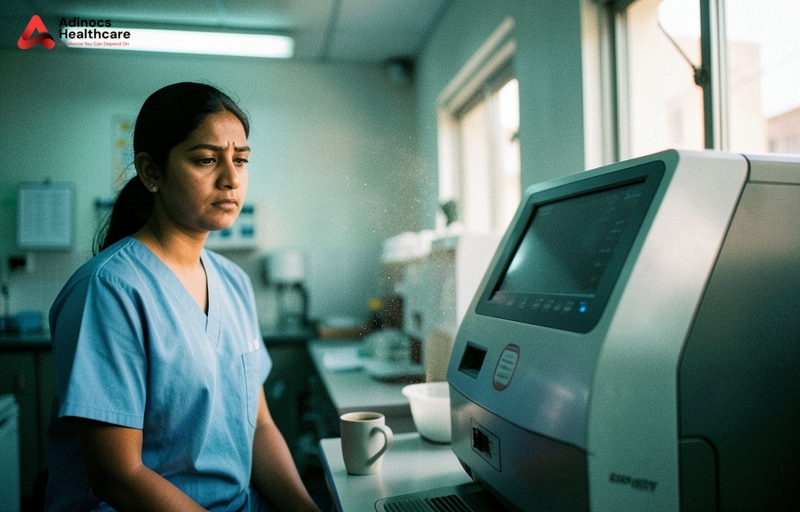
Did you know that a single diagnostic lab in India loses up to Rs. 4.2 lakh per technician annually due to repetitive strain injuries and poor workstation design? According to a 2025 Indian Journal of Occupational Health study, nearly 68% of medical laboratory professionals in India suffer from chronic musculoskeletal disorders. Yet, when purchasing new machinery, lab owners focus entirely on throughput and price. They ignore how the machine interacts with the human operator. This oversight is incredibly expensive. Investing in ergonomic diagnostic equipment India directly prevents these losses.
Why does poor ergonomics cost millions? The short answer: It triggers high staff turnover, increases diagnostic error rates by up to 30%, and causes severe operational delays. Upgrading to ergonomic diagnostic equipment India protects your margins, reduces reporting errors, and retains skilled technicians in a highly competitive 2026 market.
What are the hidden costs of non-ergonomic equipment in Indian labs?
A busy pathology lab in Siliguri was struggling with a sudden surge in staff turnover last year. Three of their senior technicians resigned within a span of four months. The reason? Chronic back pain and neck strain from operating an older, non-adjustable immunoassay analyser. The lab owner had to spend Rs. 1.8 lakh per technician on recruitment and training, not to mention the lost revenue from delayed reports. Costs are climbing. Margins shrink. This is not an isolated incident. Every single time a lab ignores physical comfort, they pay a heavy price.
What most lab owners fail to realise is that ergonomics is not a soft employee benefit. It is a hard-nosed capital preservation strategy. When your staff is in physical discomfort, they work slower. Turnaround times (TAT) crawl from four hours to six hours. In 2026, with patients demanding instant reports via WhatsApp, a slow TAT means they will simply go to the national chain next door. Not anymore can you afford such delays.
According to industry estimates, 3 out of 5 labs in India experience operational delays due to staff fatigue. When you calculate the true impact, the cost of a cheap, poorly designed machine far outweighs its initial savings. You can read more about these hidden financial factors in our detailed guide on What is the True Cost of Medical Equipment in India?.
Here is the catch: the cost of replacing a skilled technician in India has risen by 22% over the last three years. If your equipment is causing physical distress, you are essentially subsidising your competitors' recruitment efforts. Every single day.
Key factors when choosing ergonomic diagnostic equipment India
A diagnostic centre in Asansol recently upgraded its hematology setup. Instead of buying the cheapest available model, the owner focused on specific physical design elements. The result? A 15% increase in daily sample processing without adding extra staff. They did this by focusing on how the human body interacts with the machine. Specifically, they selected a hematology analyzer with an adjustable touch-screen interface and a front-loading reagent bay that eliminated repetitive overhead reaching. Simple as that.
So, what should you actually look for when purchasing ergonomic diagnostic equipment India? It goes beyond just comfortable chairs. You must evaluate how the operator interacts with the machine during a high-volume shift. Physical interface heights are critical. Can the reagent bay be accessed without awkward bending? Are the sample loading trays at elbow level?
Software ergonomics is equally important. If a technician has to perform fifteen clicks on a poorly designed touch screen just to run a single control sample, they will experience cognitive fatigue. According to the National Accreditation Board for Testing and Calibration Laboratories (NABL), maintaining a safe, hazard-free, and physically suitable environment is essential for maintaining high-quality diagnostic standards. A cramped, poorly planned lab layout directly violates these quality guidelines.
Let us look at how standard equipment compares to ergonomic alternatives:
| Feature | Standard Lab Equipment | Ergonomic Diagnostic Equipment |
|---|---|---|
| Screen Adjustment | Fixed position, causes neck strain | Tilt-and-swivel, adjustable height |
| Reagent Loading | Requires reaching or heavy lifting | Front-loading, slide-out trays at waist level |
| Software Interface | Complex menus, multiple clicks required | Intuitive UI, single-touch operation |
| Footprint and Access | Bulky, requires awkward stretching | Compact, easy access for routine maintenance |
| Pipetting & Sampling | Manual, high-force repetitive plunger action | Electronic, low-force trigger or automated pipetting |
For smaller setups or satellite labs, heavy automation might not be feasible. In such cases, point-of-care testing can offer a highly ergonomic alternative by reducing the physical steps required to process a sample. Discover how these devices are changing the market in our post on 5 POCT Devices Transforming Indian Diagnostic Labs.
How does ergonomic diagnostic equipment India reduce diagnostic errors?
Let us look at a 30-bed hospital in Patna. The facility was experiencing a high rate of transcription and labeling errors in its pathology department. The hospital administrator assumed it was a training issue. They conducted three separate workshops. Nothing changed. The errors continued to pile up, causing friction with doctors and patients alike. The root cause was not lack of knowledge. It was physical exhaustion.
The real culprit? The microscopes. The eyepieces were fixed at an angle that forced pathologists to hunch forward. By 4 PM, physical fatigue set in. When the body is tired, the brain makes mistakes. It is that simple. The impact of ergonomics on lab efficiency is direct and measurable. When you reduce staff fatigue lab India, you immediately see a drop in diagnostic errors.
A fatigued technician is twice as likely to mislabel a sample or misread a slide during the last two hours of their shift. Plot twist: many lab owners believe that speed and accuracy are always in conflict. They think you must sacrifice one for the other. Not a chance. When a workstation is designed around the natural movements of the human body, technicians can work faster and more accurately.
In our work with diagnostic centres across West Bengal, we have seen labs reduce their average turnaround time by up to 25% simply by rearranging their physical workspace and upgrading to user-friendly equipment. This is not about pampering your staff. It is about running a highly efficient, error-free business.
How can labs prevent musculoskeletal injuries among Indian lab technicians?
A pathology lab in Pune recently faced a major crisis. Their lead histotechnologist was diagnosed with severe carpal tunnel syndrome. He had to take six weeks of paid medical leave. The lab had to hire an expensive temporary replacement, costing them Rs. 75,000 extra per month. Worse, the temporary technician was unfamiliar with their specific workflow, leading to a backlog of tissue samples. This backlog delayed critical cancer biopsy reports for 42 patients. Worth knowing.
Preventing musculoskeletal injuries lab technicians India is a critical operational priority. Repetitive tasks like pipetting, capping tubes, and mounting slides put immense strain on small muscle groups. Over time, this leads to chronic conditions like cervical spondylosis, rotator cuff tendonitis, and lower back pain. These are not minor complaints; they are career-ending injuries for highly skilled laboratory professionals.
According to guidelines from the Ministry of Health and Family Welfare (MoHFW), occupational safety is a core component of healthcare quality management. Yet, many Indian labs operate with furniture and equipment that seem designed to cause injury. The financial toll of these injuries is staggering. It is not just about medical bills. It is about lost productivity, low staff morale, and the cost of hiring temporary help.
When a technician is working through pain, they are not focused on accuracy. They are focused on getting through the day. If you are operating older, hazardous machines that are causing physical strain to your team, it might be time to retire them. Learn how to do this safely and efficiently in our Medical Equipment Decommissioning Guide for Indian Labs 2026.
How do you integrate ergonomics into your lab procurement strategy?
A mid-sized diagnostic chain in Durgapur recently overhauled its entire procurement checklist. They stopped letting the finance department make decisions based solely on the lowest bid. Instead, they created a joint committee. This team included pathologists, senior technicians, and procurement officers. This simple shift in their purchasing workflow saved them over Rs. 12 lakh in post-purchase modifications and physical therapy claims within the first year. Not anymore would they buy blind.
So, how do you transition your lab to a more ergonomic setup without blowing your budget in 2026? It starts with changing how you evaluate new purchases. When choosing ergonomic lab equipment India, you must look beyond the initial price tag on the quotation. Ask your vendors specific questions about physical usability. Request a demonstration where your actual technicians can test the machine.
Here is a contrarian insight that most equipment vendors won't tell you: the most expensive, fully automated machine is not always the most ergonomic choice for your specific lab. If your staff has to stretch awkwardly to maintain a massive machine, or if the software is too complex for your Tier 2 or Tier 3 technicians to operate easily, you will not get the ROI you expected. You need a partner who understands the local context.
What this means: you need a partner who does not just sell you a machine and walk away, but helps you design the workflow around it. This is where having a reliable, regional partner makes all the difference. For labs in Kolkata, Siliguri, and across Eastern India, having on-ground support means your equipment is always calibrated, your staff is properly trained, and your workflow remains seamless.
When you plan your next procurement cycle, make ergonomics a non-negotiable line item on your checklist. Your staff, your patients, and your bottom line will thank you.
Action Plan
- Conduct an immediate workflow audit: Observe your technicians during peak hours. Are they hunching, stretching, or bending awkwardly? Address the worst bottlenecks first.
- Involve end-users in procurement: Never buy a piece of diagnostic equipment without letting your lead technicians test the interface and physical layout first.
- Prioritise adjustable furniture: Pair your ergonomic diagnostic equipment India with high-quality, adjustable chairs and footrests to accommodate different body types.
- Establish regular micro-breaks: Encourage staff to take 2-minute stretching breaks every hour to prevent muscle stiffness and fatigue.
- Partner with local support experts: Choose equipment vendors who offer on-ground training and post-installation support to ensure your machines are used correctly.
Frequently Asked Questions
How much does ergonomic diagnostic equipment cost in India compared to standard models?
Ergonomic diagnostic equipment typically costs 10% to 15% more upfront than standard non-ergonomic models. However, this initial investment is usually recovered within the first year through reduced staff absenteeism, lower turnover, and a significant drop in diagnostic reporting errors.
Can poor lab ergonomics cause diagnostic errors in pathology labs?
Yes, poor lab ergonomics directly increases diagnostic errors by causing physical and cognitive fatigue. When technicians experience neck strain or hand fatigue, their concentration drops, making them twice as likely to mislabel samples or misinterpret slide results during long shifts.
What are the most common musculoskeletal injuries for lab technicians in India?
The most common injuries include carpal tunnel syndrome, cervical spondylosis, lower back strain, and rotator cuff tendonitis. These conditions are primarily caused by repetitive pipetting, prolonged standing, and looking through poorly positioned microscope eyepieces.
Does NABL check for lab ergonomics and workstation safety during audits?
Yes, NABL guidelines require laboratories to maintain a safe, hazard-free, and physically suitable working environment. While they may not use the specific word "ergonomics" in every checklist, inspectors do evaluate workspace layout, lighting, ventilation, and physical safety hazards that affect staff health.
Which ergonomic diagnostic equipment is best for small labs in India?
For small labs, compact point-of-care testing (POCT) devices and benchtop analyzers with front-loading reagent bays are ideal. These minimize physical movement and fit easily on standard-height counters without requiring expensive custom renovations.
Conclusion
At Adinocs Healthcare, we believe that medical equipment should work for your staff, not against them. Whether you are looking to upgrade your diagnostic setup or need expert guidance on workflow design, we offer end-to-end solutions including installation, training, and on-ground support across Eastern India. Adinocs Healthcare provides flexible models with no massive upfront costs, helping you build a safer, more profitable lab. Talk to our diagnostic equipment experts at Adinocs Healthcare today for a free workflow consultation and take the first step toward a healthier, more efficient laboratory.
Data sources: National Accreditation Board for Testing and Calibration Laboratories (NABL) guidelines, Ministry of Health and Family Welfare (MoHFW) occupational health standards, and internal field studies of diagnostic centres in West Bengal.