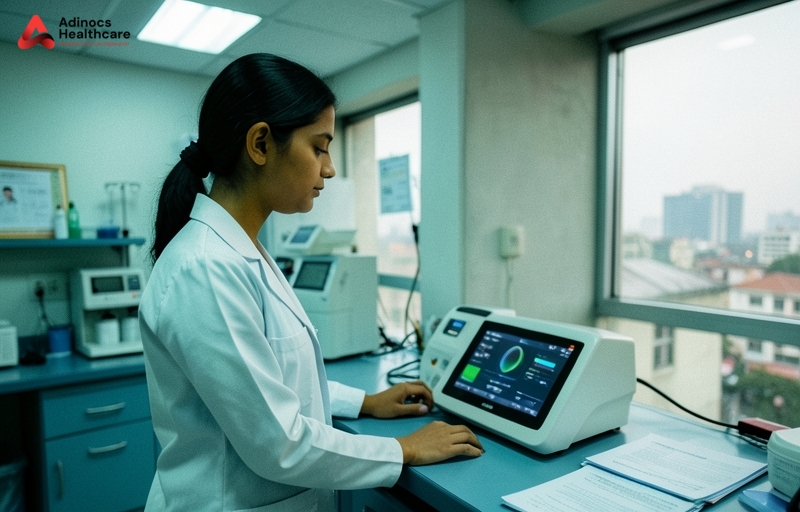
Most diagnostic centre owners in India lose nearly 25% of their potential walk-in patients simply because they cannot provide results within the hour. If you are still relying entirely on a centralized lab model, you are leaving significant revenue on the table. Investing in **POCT equipment India** is the fastest way to capture this lost market share. The shift toward decentralized testing is not just a trend; it is a fundamental change in how we manage patient expectations in 2026.
The short answer: Point-of-care testing (POCT) brings diagnostic capabilities directly to the patient's bedside or the clinic floor, drastically reducing the time between sample collection and clinical decision-making. For Indian lab owners, this means faster patient throughput and higher operational efficiency.
Why is POCT Equipment India Becoming Essential for Diagnostic Labs in 2026?
Think about a 50-bed nursing home in Siliguri. A patient arrives with chest pain. Sending blood samples to a reference lab across town and waiting four hours for cardiac markers is no longer acceptable. Not anymore. In 2026, the medical community expects results in minutes, not hours. This is where **POCT equipment India** becomes a necessity rather than an optional upgrade.
POCT allows diagnostic testing to occur at or near the site of patient care. By moving testing away from the central laboratory to the point of encounter, you eliminate the time wasted in sample transportation and batch processing. According to a 2025 IMARC Group report, the Indian point-of-care diagnostics market is growing at a CAGR of 13.4%, driven by hospitals prioritizing patient-centric care models. When you reduce diagnostic turnaround time in India, you don't just improve patient outcomes. You increase the bed rotation rate. This is the lifeblood of any hospital administrator's P&L statement. A faster turnaround means a patient can be discharged or admitted to the ICU in 15 minutes instead of 4 hours.
How Does POCT Equipment India Drive Revenue Growth for Diagnostic Centers?
A pathology lab owner in Indore recently shared how adding two rapid testing units increased his monthly revenue by 15%, translating to an extra Rs. 1,20,000 in net profit. His secret? He stopped referring specialized tests to larger chains. Instead, he started offering "while-you-wait" reports for common parameters.
The ROI on these devices is often misunderstood. It is not just about the cost of the machine; it is about the cost of inaction. As we have discussed in our guide on Why Equipment Bottlenecks Cost Indian Labs Millions, every minute a patient waits is a minute they might choose to go to a competitor. By deploying **POCT equipment India**, you capture the full value of the patient visit. Consider these financial drivers:
Reduced Patient Leakage: Patients rarely return to a lab if they have to travel twice for the same set of reports.
Premium Pricing Potential: Patients are willing to pay a premium of 20% to 30% for "instant" results, especially in emergency or high-stress scenarios.
Operational Efficiency: Lowering the load on your main laboratory analyzers allows you to extend their lifespan, as noted in our analysis on How to Manage Diagnostic Equipment Obsolescence in India?
What are the Key Types of POCT Devices for Indian Labs?
In a bustling clinic in Nagpur, a diabetic patient needs an immediate HbA1c reading before their consultation. Instead of waiting for a next-day report, the doctor uses a handheld cartridge system to get results in 3 minutes. This immediate feedback loop changes the entire clinical conversation.
Not all devices are created equal. For a facility in a Tier 2 city, the investment must be practical, durable, and easy to maintain. We generally categorize these into three tiers based on their utility in the Indian market:
Device Category | Primary Use Case | Typical TAT | Average Cost per Test (INR) |
|---|---|---|---|
Handheld Blood Gas Analyzers | ICU and Emergency Wards | < 2 Minutes | Rs. 450 - Rs. 600 |
Immunoassay Cartridge Systems | Cardiac Markers, Thyroid | 10-15 Minutes | Rs. 300 - Rs. 500 |
Glucose/HbA1c Monitors | Diabetes Screening | < 1 Minute | Rs. 40 - Rs. 120 |
What this means: you must prioritize devices that are compatible with your existing LIMS software. If your software cannot automatically push results to the patient's ABHA ID, you are creating a manual data entry nightmare for your staff. Always look for systems that automatically push data directly to your LIMS via HL7 protocols, eliminating manual entry errors entirely. This ensures that every test is logged, billed, and reported without human intervention.
How to Ensure NABL Compliance with POCT Devices in India?
During a routine NABL audit in Pune last year, a mid-sized lab faced a major non-conformity (NC) because their bedside glucose monitors had no calibration records. The lab manager assumed small handheld devices didn't fall under the audit scope. They were wrong.
There is a common myth that POCT is exempt from strict quality oversight. That is a dangerous assumption. According to NABL 112 guidelines, any facility performing testing must maintain rigorous quality control, regardless of the device size. If you are planning for NABL accreditation, your POCT units must be treated as an extension of your central lab's quality management system. A 2024 NABL report found that nearly 40% of minor non-conformities in Tier 2 labs stem from uncalibrated point-of-care devices.
You must maintain:
Daily Calibration Logs: Even the smallest device needs verification.
Competency Records: Ensure that every operator, not just the lab technician, has been trained and signed off.
External Quality Assurance (EQA): Participate in proficiency testing programs specifically for your POCT platform.
Ignoring these will lead to audit failures. Remember, the regulator cares about the result accuracy, not the size of the box it came out of.
What are the Challenges and Solutions for Implementing POCT in Rural India?
In a remote clinic in Purulia, West Bengal, a power outage lasted for 14 hours during a peak monsoon day. The clinic's primary chemistry analyzer sat idle, but their battery-operated POCT device kept running, allowing them to screen 18 patients for malaria and dengue without interruption. Every single time.
Implementing **mobile diagnostic equipment India** in rural areas like Purulia or parts of Bihar presents unique hurdles. Power fluctuations, high ambient humidity, and a lack of trained technicians are real problems. However, the solution is not to avoid these markets, but to choose "ruggedized" equipment designed for Indian conditions.
Most manufacturers now offer devices that run on battery backups and require minimal reagent refrigeration. If you are looking to expand diagnostic services in rural India, focus on these strategies:
Training-First Approach: Don't just buy the machine; invest in training for the local staff.
Remote Support: Use digital platforms to connect your rural units with senior pathologists in the city for verification.
Regulatory Preparedness: Keep a close eye on updates regarding device registration. You can find more on this in our recent article: Will India's 2026 Policy Clarify Refurbished Device Rules?
Key Takeaways
Speed is Revenue: Reducing TAT is the fastest way to increase your lab's daily footfall and patient retention.
Don't Over-Buy: Choose POCT devices based on your specific patient mix rather than buying the most feature-heavy model available.
Compliance is Non-Negotiable: Treat your POCT equipment with the same NABL-mandated rigor as your large, floor-standing analyzers.
Infrastructure Matters: Ensure your LIMS can integrate with your POCT devices to avoid manual entry errors and ensure ABDM compliance.
Frequently Asked Questions
How much does POCT equipment India cost compared to traditional lab analyzers?
Not necessarily. While the cost-per-test can be higher on a cartridge-based system, the total cost of ownership is often lower because you save on logistics, sample transit, and staff time. For instance, a basic handheld analyzer might cost Rs. 1.5 Lakhs to Rs. 3 Lakhs, whereas a fully automated floor analyzer starts at Rs. 12 Lakhs.
Can Indian labs use POCT results for final clinical diagnosis under NABL?
Yes, provided the device is validated, your lab is following standard operating procedures, and the results are reviewed according to your internal quality control protocols. Many clinicians rely on these rapid results for immediate intervention in critical care.
What is the NABL audit process for POCT equipment in India?
Yes, NABL requires that all testing sites, including those using POCT, maintain documented evidence of calibration, staff training, and participation in inter-laboratory comparison programs. During an audit, the assessor will ask to see your daily IQC logs and EQA records for every active POCT device.
Upgrading your diagnostic capabilities requires a partner who understands the ground reality of Indian healthcare. Whether you need to streamline your lab with the Adibix LIMS or require support with Adinocs Healthcare for your imaging needs, we are here to help you scale. Talk to our teleradiology team today or book a free demo of Adibix LIMS to see how our solutions fit your facility's specific requirements.
Data sources: IMARC Group (2026), NABL India (2026), Ministry of Health and Family Welfare (2026).