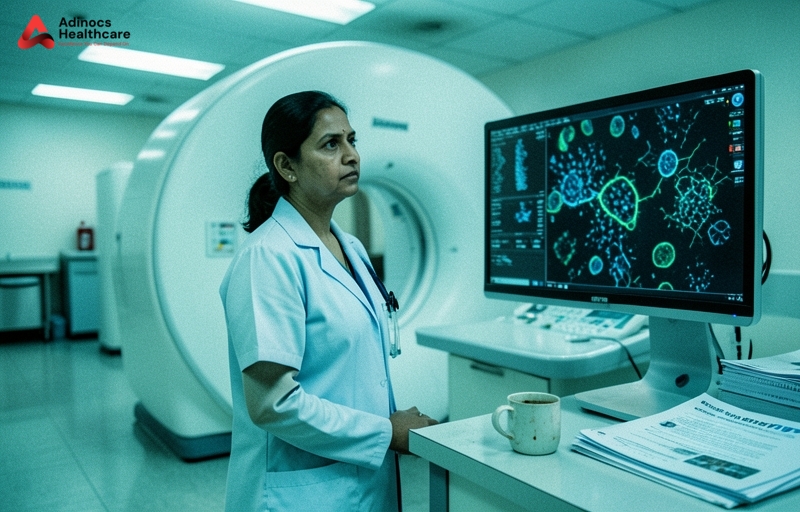
How much idle scanner time is costing your diagnostic centre every single afternoon? If you run a diagnostic centre in Pune, Kolkata, or Siliguri, you know the dreaded 1 PM to 5 PM slump. Your expensive CT and MRI machines sit cold, while your fixed overheads keep ticking. The solution is not slashing prices for emergency scans. It is capturing the massive, untapped market for preventive health checkup radiology India. By designing high-margin radiology wellness packages India, diagnostic centres can turn these quiet afternoon hours into profit engines, lifting overall revenue by 30% or more without overloading clinical staff.
The short answer: Indian radiology centres can unlock a 30% to 45% increase in high-margin revenue by embedding low-dose CT scans, cardiac calcium scoring, and automated breast ultrasounds into preventive health packages. Moving away from low-margin pathology-only bundles allows centres to maximize machine utilization during off-peak afternoon hours.
Why India's Preventive Healthcare Market Demands Radiology Wellness Packages India
In January 2026, a diagnostic clinic in central Kolkata noticed a strange pattern: over 45% of their walk-in patients for routine blood tests were proactively asking if they also needed a lung scan or a heart check. This was not a random coincidence. According to data from the National Health Authority (NHA), the expansion of digital health registries under the Ayushman Bharat Digital Mission (ABDM) has fundamentally shifted consumer mindsets from reactive treatment to proactive wellness. In fact, industry data shows that the Indian diagnostic imaging services market is expanding at a compound annual growth rate of 7.9%. The post-pandemic era has made urban and semi-urban Indians highly sensitive to silent lifestyle diseases. People do not want to wait for a heart attack or a stage 4 cancer diagnosis. They want to catch health risks early.
Consulting experience with diagnostic centres across West Bengal and Bihar reveals a massive surge in patients asking for "silent killer" screenings. You have likely noticed this trend yourself. What this means: patients are no longer just waiting for a doctor's prescription. They want to know their cardiac risk score before they feel chest pain. Yet, most checkup packages in India are still dominated by pathology. A standard preventive health checkup radiology India package often consists of a basic chest X-ray and an abdominal ultrasound, bundled with fifty different blood tests. This is a massive missed opportunity for revenue growth.
Price wars between large diagnostic chains have driven the cost of blood panels down to unsustainable levels. Not anymore. Radiology, on the other hand, requires significant capital investment, which acts as a barrier to entry. This means your imaging machines are your biggest competitive advantage. By shifting your focus toward diagnostic imaging for wellness India, you can command premium pricing while providing life-saving clinical value that pathology alone simply cannot match.
Essential Diagnostic Imaging for Radiology Wellness Packages India
Consider a mid-sized diagnostic centre in Asansol that recently lost 20% of its pathology volume to a national aggregator slashing prices by half. Instead of entering a race to the bottom, the owner introduced a low-dose CT lung screening package for heavy smokers. Within two months, they captured 80 high-margin scans that their competitors could not replicate. Pathology tests are cheap to run, but they are a commodity. Your competitor down the street can match your blood test prices in an instant. They cannot easily match high-quality diagnostic imaging for wellness India. To build a package that actually protects patients and drives high-margin revenue, you must move beyond the basic chest X-ray. The real value lies in advanced screenings that target the leading causes of mortality in India: cardiovascular diseases and late-stage cancers.
What does a modern, high-margin wellness imaging portfolio look like? It focuses on fast, low-stress scans that require minimal patient preparation. Think of coronary calcium scoring, low-dose CT (LDCT) chest scans, digital mammography, and comprehensive shear-wave elastography for fatty liver screening. These scans take less than fifteen minutes of table time but offer immense clinical insights. Let us look at the economics of these modalities compared to traditional wellness offerings:
| Modality | Target Screening | Average Cost to Centre (Rs.) | Retail Price (Rs.) | Estimated Profit Margin (%) |
|---|---|---|---|---|
| Ultrasound (Abdomen/Pelvis) | Fatty liver, gallstones, renal cysts | Rs. 300 | Rs. 1,500 | 80% |
| Low-Dose CT (LDCT) Chest | Early lung cancer, chronic lung disease | Rs. 1,200 | Rs. 4,500 | 73% |
| Coronary Calcium Scoring (CT) | Cardiac plaque, heart attack risk | Rs. 800 | Rs. 3,500 | 77% |
| Digital Mammography | Early-stage breast cancer screening | Rs. 500 | Rs. 2,500 | 80% |
By focusing on diagnostic imaging for wellness India, you transition your facility from a basic testing lab to an essential clinical partner. The trade-off: if your image quality is poor, your radiologists will miss early-stage nodules or calcifications, destroying your reputation. To understand why this is a critical financial risk, read our guide on Why Poor Image Quality Costs Indian Radiology Centers Millions.
Designing Profitable Radiology Wellness Packages India for Your Center
A 50-bed multi-specialty hospital in Siliguri was struggling with low CT scan volumes. They ran barely three scans a day. Mostly trauma cases at night. Their Rs. 1.5 crore CT machine sat idle during the day. Last year, they designed three distinct radiology wellness packages India. Within four months, their daytime CT volume jumped to twelve scans daily. The result? An extra Rs. 2.8 lakh in net profit every single month. Pure profit, purely from utilizing their existing equipment during off-peak hours.
Most centres lose money on wellness packages because they bundle too many low-margin blood tests and ignore high-margin, low-time-commitment radiology. To avoid this trap, do not offer a single, generic "full body checkup" package. That is a recipe for low conversions. Instead, segment your packages by age, gender, and lifestyle risk factors. This makes the package feel personalized and highly relevant to the patient.
Experienced operators recommend structuring your packages into three clear tiers. First, a "Young Professional Stress Package" targeting the 30-45 age group, focusing on carotid Doppler and abdominal ultrasound. Second, an "Active Smoker's Lung Health Package" targeting adults over 40 with a low-dose CT chest scan. Third, a "Senior Cardiac Wellness Package" for those over 45, which includes coronary calcium scoring and a complete abdominal scan. Keep the entry-level packages affordable, but use smart upselling during the booking process. If a patient calls to book a basic ultrasound, offer them the cardiac calcium scoring add-on for an additional Rs. 1,500. Most patients in Tier 2 and Tier 3 cities like Patna or Bhubaneswar will gladly pay for peace of mind when the clinical benefit is explained clearly.
Effective Marketing Strategies for Preventive Radiology Services
In early 2025, a diagnostic facility in Pune printed 5,000 glossy brochures for their new cardiac screening package and left them at the reception desk. Three months later, they had booked exactly four scans. They realized that passive marketing does not work for preventive care. To drive marketing radiology services wellness India, you must target the actual decision-makers and address specific health anxieties. You are not selling a medical scan; you are selling peace of mind and early control over one's health destiny.
The most effective strategy is establishing B2B corporate partnerships. Pitch directly to corporate offices in Kolkata, Pune, or Bhubaneswar. Offer on-site health awareness talks led by clinical experts, followed by discounted wellness packages booked at your centre. Corporate HR departments are actively looking for meaningful wellness benefits for their employees in 2026. A structured imaging package is far more appealing to them than a basic blood test panel.
Another powerful channel is the physician referral network. Educate local general practitioners (GPs) on the clinical value of CT calcium scoring and LDCT. According to guidelines from the World Health Organization (WHO India), early detection of cardiovascular diseases can reduce mortality by up to 20%. GPs want their patients to get screened, but they need to trust your reporting quality. If your reports are confusing or delayed, they will stop referring. Utilizing structured, easy-to-read reports replaces confusing, free-text paragraphs with clear, standardized metrics that GPs can interpret in under thirty seconds. To see how this can build physician trust, read our analysis on How Can Structured Reporting Boost Indian Radiology?.
Operationalizing Wellness Programs in Indian Radiology Centers
A pathology lab owner in Pune recently watched her reagent costs jump 18% without warning. To offset this, she launched a wellness scan program. It backfired. Her on-site radiologist was already buried under emergency trauma reporting. The wellness scans sat unread for 48 hours. Patients got angry. The program collapsed. This is the reality for many centres: they have the machines, but they do not have the reporting capacity.
According to the National Accreditation Board for Testing and Calibration Laboratories (NABL), maintaining strict quality control and turnaround times is essential for clinical credibility. If you overload your on-site radiologist with routine wellness scans, your emergency reporting turnaround times will suffer. This is where teleradiology becomes your operational secret weapon. By outsourcing your wellness scans to a reliable teleradiology partner, you keep your on-site radiologist focused on complex, urgent cases while wellness reports are delivered in the background.
To successfully operationalize your wellness program without disrupting daily workflows, follow this simple four-step process:
- Set Dedicated Hours: Schedule all wellness imaging appointments during your off-peak hours, typically between 12 PM and 4 PM. This keeps your morning and evening slots open for emergency and diagnostic walk-ins.
- Standardize Scanning Protocols: Train your technicians on low-dose screening protocols to ensure patient safety and compliance with CDSCO guidelines.
- Outsource Wellness Reporting: Route all wellness scans to a trusted teleradiology partner. This ensures that a sub-specialist reports the scans within a guaranteed 2-hour window, keeping your patient satisfaction high. To understand the legal landscape of this model, read our guide on How to Navigate Teleradiology Regulations in India (2026)?.
- Deliver Actionable Reports: Provide patients with clear, structured reports that include key images. A patient should not need a medical degree to understand their wellness report.
Key Takeaways
- Fill the afternoon slump: Schedule wellness scans between 12 PM and 4 PM to maximize machine utilization and offset fixed operating costs.
- Shift from pathology to radiology: Avoid low-margin, highly competitive blood test bundles. Focus on high-margin imaging like CT calcium scoring, low-dose CT chest, and mammography.
- Segment your packages: Create targeted wellness packages based on age, gender, and risk factors (such as smoking or family history of cardiac disease) to increase conversions.
- Build GP trust with structured reports: General practitioners are more likely to refer patients for wellness screenings if they receive clear, structured, and timely reports.
- Leverage teleradiology: Prevent operational bottlenecks by outsourcing wellness scan reporting, allowing your on-site team to focus on high-priority emergency cases.
Frequently Asked Questions
Are radiology wellness packages safe for asymptomatic patients in India?
Yes, when structured properly. Modern screening modalities like Low-Dose CT (LDCT) chest and coronary calcium scoring use minimal radiation doses compared to standard diagnostic scans. Ultrasound and mammography are standard, safe screening tools used globally for preventive care.
How much does it cost to start a wellness radiology program in India?
Almost zero upfront investment is required if you already have the imaging equipment. You do not need to purchase new machines or hire additional full-time radiologists. You only need to package your services, market them, and partner with a pay-per-report teleradiology provider.
What is the average price of radiology wellness packages in Tier 2 Indian cities?
Keep entry-level packages under Rs. 3,000 to encourage adoption. For example, a basic women's wellness package containing an ultrasound and a mammography can be priced at Rs. 2,500. You can then offer premium add-ons like CT cardiac calcium scoring for an additional Rs. 1,500.
Do Indian doctors refer patients for self-booked radiology wellness packages?
Yes, general physicians actively support them if you provide high-quality, structured reports. When general practitioners receive clear, clinically actionable reports with key images, they appreciate the early risk detection and will actively refer more patients to your centre.
Building profitable radiology wellness packages India does not require massive capital expenditure or hiring expensive new staff. By utilizing your existing imaging assets during off-peak afternoon hours and targeting the growing preventive health market, you can significantly boost your centre's margins. At Adinocs Healthcare, we help Indian diagnostic centres and hospitals scale their imaging operations seamlessly. Through our sub-specialist teleradiology services, we guarantee a 2-hour turnaround time with a pay-per-report pricing model that requires no upfront investment. Whether your facility is in Kolkata, Siliguri, or Pune, we can help you eliminate reporting bottlenecks and turn your idle scanner hours into steady profit. Talk to our teleradiology team at Adinocs Healthcare today to book a free demo of our reporting services.
Data sources: National Health Authority (NHA) digital health registry reports, World Health Organization (WHO) India cardiovascular disease screening guidelines, NABL quality control circulars, and 5C Network industry insights.