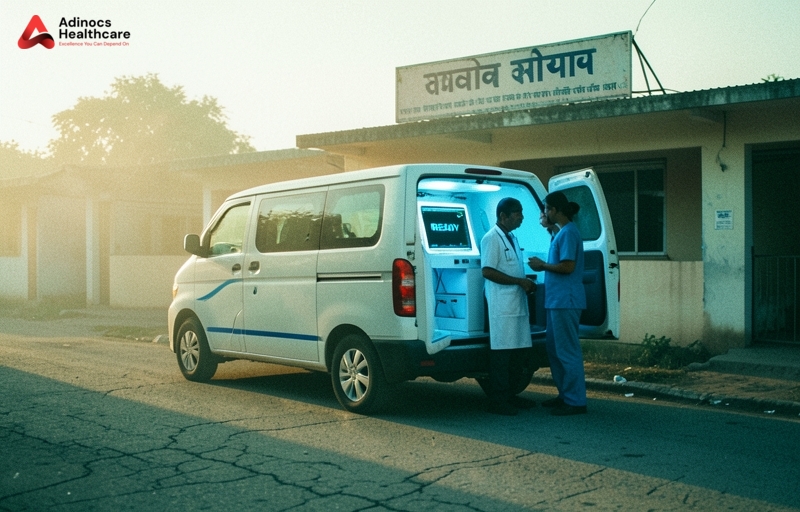
Did you know that diagnostic centres in Tier-1 and Tier-2 Indian cities spend up to 40% of their monthly operating budget on commercial rent alone? High commercial real estate costs bleed cash flow long before a single patient steps inside. That is why forward-thinking hospital owners choose a flexible Mobile Radiology Business Model India operators use to scale efficiently in 2026. By mounting digital imaging equipment inside customized commercial vehicles, you deliver chest X-rays, health screenings, and routine diagnostics directly to factories, nursing homes, and residential complexes without signing a 10-year lease.
The short answer: A fully equipped mobile radiology van in India costs between Rs. 35 lakh and Rs. 65 lakh in total setup capital. Operating expenses run around Rs. 1.2 lakh to Rs. 1.8 lakh per month, with most well-run mobile units achieving full financial payback within 14 to 18 months.
What is the initial setup cost for a Mobile Radiology Business Model India?
Setting up a mobile imaging van requires balancing automotive engineering with strict healthcare compliance. You cannot simply bolt a portable X-ray machine inside a cargo van and hit the road. In late 2025, a diagnostic provider in Asansol spent Rs. 8 lakh retrofitting a used vehicle, only to have local radiation authorities reject the unit because the chassis floor buckled under 1.8mm lead shielding. Worth knowing. Let us look at realistic capital expenditure (CapEx) breakdowns for an AERB-compliant vehicle in 2026.
The primary cost drivers divide into three distinct categories: the base vehicle chassis, custom body fabrication with radiation shielding, and core medical imaging equipment. Choosing between a standard 100mA digital radiography (DR) system or a multi-modality setup dramatically impacts your initial cheque size. Here is how capital allocation looks across standard configurations in India:
| Cost Component | Basic X-Ray Van (DR System) | Advanced Multi-Modality Van |
|---|---|---|
| Base Vehicle Chassis (Force Traveller / Tata Winger) | Rs. 1,800,000 to Rs. 2,200,000 | Rs. 2,400,000 to Rs. 3,000,000 |
| Lead Shielding & Fabrication (AERB Spec) | Rs. 400,000 to Rs. 600,000 | Rs. 650,000 to Rs. 900,000 |
| Medical Equipment (X-Ray / Portable USG) | Rs. 1,000,000 to Rs. 1,600,000 | Rs. 2,200,000 to Rs. 3,500,000 |
| Power Backup (Lithium Inverter + Generator) | Rs. 250,000 to Rs. 350,000 | Rs. 400,000 to Rs. 550,000 |
| Air Conditioning & Interior Fitments | Rs. 200,000 to Rs. 300,000 | Rs. 300,000 to Rs. 450,000 |
| Total Estimated Setup Cost | Rs. 36.5 Lakh to Rs. 50.5 Lakh | Rs. 59.5 Lakh to Rs. 84.0 Lakh |
Here's the catch with recurring operational expenses (OpEx): diesel fuel, driver wages, radiographer stipends, vehicle maintenance, and insurance add around Rs. 1,40,000 per month. If you want to evaluate how this capital layout compares to fixed equipment investments, read our breakdown on Which Radiology Machine Has the Best ROI in India?.
Which radiology modalities yield the highest profit in a Mobile Radiology Business Model India?
In March 2026, an industrial health checkup camp in Durgapur processed 114 factory workers in a single six-hour window using one digital X-ray van. Not all radiology services perform equally on wheels. Digital X-ray remains the undisputed backbone of mobile diagnostic units India relies on for high-volume revenue. Why? Because chest X-rays require minimal scan time and generate rapid patient throughput during corporate health checkups. A single mobile team can comfortably conduct 80 to 120 digital X-rays in a six-hour shift at a manufacturing plant in Durgapur or Howrah.
What about contrast studies or ultrasound? Contrast imaging requires specialized contrast injectors and immediate emergency support, which increases liability risks in remote settings. To understand contrast handling costs, check out our analysis on whether Do Closed-System Contrast Injectors Cost Indian Labs More?. For mobile vans, digital chest X-rays and mammography offer the cleanest operational margins.
Here is how key modalities rank by margin and operational feasibility:
- Digital Radiography (DR X-Ray): Highest volume, lowest processing time per patient. Yields 65% to 75% gross profit margin per scan during corporate camps.
- Digital Mammography: High revenue per patient, excellent for government-sponsored public health drives and CSR-funded screening programs in rural West Bengal and Bihar.
- Portable Ultrasound & Echo: Excellent margins, but subject to strict mobility restrictions under national gender-selection prevention laws.
- Electrocardiogram (ECG) & Blood Collection: Perfect low-cost add-ons that turn a basic X-ray van into a complete mobile health checkup station.
How do AERB and PC-PNDT rules apply to mobile radiology vans?
A 2025 compliance audit across West Bengal revealed that 35% of unauthorized mobile health vans faced immediate cease-and-desist orders due to improper radiation shielding or uncalibrated equipment. Regulatory compliance is where many first-time operators hit a wall. In India, operating a radiation-emitting device inside a moving vehicle demands rigorous authorization. According to mandatory directives from the Atomic Energy Regulatory Board (AERB), your mobile unit must obtain type approval for both the X-ray equipment and the vehicle layout through the eLORA portal before scanning your first patient.
Lead lining is non-negotiable. The walls, floor, and ceiling surrounding the X-ray room must contain at least 1.5mm to 2.0mm lead equivalence shielding. Radiation leakage testing must be conducted by certified radiological safety officers (RSO). Furthermore, all radiographers operating inside the unit must wear Thermo-Luminescent Dosimeter (TLD) badges that undergo quarterly monitoring.
What about ultrasound imaging? The rules are even tighter. Under guidelines managed by the Ministry of Health and Family Welfare (MoHFW) under the PC-PNDT Act, mobile ultrasound machines face strict registration requirements to prevent illegal misuse. In many Indian states, mobile ultrasound registration is granted only to government entities or approved non-profit organizations for specific outreach programs. Private operators should consult local district authorities before purchasing ultrasound equipment for mobile use.
How to calculate the ROI of a mobile imaging unit?
In mid-2025, a mobile clinic operating in Tier-3 Odisha shifted its focus from ad-hoc village visits to pre-booked corporate health drives, boosting monthly revenue from Rs. 90,000 to Rs. 4,10,000 in under 90 days. Calculating financial return for mobile imaging requires measuring utilization density rather than daily patient walk-ins. In a fixed facility, you wait for patients to arrive. In a mobile unit, you go where 100 patients are already lined up. Let us run a practical calculation based on real-world Indian operational data in 2026.
Consider a basic mobile DR X-ray van with an initial setup cost of Rs. 42 lakh. Your monthly fixed costs (vehicle EMI, staff wages, fuel, maintenance) total Rs. 1.5 lakh. If you charge an average of Rs. 350 per chest X-ray for corporate screenings, here is what your financial trajectory looks like:
- Target Volume: 20 patient scans per day across 22 working days = 440 scans per month.
- Monthly Gross Revenue: 440 scans x Rs. 350 = Rs. 1,54,000. (Breakeven level).
- Scaled Volume (Corporate Camps): 40 scans per day across 22 days = 880 scans per month.
- Scaled Gross Revenue: 880 scans x Rs. 350 = Rs. 3,08,000 per month.
- Net Monthly Profit: Rs. 3,08,000 minus Rs. 1,50,000 OpEx = Rs. 1,58,000 net profit per month.
- Simple Payback Period: Rs. 4,200,000 setup cost / Rs. 158,000 monthly profit = 26.5 months.
Now, increase your daily volume to 75 scans by tying up with local manufacturing plants, construction sites, and housing societies in Patna or Siliguri. At 75 scans per day, monthly gross revenue jumps to Rs. 5,77,500. After deducting operational costs, net monthly profit reaches Rs. 4,27,500. Your payback period drops to under 10 months. Simple math.
Case Study: A 40-bed hospital in Siliguri deployed a mobile DR unit in early 2025 to serve tea estates and remote clinic networks across North Bengal. By bundling chest X-rays with basic occupational health checkups, the hospital generated 1,400 scans per month. The mobile service achieved complete capital payback in just 11 months while feeding secondary specialty referrals directly back to their main hospital wing.
How to integrate teleradiology for mobile imaging units?
In late 2025, an independent diagnostic network in Ranchi reduced their turnaround time from 24 hours to 45 minutes by switching from on-site radiologist visits to cloud DICOM transmission. Here is the catch: hiring a full-time, MD radiologist at Rs. 2.5 lakh per month to sit inside a van driving across rural roads destroys your operational margins. That is where remote reporting technology transforms your unit's financial viability.
By connecting your mobile van's DICOM output to a cloud-based teleradiology platform using dual 4G/5G SIM routers, your radiographer uploads scans immediately after acquisition. A sub-specialist radiologist stationed in Kolkata or Hyderabad reads the image, constructs the report, and digitally signs it within 2 hours. This turnaround speed allows mobile medical teams to hand printed or digital reports to patients before the van leaves the screening site.
When emergency conditions like pneumothorax, severe pneumonia, or active tuberculosis appear on a routine chest scan, rapid reporting becomes critical. Implementing structured reporting systems ensures critical findings reach site coordinators immediately. To learn how fast reporting protocols work during emergencies, read our article on Best Critical Radiology TAT Protocols in India 2026.
Key Takeaways
- Initial Investment: Expect a total capital outlay between Rs. 35 lakh and Rs. 65 lakh for an AERB-certified mobile X-ray van in India.
- Primary Profit Drivers: High-volume corporate health drives, industrial factory checkups, and outreach diagnostic camps offer the highest profit margins.
- AERB Compliance: Vehicle structural shielding (1.5mm to 2.0mm lead) and eLORA registration are mandatory before clinical operations begin.
- Payback Timeline: Operating at 50 to 75 scans per day yields full financial ROI within 10 to 14 months.
- Operational Efficiency: Teleradiology integration eliminates the need for an on-site radiologist, cutting payroll costs by up to 60%.
Frequently Asked Questions
What is the minimum setup cost for a mobile X-ray van in India?
The minimum entry setup cost is approximately Rs. 35 lakh to Rs. 40 lakh. This includes a retrofitted commercial van chassis, lead shielding, a portable 100mA Digital Radiography (DR) system, power backup, and preliminary AERB certification fees.
Do I need a full-time radiologist inside the mobile van?
No, you do not need an on-site radiologist inside the vehicle. A certified radiographer acquires the X-ray images, and the files are transmitted electronically to remote radiologists via cloud teleradiology for reporting.
Is PC-PNDT approval required for mobile X-ray units?
No, PC-PNDT regulations apply specifically to ultrasound and sex-determination technology, not standard digital X-ray equipment. However, X-ray units must strictly comply with AERB radiation safety rules.
How many X-rays can a mobile van process per day?
A well-organized mobile team using a modern digital radiography (DR) system can comfortably acquire and process between 80 and 150 chest X-rays in a standard 8-hour operational shift.
Which mobile radiology business model in India gives the fastest ROI?
B2B industrial tie-ups and corporate employee health screenings offer the fastest payback (10 to 12 months) because they guarantee high daily scan volumes (50+ patients per visit) with minimal marketing expenditure.
Building a profitable mobile diagnostic network requires balancing capital costs with reliable diagnostic support. At Adinocs Healthcare, we provide sub-specialist teleradiology reporting with guaranteed turnaround times and pay-per-report pricing, allowing your mobile diagnostic business to run lean without compromising diagnostic quality. Talk to our teleradiology team today to discuss how we can support your growth.
Data sources: Atomic Energy Regulatory Board (AERB) guidelines, Ministry of Health and Family Welfare (MoHFW) standards, and internal healthcare operations data from Indian diagnostic facilities.