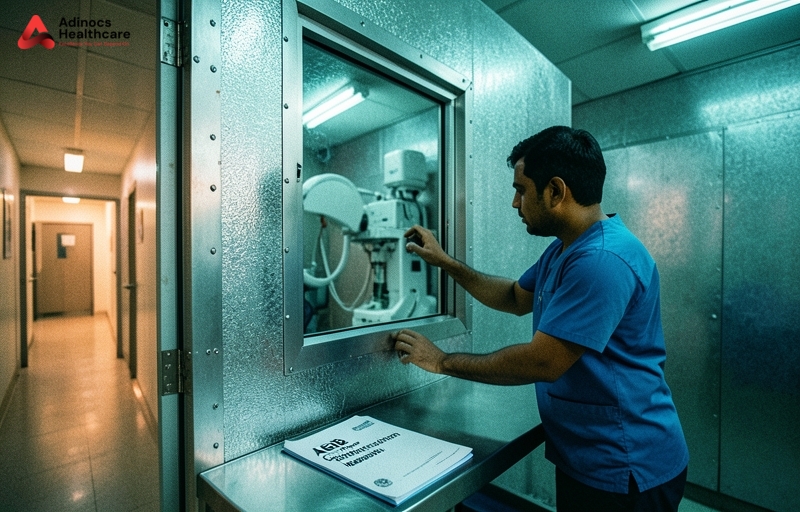
Did you know that nearly 35% of diagnostic centres in Tier 2 and Tier 3 Indian cities face delays of up to six months due to radiation shielding non-compliance? Setting up a compliant diagnostic facility in India costs between Rs. 1.5 lakh and Rs. 8.5 lakh for room shielding and site preparation alone. When calculating your total radiology equipment installation cost India, buying the machine is only half the battle. Administrators frequently budget heavily for the scanner itself while overlooking the mandatory physical infrastructure required to protect workers, patients, and adjacent rooms from radiation exposure.
The short answer: Radiology room shielding and site preparation cost between Rs. 1.5 lakh and Rs. 8.5 lakh in India depending on modality (X-ray vs. CT). This cost covers AERB-mandated lead sheet lining, lead-lined flush doors, structural wall reinforcements, dedicated precision cooling, and specialized electrical earthing.
What are the mandatory AERB room requirements for 2026?
More than 40% of first-time AERB site approvals are rejected due to unshielded doorways and inadequate wall density. Consider what happened in Asansol during a recent site inspection. A local facility installed a digital radiography unit inside a spare room with standard 9-inch brick walls. Owners assumed thick brickwork offered enough protection. They were wrong. The Atomic Energy Regulatory Board (AERB) rejected the license because the entryway had zero lead protection and the wall facing the waiting lounge leaked radiation. Workers had to strip the plaster, install 2.0 mm lead sheets, and refinish the room. The oversight delayed launch by 68 days and added Rs. 1.8 lakh in unplanned structural rework.
To avoid this, you must understand the AERB room requirements 2026 before starting any civil work. For diagnostic X-ray facilities, the room size must measure at least 18 square metres for a general fixed X-ray machine. Installing a CT scan requires a minimum footprint of 25 square metres. Are these dimensions negotiable? Zero exceptions. These space requirements ensure that distance attenuates radiation levels before rays hit boundary walls.
According to directives from the Atomic Energy Regulatory Board (AERB), all structural walls of an X-ray room must provide shielding equivalent to at least 1.7 mm of lead. CT scanner rooms require 2.0 mm to 2.5 mm lead equivalence. Standard 9-inch (23 cm) solid red brick walls naturally yield approximately 1.7 mm lead equivalence. But what if your facility uses hollow concrete blocks or drywall partitions? You must retrofit them with solid lead sheets or high-density baryte plaster. The operator control console must stand behind a protective barrier equipped with a lead glass window, allowing full vision of the patient during exposure.
How much does lead shielding cost per square foot in India?
Lead pricing moves alongside global commodity markets. In India, raw 2.0 mm lead sheets for diagnostic room shielding cost between Rs. 380 and Rs. 450 per square foot. Freight adds up fast. Shipping three metric tons of raw lead sheets from distribution hubs in Kolkata to regional centres like Siliguri or Tezpur adds Rs. 25,000 to Rs. 40,000 in transit expenses alone. Lead is dense and unwieldy. Installing it requires specialized crews trained to mount heavy sheets without tears, adding another Rs. 80 to Rs. 120 per square foot in specialized labor fees.
Here is a contrarian insight that generic civil contractors miss: you do not need lead sheets on every single wall. If your room is large and a wall faces an unoccupied outdoor area, standard brickwork provides sufficient attenuation. What this means: you can save thousands by targeting lead deployment where it matters most. However, for walls bordering busy corridors, nurse stations, or upper floors, heavy shielding is non-negotiable. This is where your overall lead shielding cost for X-ray room India increases.
Here is the breakdown of material and civil expenses for a standard diagnostic room in 2026:
| Shielding Component | Required Specifications | Average Material Cost (INR) | Average Installation Cost (INR) |
|---|---|---|---|
| Lead Sheet (per sq ft) | 2.0 mm thickness | Rs. 380 - Rs. 450 | Rs. 80 - Rs. 120 |
| Lead-Lined Door | 2.0 mm lead eq, flush steel frame | Rs. 55,000 - Rs. 75,000 | Rs. 8,000 - Rs. 12,000 |
| Lead Glass Window | 12" x 18" (2.0 mm lead eq) | Rs. 18,000 - Rs. 26,000 | Rs. 3,000 - Rs. 5,000 |
| Baryte Plaster (per bag) | 50 kg bag (covers ~15 sq ft at 15 mm) | Rs. 1,200 - Rs. 1,600 | Rs. 400 - Rs. 600 |
Choosing between imported hardware and domestic systems will change your capital outlay, but radiation physics remains identical regardless of machine origin. To understand how to budget equipment alongside room preparation, read our comparison on Global vs. Indian Equipment: Better Long-Term Value in 2026?
Why do HVAC and power requirements increase the total radiology equipment installation cost India?
A diagnostic center owner in Guwahati learned this lesson after rushing his setup last year. He spent Rs. 4 lakh lining his room with lead for a 16-slice CT scanner. However, he ignored the critical electrical and climate controls necessary for a stable radiology site preparation cost budget. Within three weeks of operation, the CT detector array overheated during a heatwave and burned out. The repair bill hit Rs. 3.5 lakh for replacement modules and resulted in six days of lost bookings during peak operating hours.
Radiology hardware generates massive thermal output. High-frequency X-ray tubes and CT gantries require controlled microclimates to avoid thermal shutdown. CT rooms must stay between 20 and 22 degrees Celsius with relative humidity held below 60%. Standard home split air conditioners cannot maintain these strict parameters under heavy patient loads. You need a dedicated precision AC unit with continuous dehumidification. High humidity causes condensation inside high-voltage transformers, leading to sudden short circuits.
Power infrastructure demands equal attention. A digital X-ray system needs a dedicated 3-phase power supply rated for 30 kVA to 50 kVA. CT scanners demand 50 kVA to 100 kVA uninterrupted lines. The financial reality: you must install a true online double-conversion UPS (20 kVA to 80 kVA) costing Rs. 1.5 lakh to Rs. 4.5 lakh to shield delicate electronics from grid surges. An active servo voltage stabilizer adds another Rs. 80,000 to Rs. 1.8 lakh. You also must dig separate chemical earthing pits with electrical resistance measured strictly below 1.0 ohm. High resistance damages digital flat-panel detectors.
Eastern India's humid climate makes environmental stabilization vital. High humidity and airborne dust corrode sensitive circuitry fast. Learn how to protect hardware components in our guide on Does Indian Weather Shorten Your Equipment Lifespan?
How to avoid budget overruns during radiology equipment installation cost India?
Proper site selection before purchasing machinery cuts installation expenses by up to 25%. In Patna, healthcare operators reduced CT scanner installation costs by Rs. 2.4 lakh simply by constructing a ground-floor suite next to the emergency department rather than retrofitting an old upper-floor ward. Involving a qualified radiology site engineer prior to signing equipment procurement contracts prevented structural modifications after delivery.
To control your budget during facility setup, execute your project using this structured three-step checklist:
- Secure e-LORA layout approval first: Before laying bricks or mixing plaster, submit architectural floor plans through the AERB e-LORA portal. Obtaining formal layout approval (Site Approval) before civil work starts eliminates costly tear-downs later.
- Apply baryte plaster on structural walls: Baryte (barium sulphate) plaster costs up to 40% less than raw lead sheeting for wall coverage. A 15 mm layer of baryte plaster matches the protection of 2.0 mm lead sheets. The trade-off: baryte plaster requires skilled application by experienced masons and can crack if structural settling occurs.
- Work with a single turnkey provider: Avoid splitting civil shielding, electrical wiring, and HVAC installation across three separate contractors. Finger-pointing occurs when shielding fails tests. A single engineering vendor takes total responsibility for AERB compliance.
Even with solid construction, minor errors in machine setting can cause workflow disruption. Read our analysis on Why Calibrated Equipment Still Fails Indian Labs in 2026.
Which installation mistakes lead to AERB certification failure?
A diagnostic centre in Ranchi suffered three consecutive AERB registration rejections due to improper wall construction. The contractor mounted heavy lead sheets onto standard plywood partitions using thin nails. Over six months, weight caused the unsupported lead sheets to sag inside the wall cavity, leaving an unshielded 2-inch gap near the ceiling. Scatter radiation leaked straight into the public billing hall. The owner was forced to tear down the drywall and rebuild using steel reinforcement studs.
This failure highlights the danger of radiation gaps. Here are the primary structural errors that trigger AERB compliance rejections:
- Insufficient sheet overlap: Lead sheets must overlap by at least 15 mm at all seams. Butt joints allow radiation to leak through microscopic seams during exposures.
- Unshielded fastener penetrations: Screws and nails driven through lead sheets puncture the protection. Every screw head must be covered with a lead cap matching the wall's lead equivalence thickness.
- Incorrect lead glass sizing: The control room viewing window must allow direct visual sight of both the patient table and the access door. Small or misplaced windows fail inspection.
- Uncertified wooden doors: Gluing lead foil onto standard interior wooden doors fails. Heavy lead causes domestic door frames to warp over time, creating gaps around the perimeter. Use factory-manufactured steel flush doors with continuous lead cores.
Under directives from the Central Drugs Standard Control Organisation (CDSCO) and AERB, all diagnostic installations must complete formal Quality Assurance (QA) testing by a certified medical physicist prior to clinical operation. Operating uncertified hardware exposes owners to immediate sealing orders and severe legal penalties.
Key Takeaways
- Draft AERB plans before equipment delivery: Submit layout plans via e-LORA before starting civil work to prevent expensive structural modifications later.
- Use baryte plaster for walls and lead for doors: Apply 15 mm baryte plaster on brick walls to cut material costs, but use factory lead-lined steel doors for entryways.
- Require 15 mm overlaps on lead joints: Direct contractors to overlap sheet seams by 15 mm minimum and cap every fastener with lead buttons. Zero exceptions.
- Install dedicated precision cooling and earthing: Maintain 20 to 22 degrees Celsius temperatures and dedicated chemical earthing (<1.0 ohm) to safeguard digital detectors from thermal and voltage failure.
Frequently Asked Questions
How much does radiology room shielding cost in India for X-ray vs CT?
X-ray room shielding typically costs between Rs. 1.5 lakh and Rs. 3.5 lakh, while CT scan room shielding ranges from Rs. 4.0 lakh to Rs. 8.5 lakh. CT rooms require thicker lead lining (2.0 mm to 2.5 mm), larger room dimensions (25 sq metres minimum), and heavy-duty precision cooling systems.
Is a lead-lined door mandatory for X-ray room AERB approval in India?
Yes, a factory-manufactured lead-lined door offering at least 1.7 mm lead equivalence is mandatory for diagnostic X-ray rooms to block radiation from entering public corridors. Standard wooden or aluminum doors provide zero protection against diagnostic X-rays.
What thickness of lead glass is required for CT scan control room in India?
A CT control room window requires lead glass with a minimum lead equivalence of 2.0 mm to 2.5 mm, matching the highest operating voltage of the scanner (typically 120 kV to 140 kV). This ensures full visibility while protecting technicians at the console.
Can I use baryte plaster instead of lead sheet for X-ray room in India?
Yes, baryte plaster is an approved, cost-effective alternative to lead sheets for brick walls when applied uniformly at 15 mm thickness by experienced masons. However, baryte plaster cannot be used on moving doors or structural ceilings, where sheet lead remains mandatory.
What is the penalty for operating an X-ray machine without AERB license in India?
Operating an uncertified radiation facility leads to immediate sealing of the equipment by AERB inspectors, cancellation of facility operating licenses, and legal prosecution under the Atomic Energy Act. It also voids institutional commercial insurance policies in case of equipment failure.
Conclusion
Setting up a radiology department requires careful site selection, regulatory adherence, and accurate budgeting. Cutting corners on shielding creates safety risks and leads to costly structural rework during mandatory regulatory inspections. At Adinocs Healthcare, we support diagnostic facilities through every stage of development. From complete AERB e-LORA site plan filings and precision lead shielding installation to final quality assurance testing and ongoing maintenance, our engineering team ensures your facility opens on schedule. Operating across Kolkata, West Bengal, Bihar, Jharkhand, and the Northeast, we deliver turnkey installation support tailored to regional infrastructure conditions. Book a free site consultation with Adinocs Healthcare today to receive a customized, AERB-compliant site preparation estimate for your facility.
Data sources: Atomic Energy Regulatory Board (AERB) safety directives, CDSCO medical device regulations, and Indian diagnostic sector infrastructure benchmarks.