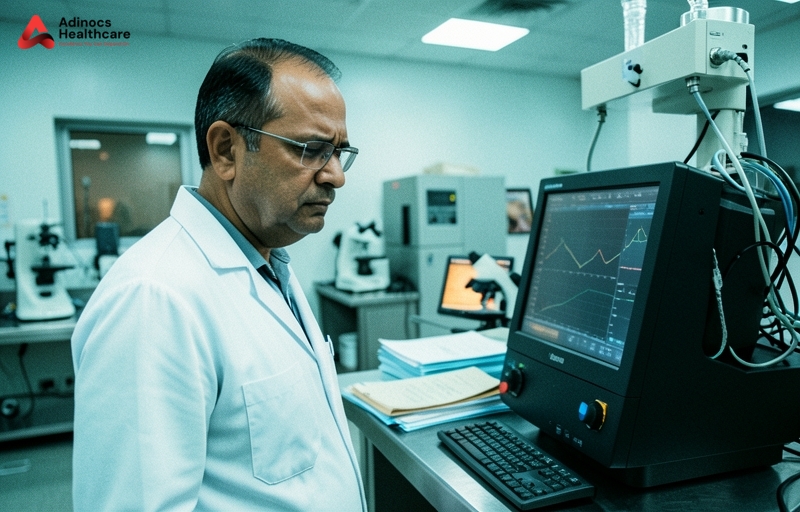
Why do Indian laboratories struggle to adopt new diagnostic technologies? The short answer is a massive mismatch between academic training and automated workflows, driven by the widespread skill gap diagnostic labs India faces today. Nearly 70% of diagnostic centres in Tier 2 and Tier 3 cities fail to realize the full return on investment (ROI) on advanced equipment because technicians cannot run them without manual overrides. Lab owners spend lakhs on high-throughput analyzers but struggle to find technicians who can run them. Margins are razor-thin. Staff turnover is high. If your technicians cannot operate your newer machines efficiently, your expensive equipment becomes nothing more than a glorified manual workstation. It sits idle.
The short answer: Indian labs struggle to adopt new technologies because of a massive mismatch between academic training and practical, automated laboratory workflows. Bridging this skill gap requires structured on-the-job training, modern laboratory information systems (LIMS) that automate validation, and strategic partnerships with equipment vendors.
What are the key drivers of the skill gap diagnostic labs India faces in 2026?
A pathology lab in Siliguri recently upgraded to a semi-automated chemiluminescence immunoassay (CLIA) system. The lab owner expected turnaround times to drop by half. Instead, reagent wastage spiked by 40%. Why? The technician, trained on manual ELISA plates back in 2018, kept overriding the system's automated calibration protocols. He was comfortable with manual pipetting and distrusted the machine's automated fluidics. This is not an isolated incident. It happens every single day across West Bengal and Eastern India.
The academic curriculum for Medical Laboratory Technology (MLT) in India has not kept pace with industry demands. Most graduates enter the workforce with theoretical knowledge of manual staining and mouth-pipetting. Yet, modern labs demand proficiency in digital interfaces, molecular diagnostics, and automated quality control. A 2025 NABL survey revealed that over 58% of non-conformities in Tier 2 labs are directly linked to inadequate technician competency records. Meeting these standards is nearly impossible when entry-level technicians do not understand basic digital error logs. Why buy a Ferrari if no one knows how to drive it?
What are the specific skills missing? First, digital literacy. Technicians often struggle to navigate modern middleware. They get stuck. Second, analytical troubleshooting. When an analyzer flags an outlier, a typical technician's response is to rerun the sample. Every time. They rarely look at the calibration curves or check for systemic bias. Third, compliance documentation. With the rollout of the Ayushman Bharat Digital Mission (ABDM), technicians must understand how to link health IDs (ABHA) and manage digital consent. Most have never received a single hour of training on data privacy or digital workflows. How can you expect high margins when your team is wasting expensive reagents?
How does the skill gap diagnostic labs India faces impact lab efficiency?
A mid-sized lab in Patna processing 500 samples a day recently lost Rs. 2.4 lakh in a single month solely due to analytical errors and sample rejection. The owner had just installed a high-speed biochemistry analyzer. However, the staff kept using the wrong collection tubes. When your staff lacks the training to handle modern equipment, your operational costs skyrocket. The machine sits idle. Reagents expire. Patients walk away because their reports are delayed.
This skill gap directly feeds into pre-analytical errors. In fact, incorrect sample handling is the leading cause of skewed results. If you want to understand how deep this problem goes, read about Why Pre-Analytical Errors Cost Indian Labs Millions. When technicians do not understand the chemistry behind vacuum tubes or the sensitivity of molecular samples, the entire diagnostic pipeline breaks down.
The operational difference between a lab with skilled technicians and one struggling with skill deficiencies is stark. Here is a direct comparison of how these gaps manifest in daily operations:
| Operational Metric | Lab with Skill Deficiencies | Optimised Lab (Trained Staff) |
|---|---|---|
| Average Turnaround Time (TAT) | 4 to 6 hours (frequent manual re-runs) | Under 2 hours (automated validation) |
| Reagent Wastage Rate | 12% to 15% (due to calibration errors) | Less than 3% (strict protocol adherence) |
| Pre-analytical Error Rate | 8% to 10% (poor sample handling) | Under 1.5% (standardised collection) |
| Equipment Downtime | High (waiting for external service engineers) | Low (basic troubleshooting done in-house) |
The trade-off: you can either invest in upskilling your workforce or continue to pay the hidden tax of high error rates, wasted reagents, and lost doctor referrals. (And yes, this is the exact same problem your competitor in Asansol is facing right now).
What new diagnostic technologies require specialized training in India?
In 2025, a diagnostic chain in Durgapur installed a high-throughput molecular PCR setup but had to halt operations for three weeks because the staff kept contaminating the master mix. They lost over Rs. 4.5 lakh in wasted reagents alone. As of 2026, molecular testing, digital pathology, and advanced immunoassay platforms are no longer restricted to metro-based corporate chains. Tier 2 and Tier 3 hospitals are installing these systems to keep patients from traveling to Kolkata or Delhi. However, How Can LIMS & Digital Pathology Solve India's Pathologist Gap? if the ground-level technicians cannot operate the scanners?
Digital pathology requires a completely different workflow. A technician cannot simply slap a coverslip on a slide and hand it over. They must learn how to prepare ultra-thin, bubble-free tissue sections. Why? Because high-speed digital scanners will fail to focus on uneven slides. A single bubble can ruin an entire digital scan, forcing a time-consuming manual reload. Worth knowing.
Here's the catch: the introduction of the Central Drugs Standard Control Organisation (CDSCO) Medical Devices Rules has placed stricter compliance burdens on in-vitro diagnostic (IVD) software. According to a 2025 Indian IVD market report, the molecular diagnostics market in India is growing at a CAGR of 14.2%, yet the supply of trained molecular technicians is growing at less than 4%. Technicians now need specialized training for new lab technologies India is adopting, particularly in PCR setup and next-generation sequencing (NGS) prep. If a technician does not understand the critical nature of PCR clean-zones, cross-contamination will lead to false positives. No amount of expensive software can fix a contaminated sample.
How can you identify the skill gap diagnostic labs India struggle with in your own facility?
During a recent NABL audit in Ranchi, a lab owner was shocked when the auditor flagged six major non-conformities in the hematology department. All of them were traced back to a single technician who did not know how to read calibration curves. The lab's accreditation was put on hold for 45 days. You cannot fix what you do not measure. Most lab owners only realize they have a training problem when a major clinical error occurs or when an NABL auditor flags a non-conformity. By then, the damage to your reputation is already done. You need a proactive way to find the weak links in your team.
Here is a simple, four-step process to audit your lab's competency levels today:
- Audit your control run logs: Look at how many times your team runs controls before getting an acceptable result. If they are running controls three or four times daily, they do not understand calibration.
- Track individual technician error rates: Use your LIMS to monitor who is validating reports with high edit rates. Who is responsible for the most rejected samples?
- Conduct blind sample testing: Insert a known control sample into the daily routine workflow without telling the staff. Compare their reported results against the actual value.
- Review cold chain compliance: Check if your staff knows how to handle temperature-sensitive reagents. For a deeper dive into this specific operational bottleneck, read our guide on How Do Indian Labs Ensure Sample Cold Chain Integrity?.
A 50-bed multi-specialty hospital in Midnapore achieved a 35% reduction in analytical errors within two months. They did not buy new machines. Instead, they conducted a baseline competency audit, identified that three senior technicians were struggling with automated cell counter calibration, and ran a targeted weekend retraining program.
What strategies can Indian labs use for effective workforce upskilling?
A 100-bed hospital in Haldia stopped sending their technicians to expensive weekend seminars after realizing they forgot 80% of the material within two weeks. They were wasting Rs. 50,000 per seminar with zero operational improvement. When lab owners think of upskilling lab technicians India, they usually picture expensive weekend seminars or vendor-led training sessions. Here is the catch: vendor training is often a rushed, two-hour demonstration when the machine is installed. Within two weeks, your technicians have forgotten 80% of what they learned. They fall back on their old, manual habits.
Plot twist: the most effective training does not happen in a classroom. It happens on the lab floor through micro-learning. Instead of scheduling long, boring lectures, create five-minute video SOPs (Standard Operating Procedures) on a tablet kept next to each analyzer. If a technician forgets how to perform a daily maintenance wash, they can watch a quick video right at the workstation.
What this means: you must focus on building future skills for pathology labs India requires by using automated LIMS platforms like Adibix. Your LIMS should not just be a billing tool. It should act as an operational guardrail. Modern LIMS systems prevent untrained staff from making critical mistakes. They block report validation if the analyzer's calibration data is missing or out of range. This automated oversight reduces your dependency on highly specialized senior staff for routine checks.
Finally, tie upskilling to performance incentives. Technicians who complete advanced modules on digital pathology or molecular diagnostics should receive clear career progression. This reduces staff turnover, which is currently one of the biggest operational headaches for Indian lab owners.
Action Plan for Indian Lab Owners
- Conduct a baseline audit: Use your LIMS data this week to identify which workstations have the highest sample rejection and repeat-run rates.
- Implement micro-learning SOPs: Replace dusty paper manuals with short, visual checklists or video guides placed directly next to your analyzers.
- Partner with equipment vendors: Negotiate mandatory, quarterly refresher training sessions into your annual maintenance contracts (AMC).
- Deploy a smart LIMS: Upgrade to a laboratory information system that has built-in validation rules to prevent manual technician errors from reaching patients.
Frequently Asked Questions
Why do lab technicians in India struggle with modern LIMS software?
Most technicians struggle because traditional LIMS platforms are overly complex, poorly designed, and require too many manual clicks. Technicians are focused on sample processing, not data entry. Switching to an intuitive, mobile-friendly system like Adinocs Healthcare (Adibix LIMS) simplifies the workflow and reduces the digital learning curve significantly.
How much does NABL training cost for a small lab in India?
Basic internal NABL training can be managed in-house for minimal cost, but official external courses on ISO 15189:2022 standards typically range from Rs. 5,000 to Rs. 15,000 per technician. However, the cost of not training your staff is far higher, often leading to failed audits and suspended accreditations.
Which diagnostic skills are most in demand for Indian labs?
The three most critical skills are digital slide scanning management, basic molecular workflow handling (such as PCR setup), and digital troubleshooting of analyzer interface errors. Technicians who possess these skills are highly valued and help labs reduce operational downtime significantly.
How can a small lab in a Tier 3 Indian city afford technician training?
Small labs can use free resources from equipment manufacturers, implement peer-to-peer mentoring programs where senior staff train juniors, and use software with built-in validation rules to guide technicians through complex workflows without requiring expensive external courses.
Bridging the Gap for Operational Success
Adopting new diagnostic technology is not just about signing the purchase order for a new analyzer. It is about ensuring your team has the skills to run it efficiently. Without structured training and smart software guardrails, your investment will not yield the returns you expect. At Adinocs Healthcare, we understand these operational challenges. Our Adibix LIMS is built specifically for Indian labs. It features intuitive workflows and built-in compliance tools. This makes it easy for technicians of all skill levels to operate error-free. Let us help you streamline your lab operations. Book a free demo of Adibix LIMS today.
Data sources: National Accreditation Board for Testing and Calibration Laboratories (NABL) guidelines, Central Drugs Standard Control Organisation (CDSCO) medical device regulations, and internal operational data from Adinocs Healthcare.