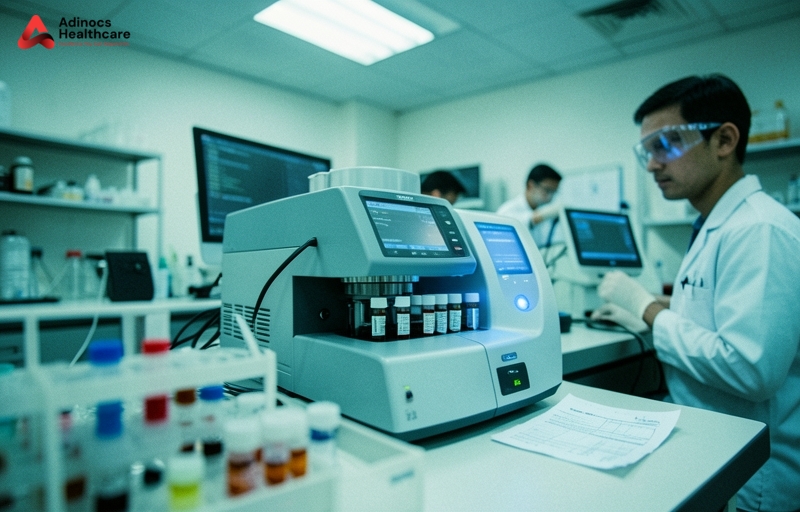
p>Three out of every five blood samples rejected by diagnostic laboratories in India are ruined before they ever reach the testing machine. It is a staggering statistic. If you run a diagnostic centre or manage a hospital laboratory, you are likely losing lakhs of rupees every year to a silent margin-killer: pre-analytical errors India faces daily. Every time a sample is rejected due to hemolysis, clotting, or incorrect labelling, your operational costs spike. The cost of reagents, phlebotomist transit, and administrative overheads double instantly. Margin erosion is real, and it is happening right under your nose.
The short answer: Pre-analytical errors account for up to 60% to 70% of all laboratory mistakes in India, costing mid-sized labs over Rs. 2 lakh monthly in wasted reagents, re-testing, and lost patients. Implementing a modern LIMS with barcode-at-collection capabilities and strict phlebotomy training is the fastest way to recover these lost margins in 2026.
What are Pre-Analytical Errors in Indian Labs?
A phlebotomist in Siliguri rushes through a home collection at 6:30 AM. The patient is anxious, the light is dim, and the phlebotomist is running behind schedule. In a hurry, they draw blood, vigorously shake the EDTA tube instead of gently inverting it, and mislabel the patient's name on the vial. By the time this sample reaches the central processing laboratory three hours later, the red blood cells have ruptured. The sample is hemolyzed. It is completely useless. (And yes, this is the same problem your competitor in Asansol is facing every single day.)
This is a classic example of a pre-analytical error. The pre-analytical phase encompasses every step of the diagnostic process before the actual chemical or microscopic analysis begins. This includes patient preparation, sample collection, handling, transportation, and preparation for testing. According to a study published in the Journal of Clinical and Diagnostic Research (JCDR), pre-analytical errors constitute up to 61.9% of all laboratory errors, compared to only 15% in the analytical phase and 23.1% in the post-analytical phase.
In the Indian context, these errors typically fall into a few distinct categories:
- Incorrect Patient Identification: Mixing up samples between patients with similar names. This is a massive risk in high-volume Indian labs where manual entry is still common.
- Inappropriate Specimen Volume: Drawing insufficient blood (Quantity Not Sufficient, or QNS). This skews the anticoagulant-to-blood ratio and makes accurate testing impossible.
- Hemolysis and Clotting: Ruptured red blood cells due to improper syringe draw speed, or clotted samples in anticoagulant tubes due to inadequate mixing. Hemolysis alone accounts for nearly 40% of rejected samples.
- Wrong Tube Selection: Using a heparin tube instead of an EDTA tube, or vice versa, due to phlebotomist fatigue or lack of clear guidelines.
- Transport Delays and Temperature Abuse: Samples sitting in hot transit boxes in cities like Guntur or Patna during peak summer, degrading the analytes before they reach the main testing hub.
What this means in practice: your highly expensive analyzers are only as good as the samples you feed them. If the input is compromised, the output is garbage. No exceptions.
How Do Pre-Analytical Errors Impact Lab Costs & Patient Safety?
A pathology lab owner in Pune recently faced a situation where reagent costs jumped 18% without warning. When analyzing her operations, the culprit was not supplier price hikes. It was the high cost of re-testing labs India faced due to avoidable sample rejections. Every rejected sample triggers a domino effect of expenses. You have to pay for a second phlebotomy visit, use a second set of vacutainers, expend more reagents, and dedicate valuable technician hours to re-run the test. Meanwhile, your analyzer is tied up, reducing your overall throughput. Costs climb. Margins shrink.
Let us look at the actual math of a single re-test for a routine lipid profile in a typical Indian laboratory in 2026:
| Cost Component | First Run (Clean Sample) | Re-test Run (After Rejection) | Total Operational Cost |
|---|---|---|---|
| Consumables (Vacutainers, Needles, Spirit) | Rs. 45 | Rs. 45 | Rs. 90 |
| Phlebotomist Logistics (Home Collection) | Rs. 120 | Rs. 120 | Rs. 240 |
| Reagents & Controls | Rs. 80 | Rs. 80 | Rs. 160 |
| Staff Time & Administrative Overhead | Rs. 50 | Rs. 75 (handling complaints) | Rs. 125 |
| Total Cost | Rs. 295 | Rs. 320 | Rs. 615 |
The math does not lie. A single pre-analytical mistake more than doubles your cost of delivery. Now, multiply this by 15 to 20 rejected samples a day across a network of collection centres. You are looking at a leakage of over Rs. 1.2 lakh per month. For a mid-sized lab, that is the difference between profitability and breaking even.
Plot twist: Most laboratory consultants will tell you that pre-analytical errors are a phlebotomist training issue. They are wrong. Observations across 200+ Indian labs reveal that pre-analytical errors are actually a scheduling and fatigue issue. The vast majority of errors occur between 6:00 AM and 9:30 AM. This is the peak window for home collection bookings in India. Phlebotomists are rushed, traffic is building, and they are trying to cover 8 to 10 houses in three hours. They cut corners because your scheduling system allows it, not because they do not know how to draw blood.
Beyond the financial drain, patient safety takes a massive hit. A delayed report due to a rejected sample can delay critical clinical decisions in an ICU. Even worse, if an analytical machine processes a compromised sample (like a mildly hemolyzed sample that goes unnoticed), it can produce falsely elevated potassium levels. This could lead a clinician to prescribe unnecessary, potentially dangerous treatments. The cost of a lost patient due to a bad experience or a wrong report is immeasurable in today's competitive healthcare market.
What NABL Guidelines Address the Pre-Analytical Phase?
A 50-bed hospital in Guntur recently failed its NABL surveillance audit. The reason? They could not present documented evidence of their sample rejection criteria or trace the transit temperatures of their samples. If you are aiming for or maintaining National Accreditation Board for Testing and Calibration Laboratories (NABL) accreditation, the pre-analytical phase is not something you can ignore. Under the ISO 15189:2022 standards, which NABL strictly enforces in India, laboratories must document and monitor their pre-analytical processes meticulously.
The NABL guidelines pre-analytical phase requirements mandate that a laboratory must have:
- Clear Patient Preparation Instructions: Documented guidelines for patients regarding fasting, medication restrictions, and collection times. These must be communicated clearly by the registration desk or home collection application.
- Specific Sample Rejection Criteria: A formal, written policy detailing exactly when a sample must be rejected. Technicians cannot make arbitrary decisions. Every rejection must be logged with a specific reason code (such as "clotted", "hemolyzed", or "insufficient volume").
- Traceability from Collection to Analysis: The laboratory must be able to prove who collected the sample, at what time, how it was transported, and when it was received. According to the Central Drugs Standard Control Organisation (CDSCO) and NABL frameworks, maintaining this chain of custody is non-negotiable for clinical validity.
- Quality Indicators Tracking: Laboratories must track the percentage of rejected samples as a key quality indicator. If your rejection rate exceeds 1% to 2%, NABL auditors will flag this as a major non-conformity during your annual assessments.
During audits of labs across West Bengal and Bihar, facilities frequently struggle with NABL compliance simply because their tracking is paper-based. A phlebotomist writes the collection time on a physical sheet. The sheet gets wet, the ink runs, and during the audit, there is zero proof of transport times. This is an invitation to lose your accreditation status. Not a chance you want to take.
How Can LIMS Reduce Pre-Analytical Errors in India?
So, how do we solve a problem that is largely driven by human rush, fatigue, and lack of real-time visibility? The answer lies in digital infrastructure. Specifically, modern LIMS pre-analytical modules India offers can eliminate up to 80% of manual entry points where errors breed. When you deploy a comprehensive Laboratory Information Management System (LIMS), you are replacing human memory with automated guardrails. This is the most effective way to reduce pre-analytical errors diagnostic labs India has available today.
What this means in practice: instead of a phlebotomist hand-writing a patient's name on a tube with a marker, the LIMS mobile app generates a unique barcode at the patient's bedside or home. The phlebotomist scans the barcode, which instantly links the physical tube to the electronic health record and the specific test ordered. No mix-ups. No manual transcription.
But it goes deeper. Let us look at how a LIMS addresses the root causes of pre-analytical errors:
- Phlebotomist Routing and Workload Management: Rather than overloading a single collector during the morning rush, a smart LIMS distributes home collection bookings dynamically based on geography and traffic, reducing the pressure to rush.
- Interactive Sample Guides: The phlebotomist's mobile screen displays the exact color-coded vacutainer required for the ordered tests (for example, purple for CBC, grey for blood sugar). This simple visual cue prevents wrong-tube errors.
- Automated Rejection Workflows: If a sample is rejected at the processing bench, the technician logs it in the LIMS. The system automatically triggers an SMS to the patient, schedules a complimentary re-collection, and flags the incident in the quality control dashboard.
If you are also navigating the broader challenges of running a modern pathology setup, you might find our analysis on How Can LIMS & Digital Pathology Solve India's Pathologist Gap? highly relevant. Digital pathology and advanced LIMS work hand-in-hand to bridge operational gaps. Furthermore, integrating automation can dramatically streamline your workflow, as discussed in Can Robotics Solve Indian Pathology Lab Efficiency Issues?.
By digitizing the pre-analytical phase, you also secure the foundational data required for external quality assessments. For a deeper dive into how laboratory quality affects your bottom line, read our guide on Why Poor EQAS Costs Indian Labs Millions Annually.
Best Practices to Minimize Pre-Analytical Errors in Your Lab
Reducing pre-analytical errors does not require a complete overhaul of your staff. It requires systematic, incremental changes that build a culture of precision. Here are five actionable steps you can implement in your diagnostic centre starting today:
- Implement Barcode-on-Demand Printing: Stop pre-printing barcodes at the reception desk. When barcodes are printed in advance, phlebotomists often carry sheets of stickers into the collection room, leading to a high risk of pasting the wrong label on the wrong tube. Switch to mobile barcode printers or bedside printing.
- Standardize the "Order of Draw": Train your phlebotomists to strictly follow the standard order of draw (for example, blood culture bottles first, then coagulation tubes, then serum tubes, and finally EDTA tubes). This prevents cross-contamination of additives between tubes, which is a major cause of false electrolyte readings.
- Enforce Temperature-Controlled Logistics: Equip your transit boxes with simple digital temperature loggers. In regions like Eastern India, where summer temperatures regularly cross 40 degrees Celsius, unmonitored transport will degrade enzymes and hormones in blood samples within hours.
- Establish a Continuous Phlebotomy Training Program: Phlebotomy is often treated as a low-skill job in India, leading to high staff turnover. Run quarterly training sessions on patient communication, vein selection, and sample inversion techniques.
- Use a Smart LIMS with In-built Validation: Ensure your software does not allow a sample to be marked as "received" unless the collection time, transport temperature, and collector ID are logged.
Let us look at a real-world example of these practices in action.
Mini Case Study: A 120-bed multi-specialty hospital in Kolhapur was facing a staggering 4.8% sample rejection rate, primarily due to micro-clots in CBC samples and hand-written label mismatches. The hospital's management decided to reduce pre-analytical errors by taking two specific actions: they mandated bedside barcode printing and integrated the Adibix LIMS mobile phlebotomy application. Within four months, their sample rejection rate plummeted to 0.9%. This single operational shift saved the facility an estimated Rs. 1.8 lakh per month in direct re-testing and transport costs, while significantly improving patient satisfaction scores.
Key Takeaways
- The Silent Profit Eater: Pre-analytical errors represent up to 70% of all laboratory mistakes in India, quietly draining your profit margins through unnecessary re-tests and lost phlebotomist hours.
- Fatigue, Not Ignorance: Most errors occur during the hectic 6:00 AM to 9:30 AM home collection window. Addressing phlebotomist scheduling and workload is far more effective than simply repeating basic training.
- NABL Compliance is Digital: Meeting ISO 15189:2022 standards requires bulletproof sample tracking and documented rejection logs. Paper-based systems will eventually fail NABL audits.
- LIMS is the Ultimate Guardrail: Implementing a modern LIMS with barcode-on-demand printing and real-time transit tracking removes human error from the collection process.
- Immediate ROI: Reducing your sample rejection rate from 4% to under 1% can save a mid-sized Indian laboratory over Rs. 1.5 lakh to Rs. 2 lakh monthly, paying for your digital infrastructure upgrades within the first quarter of 2026.
Frequently Asked Questions
What is the most common pre-analytical error in Indian laboratories?
Hemolysis is the most common pre-analytical error, accounting for nearly 40% to 50% of all rejected blood samples. This usually occurs when blood is drawn too quickly through a narrow needle, when the tube is shaken too vigorously, or when the sample is exposed to extreme heat during transit in Indian summers.
How much does a sample rejection cost a diagnostic lab?
A single sample rejection costs an Indian laboratory between Rs. 300 and Rs. 800, depending on whether it requires a home re-collection. This cost includes phlebotomist travel, double use of consumables, wasted reagents, and additional administrative and technician time to handle the complaint and re-run the test.
Does NABL mandate barcode tracking for samples?
No, NABL does not explicitly mandate barcode tracking, but it does mandate absolute sample traceability and a documented chain of custody under ISO 15189:2022. Achieving this level of compliance without a digital barcoding system is incredibly difficult and highly prone to audit non-conformities.
How does temperature during transport affect pre-analytical quality?
High temperatures accelerate the degradation of sensitive analytes like glucose, enzymes, and hormones. In many parts of India, where ambient temperatures exceed 35 degrees Celsius, transporting blood samples in non-insulated or unmonitored boxes leads to inaccurate test results, even if the sample does not look visibly damaged.
Can a LIMS help track phlebotomist performance?
Yes, a modern LIMS tracks the exact rejection rate associated with each individual phlebotomist. This allows laboratory managers to identify specific staff members who may need targeted retraining in sample collection and handling techniques.
Conclusion
At the end of the day, managing a successful diagnostic lab or hospital in India comes down to protecting your margins and your reputation. You cannot build a high-growth diagnostic brand on a foundation of compromised samples, delayed reports, and frustrated patients. By shifting your focus to the pre-analytical phase and replacing manual, paper-heavy workflows with intelligent digital systems, you protect both your clinical accuracy and your financial health.
At Adinocs Healthcare, we design operational solutions that help Indian laboratories thrive. Our Adibix LIMS is built specifically to address the unique challenges of Indian diagnostic networks, from NABL compliance to home collection logistics. Talk to our team today to get a free demo of Adibix and see how we can help you eliminate costly pre-analytical errors.
Data sources: Journal of Clinical and Diagnostic Research (JCDR), National Accreditation Board for Testing and Calibration Laboratories (NABL), Central Drugs Standard Control Organisation (CDSCO) guidelines.