
Why Paper-Based Labs Risk NABL Failure in 2026
Indian diagnostic labs face NABL audit risks with paper records. Learn why going paperless with LIMS is crucial for 2026 compliance and efficiency.
Read ArticleDiscover how optimizing pathology lab design in India, especially with modular solutions, can significantly boost efficiency, ensure NABL compliance, and prepare your diagnostic center for future growth in 2026.
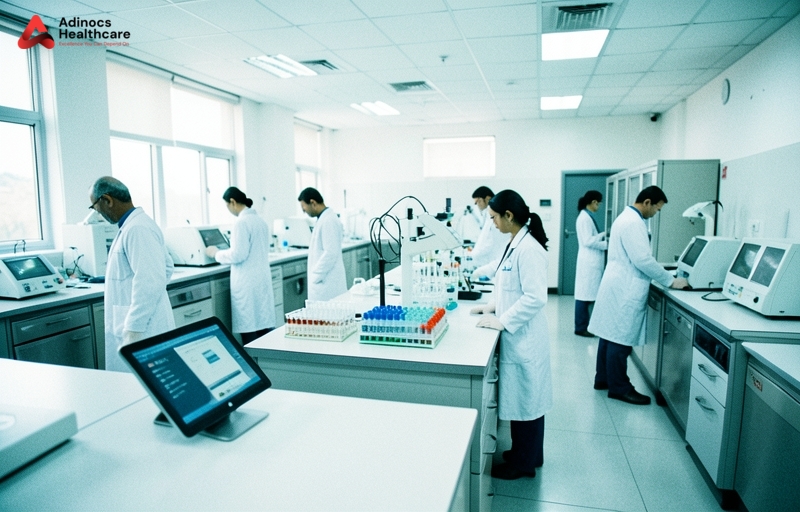
Most diagnostic centres in India lose 30% of their potential operational capacity because their floor plan was designed for 2015. This is why modern pathology lab design India focuses on flexibility over fixed walls. You might have the best testing machines. But if your technicians walk 50 steps to drop off a sample, your turnaround time is already compromised. Every second counts.
TL;DR: Modular lab design allows Indian diagnostic centres to reconfigure workspaces in days rather than months. This reduces sample transit times and helps labs meet NABL compliance without expensive civil renovations.
A mid-sized lab in Siliguri recently found that rearranging just three workstations reduced their sample processing time by 12 minutes per batch. That is a massive win. In 2026, the economics of running a lab have shifted. We see this pattern across Tier 2 cities like Dhanbad: the facility that handles 200 samples a day often has the same physical footprint as the one handling 500. The difference? The high-volume labs stopped using static, brick-and-mortar furniture.
When you design your space, you are not just placing tables. You are building a system. If your layout is rigid, you cannot scale. Many owners in West Bengal and Bihar tell us that their biggest hurdle isn't the cost of machines. It is the cost of downtime. A single day of closure for renovations can cost a medium-sized lab between Rs. 20,000 and Rs. 50,000 in lost revenue. Worth noting: a poorly planned layout creates bottlenecks at the pre-analytical stage. This is where why pre-analytical errors cost Indian labs millions every year.
Consider the patient experience in a busy centre in Patna. If the reception area is too close to the sample collection zone, privacy is compromised. Efficiency drops. A thoughtful design separates these flows. It keeps the back-end processing area quiet and focused. Meanwhile, the front end remains welcoming. This balance is what separates a profitable, high-volume lab from one that struggles to break even. Do you know how many steps your staff takes per sample?
Imagine an auditor from NABL walking into a Kolkata lab and finding a blood sample sitting next to the administrative reporting desk. That is an immediate non-compliance. According to the National Accreditation Board for Testing and Calibration Laboratories (NABL), your laboratory must maintain specific environmental conditions to ensure sample integrity. When you look at NABL 112 guidelines, they are very clear: cross-contamination must be prevented. Period.
If you are planning a new layout, you need to think about the path of the sample. From the moment the patient enters, to the collection, to the testing, and finally to the reporting, the sample should never move backward. This is a "one-way flow" system. Auditors look for this specifically. If your lab is in an old building in Kolkata, you might think you are stuck with your current walls. Not anymore.
Many labs today use modular partitions. These satisfy NABL requirements for cleanliness and separation while allowing you to change your layout as your testing volume grows. What this means: you can expand your hematology section by 20% without breaking a single brick. If you are struggling with these requirements, it might be worth reading about how do Indian labs ensure sample cold chain integrity to see how design and equipment placement intersect.
A lab owner in Bhubaneswar switched to modular benches and reduced his setup time from 4 months to 18 days. The difference was staggering. Modular lab solutions India are no longer just a trend for large corporate hospitals. They are becoming the standard for independent diagnostic centres that need to stay lean. Here is how they compare to traditional construction:
| Feature | Traditional Lab Design | Modular Lab Design |
|---|---|---|
| Installation Time | 3 to 6 months | 2 to 4 weeks |
| Flexibility | Low (Fixed walls) | High (Reconfigurable) |
| Cost | High upfront (Civil work) | Lower (Asset-based) |
| NABL Compliance | Difficult to modify | Easier to adapt |
The biggest benefit is the ability to upgrade. When you introduce new diagnostic technology, your workflow changes. If you have to break down walls to accommodate a new automated analyser, you lose money for weeks. With modular systems, you can swap out a workstation or rearrange a row of benches over a weekend. For a lab owner in a competitive market, that speed is your competitive edge. It is the difference between being first to market with a new test or being last.
In a busy Patna clinic, we noticed a phlebotomist walking nearly 4 kilometers a day just to fetch labels and tubes. That is pure waste. Optimization is about reducing the "waste" of motion. If your phlebotomist has to walk to the other side of the room to grab a barcode label, you are losing seconds. Multiply those seconds by 300 patients a day. You have lost hours of productivity. Every single day.
1. Map the Patient Journey: Start from the entrance. Ensure registration, collection, and waiting areas are distinct. This prevents crowding in the collection zone.
2. Zone Your Lab: Keep the clean zone (reporting/admin) separate from the dirty zone (sample processing). Never let these paths cross. It is a basic safety rule.
3. Centralise Supplies: Keep consumables within arm's reach. If you are still using manual systems that create clutter, it is time to look at how digital solutions like Adibix can streamline your backend. Digital tracking removes the need for massive paper filing cabinets.
4. Standardise Workstations: Every bench should have the same power points, data ports, and storage. This makes it easy for staff to move between stations without searching for tools.
If you feel your lab is constantly cluttered, you are not alone. Many owners struggle with the transition from manual to digital. We discuss this in our guide on why Indian labs struggle adopting new diagnostic tech. The space should support the technology, not fight it. Does your current layout feel like a hurdle?
Last year, a lab in Delhi tried to install a high-end molecular diagnostic system only to find their electrical panel couldn't handle the 15kW load. They had to shut down for two weeks to upgrade the wiring. Future-ready pathology lab design India means preparing for the unknown. In 2026, you might be focused on routine blood work. In 2028, you might need to add molecular testing or specialized immunology. If your infrastructure cannot handle the electrical load or the ventilation requirements, you are stuck.
When you build or renovate, always over-provision your utilities. Install 20% more electrical points than you think you need. Ensure your HVAC system has the capacity to handle heat loads from future equipment. And most importantly, choose flooring and surfaces that are chemically resistant. Epoxy flooring is a standard for a reason. It handles spills without degrading.
The goal is to create a space that doesn't age. By using high-quality, durable materials and flexible furniture, you avoid the need for a major renovation every five years. This is how you protect your capital. It keeps your margins healthy, regardless of how the market shifts. The trade-off is a slightly higher initial cost for materials, but the long-term savings are immense.
While the per-unit cost of modular furniture can be 10-15% higher than basic wooden or steel benches, the total project cost is often lower. You save significantly on civil labor, demolition, and the lost revenue associated with long shutdown periods. Most labs recover this cost within the first 12 months of operation.
Yes. That is the primary advantage. Modular solutions allow you to upgrade your lab section by section. You can refurbish the biochemistry area over a weekend while the hematology section continues to function. This ensures your revenue stream remains uninterrupted.
NABL focuses on the prevention of cross-contamination and the logical flow of samples. For small labs, this means having a clear separation between the sample collection area and the processing area. It also requires dedicated space for waste management and a controlled environment for reagent storage. A modular layout makes these separations easy to prove during an audit.
Efficiency in your lab starts with the walls around you. If you are ready to modernize your facility, our team at Adinocs Healthcare can help you design a space that supports your growth. From lab automation to LIMS integration, we provide the infrastructure that keeps Indian labs running at peak performance. Book a free demo of Adibix LIMS today to see how digital workflow complements a modular physical layout.
Data sources: NABL India guidelines (2026), Ministry of Health and Family Welfare (MoHFW) Diagnostic standards, Industry analysis on Indian healthcare operational costs.
About the Author
Adinocs Healthcare
Healthcare Operations Team
Adinocs Healthcare is an Indian B2B healthcare services company based in Kolkata, providing teleradiology reporting (Adinocs), laboratory management software (Adibix), and medical equipment services. Our team works with hospitals, diagnostic centres, and pathology labs across India - from Tier-1 metros to remote Tier-3 cities - delivering on-ground support that distant Bangalore-based competitors cannot match. Articles are written and reviewed by our operations team with 15+ years of healthcare industry experience.
Join decision-makers who stay ahead with our curated articles.
No spam. Unsubscribe anytime.