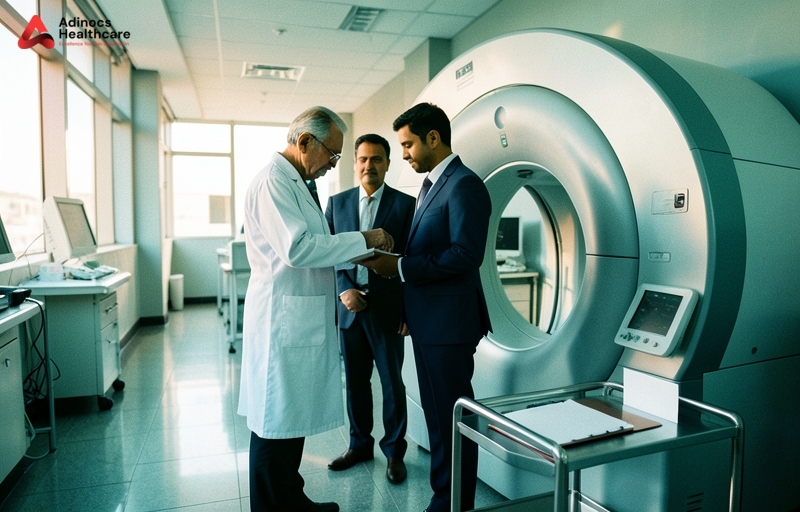
The short answer: To maximize resale returns during a medical equipment trade-in India process, healthcare facilities must maintain complete OEM service binders, retain active software licenses, and collect competitive quotes from third-party refurbishers rather than relying solely on vendor trade-in allowances. Diagnostic centers in India recover up to 35% more capital by auditing machine condition and software entitlement keys before starting trade-in negotiations.
According to a 2025 Indian Diagnostic Infrastructure Survey, nearly 68% of Tier 2 and Tier 3 facilities treat functional 5-year-old analyzers and imaging systems as scrap metal during upgrades. They lose between Rs. 1.5 lakh and Rs. 12 lakh per machine as a result. Upgrading pathology analyzers or radiology suites forces owners to manage narrow profit margins while funding capital expenditure. When planning a medical equipment trade-in India project, accepting the vendor's first buy-back offer is a costly oversight. Understanding how regional buy-back programs operate unlocks capital sitting right inside your facility.
How does medical equipment trade-in India process work?
A pathology lab in Ranchi recently attempted to swap a seven-year-old semi-automated biochemistry analyzer for a fully automated floor model. The local distributor offered a meager Rs. 40,000 as a scrap allowance on the purchase invoice. That felt low. After obtaining independent valuation quotes from regional refurbishers in Kolkata, the lab director secured Rs. 1.8 lakh for the exact same unit. That represents a 350% increase in capital recovery on a single asset. Huge difference. That extra cash offset 15% of their new machine invoice.
The standard trade-in process in India follows four basic stages:
- Technical evaluation: Engineers inspect physical chassis wear, component degradation, vacuum tube exposure counts, and software build numbers.
- De-installation assessment: Estimating logistics costs for removing heavy machinery without damaging facility walls or electrical panels.
- Regulatory compliance verification: Verifying serial numbers against regulatory frameworks established by the Central Drugs Standard Control Organisation (CDSCO) and Atomic Energy Regulatory Board (AERB) eLORA portals to ensure clean legal ownership transfers.
- Credit application: Structuring the asset payoff as a cash settlement or a direct credit against a new capital purchase invoice.
Here's the catch. Original Equipment Manufacturers (OEMs) often inflate trade-in discounts on paper while holding full price on new equipment. Third-party refurbishers calculate payouts based on active secondary market demand in regional hubs across Bihar, Odisha, and Assam. Why accept a low offer when demand is high? Executing a planned trade-in strategy ensures you retain leverage throughout sales discussions.
What factors determine medical equipment trade-in India valuation?
In 2025, a diagnostic center in coastal Vizag tried to trade in a 4-year-old ultrasound system, expecting a payout of Rs. 4.5 lakh. Unmanaged humidity had corroded the internal motherboards and transducer connectors, dropping the offer to Rs. 1.8 lakh. Environmental conditions directly impact secondary valuation. A CT scanner running in an air-conditioned room in Pune commands a far higher price than an identical unit operated in humid conditions without proper climate controls. Unmanaged moisture causes micro-corrosion on sensitive PCB boards, instantly slashing thousands of rupees off resale offers. To understand how environmental factors impact machine longevity, read our analysis on Does Indian Weather Shorten Your Equipment Lifespan?.
What this means: Buyers calculate buy-back offers using six specific operational metrics:
- Tube/Detector life remaining: For X-ray, CT, and fluoroscopy systems, slice counts or exposure numbers dictate resale value. A CT tube with 70% remaining life adds Rs. 5 lakh to Rs. 8 lakh over a spent tube needing replacement.
- Software tier and dongles: Physical hardware is only half the asset. Original software installation keys, active advanced licenses (like cardiac or vascular packages), and original license dongles increase offer prices by 15% to 20%.
- Service history continuity: Unbroken Annual Maintenance Contracts (AMC) or Comprehensive Maintenance Contracts (CMC) backed by OEM-certified engineers prove the machine was maintained using genuine factory parts.
- De-installation complexity: If removing an MRI magnet requires knocking down structural masonry in a congested Kolkata neighborhood, the buyer deducts those rigging costs directly from your trade-in quote. If you need to reconfigure room layouts or radiation shielding after removal, check our guide on How Much Does Radiology Room Shielding Cost in India?.
- Regional market liquidity: High-throughput machines like 16-slice CTs and 4-channel ultrasound units have immediate buyers in Tier 3 towns. Niche specialized gear takes longer to re-sell, dragging down buyer offers.
- NABL audit compliance: Calibration logs satisfying National Accreditation Board for Testing and Calibration Laboratories standards give second-hand buyers confidence that machine output remains within tight clinical tolerances. A 2025 NABL report found that labs with complete calibration logs average 22% higher resale payouts.
Should you sell to an OEM vendor or a third-party refurbisher?
A 50-bed hospital in Nagpur traded a 1.5T MRI directly through their OEM vendor, receiving an apparent trade-in allowance of Rs. 12 lakh on paper. However, the vendor quietly reduced the discount on the replacement scanner by Rs. 4 lakh. Meanwhile, an independent refurbisher had offered Rs. 10.5 lakh in direct cash settlement without altering new machine pricing. The net return was significantly higher through the independent refurbisher. Worth noting.
Here is how the main selling channels compare for a typical 5-year-old diagnostic imaging asset in India:
| Evaluation Factor | OEM Vendor Buy-Back | Third-Party Refurbisher | Direct Sale to Smaller Clinic |
|---|---|---|---|
| Average Payout Level | Moderate (often bundled into machine discounts) | High (cash-focused based on regional demand) | Highest potential (no middleman margin) |
| Transaction Speed | Fast (aligned with new delivery schedule) | Moderate (requires independent appraisal) | Slow (buyer financing delays are common) |
| De-installation Responsibility | Handled completely by vendor engineering team | Handled completely by refurbisher riggers | Often disputed or split between parties |
| Regulatory Liability Transfer | Instant and clean documentation | Requires explicit contract clauses | High risk without formal AERB transfer filings |
The trade-off: If operational downtime must be zero, OEM buy-backs make sense because vendors sync removal with installation. But if you want maximum cash to reduce overall project debt, third-party refurbishers almost always yield higher net revenue.
How to prepare old equipment for maximum resale value?
A 40-bed facility in Siliguri achieved a 35% higher valuation on its 5-year-old color Doppler ultrasound by taking simple prep steps before bringing in appraisers. They did not spend lakhs on repairs. They simply organized their documentation, cleaned the physical housing, and conducted basic maintenance checks. That simple.
Follow these five steps to prepare your diagnostic assets for maximum trade-in value:
- Dig up every software key and recovery disk: Missing license keys force buyers to factor in software re-licensing costs from the manufacturer. Locate all physical USB keys, CDs, and paper software certificates.
- Compile an unbroken service binder: Collect every field service report (FSR) from day one. A neat binder showing regular preventive maintenance builds buyer trust instantly.
- Fix minor cosmetic blemishes: Replace cracked plastic casings, fix loose knobs, and touch up chipped paint. First impressions matter to equipment brokers as much as automobile dealers.
- Run a final calibration test: Document operational performance with standard phantom test images or fresh control runs. Proving the system works perfectly right now removes buyer risk.
- Get independent valuation benchmarks: Do not rely on a single vendor quote. Request valuation estimates from at least two regional refurbishers to establish a clear baseline.
When selecting new diagnostic hardware after trading in old units, balance upfront cost against ongoing reliability. Read our comparison analysis on Global vs. Indian Equipment: Better Long-Term Value in 2026? to plan your capital purchases wisely.
What are the tax implications of equipment trade-ins in 2026?
When a multi-specialty clinic in Lucknow traded in three 2021-model hemodialysis machines without accounting for block depreciation rules under Section 32 of the Income Tax Act, they faced an unexpected short-term capital gains (STCG) tax hit of Rs. 3.2 lakh. Tax treatment under Indian financial regulations directly affects the net financial return of an equipment upgrade.
Under Section 32, medical equipment falls within specific "block of assets" categories carrying standardized block depreciation rates (typically 15% for general plant and medical equipment). When you trade in or sell a capital asset, the sale proceeds are deducted directly from the written-down value (WDV) of that asset block. If the trade-in allowance exceeds the total WDV of the block, the surplus triggers STCG tax liabilities. Conversely, if you re-invest the full amount into new capital machinery within the same financial year, you avoid immediate capital gains penalties while building a fresh depreciation base for upcoming assessment years.
What about Goods and Services Tax (GST)? Selling used medical equipment is treated as a supply of capital goods under Indian tax laws. GST applies based on equipment classification and transaction structure. If you claimed Input Tax Credit (ITC) on the original purchase years ago, you must calculate GST obligations on the current transaction value under GST Section 18(6) rules. Always consult a qualified Chartered Accountant before finalizing sell-off documentation.
Key Takeaways
- Never accept the initial offer: OEM trade-in values are often structured to favor the vendor. Always get independent third-party quotes.
- Documentation drives price: Complete service logs, software licenses, and NABL calibration reports can raise trade-in value by 20% to 35%.
- Climate care protects value: Consistent temperature and humidity control during operational years prevents internal component decay, preserving asset value.
- Factor in removal logistics: Ensure removal costs, structural restoration, and de-installation safety are clearly defined in the sales contract.
- Sync with tax strategy: Time trade-ins within the same financial year as new purchases to optimize block depreciation and minimize capital gains tax liabilities.
Frequently Asked Questions
How much value does a 5-year-old radiology machine retain in India?
A 5-year-old radiology system typically retains between 25% and 40% of its original purchase price in India. Exact value depends on tube usage counts, brand reputation, service continuity under OEM maintenance contracts, and overall physical condition.
Is selling used CT or X-ray equipment legal under AERB rules in India?
Yes, selling used CT or X-ray equipment is completely legal provided you comply with CDSCO regulations and Atomic Energy Regulatory Board (AERB) eLORA portal transfer protocols. The acquiring facility must hold valid AERB registrations and site approvals before operating radiation-emitting equipment.
Can I get buy-back cash for broken or non-working lab equipment in India?
Yes. Non-working equipment can be traded in for scrap value or as donor systems for spare parts. While non-functional gear yields lower payouts, third-party refurbishers routinely purchase broken units to harvest functional detectors, power supplies, or circuit boards.
How long does a third-party medical equipment valuation take in India?
A standard third-party valuation takes 48 to 72 hours once complete documentation (serial numbers, software license details, exposure counts, and service logs) is submitted. On-site engineering evaluations for heavy imaging equipment like MRIs or CTs typically require 1 business day.
Navigating equipment upgrades while maintaining financial flexibility requires smart operational strategy. At Adinocs Healthcare, we support hospitals and pathology labs across Eastern India with complete diagnostic equipment solutions, turnkey installation, operator training, and sub-specialist teleradiology support. Whether you need pay-per-report teleradiology to expand your clinical bandwidth or assistance evaluating modern diagnostic gear, our team is here to guide your operations. Talk to our diagnostic equipment specialists at Adinocs Healthcare today to schedule your asset evaluation.
Data sources: CDSCO Medical Devices Rules Guidelines, Income Tax Act Section 32 Asset Frameworks, NABL Calibration Protocols (2025/2026), Indian Diagnostic Resale Index Benchmarks.