Why Equipment Bottlenecks Cost Indian Labs Millions
Equipment bottlenecks lead to long patient waits and lost revenue. Learn how Indian diagnostic labs can optimize equipment for better throughput and profitability.
Read ArticleStop losing money on idle machines. Learn how to fix radiology equipment underutilization in India to boost your diagnostic center's ROI and revenue.
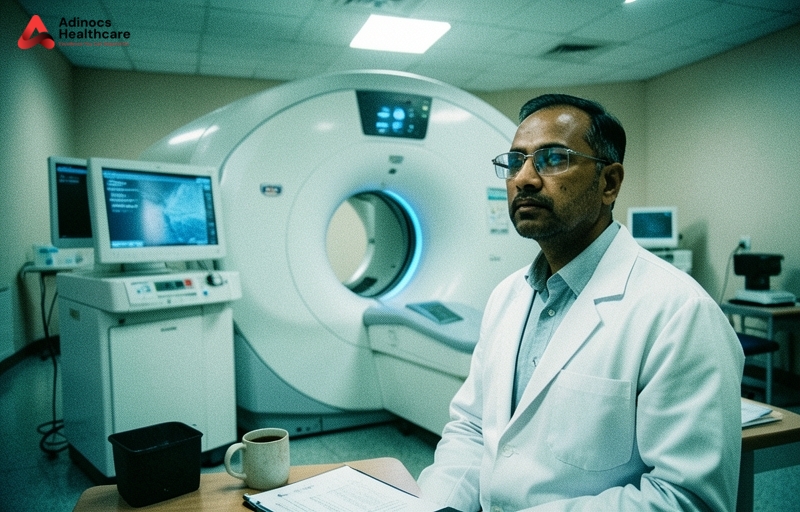
Is your CT scanner or MRI machine sitting completely dark for hours every afternoon? If you operate an imaging center or hospital diagnostic department in cities like Patna, Siliguri, or Ranchi, the answer is likely yes. According to a 2025 Indian healthcare operations survey, over 65% of imaging modalities in tier-2 diagnostic centers operate at less than half their daily functional capacity. Tackling radiology equipment underutilization India wide is the quickest way to protect cash flow without buying new machinery. Idle gantries swallow fixed overhead while patients wait hours for delayed reports.
The short answer: Severe radiology equipment underutilization India centers experience drains up to Rs. 4.5 lakh per month per machine, driven mostly by radiologist shortages and fragmented patient scheduling. Connecting your modalities to sub-specialist teleradiology networks and streamlining pre-scan prep recovers 4 to 6 extra scan slots daily without adding fixed salary costs.
A 50-bed multi-specialty hospital in Asansol purchased a 16-slice CT scanner in early 2025 expecting 25 scans a day. Six months after installation, logbooks showed an average of just 7 scans daily. The machine sat cold for most of the afternoon. The owner thought he had a marketing problem. He was wrong. He had an operational bottleneck.
Let's run the actual numbers for an idle CT or MRI machine in an Indian setting. Fixed costs don't care whether your machine scans 5 patients or 30 patients a day. Bank interest on equipment loans averages 11% to 13% annually. Comprehensive Annual Maintenance Contracts (AMC) for a mid-tier CT scanner cost between Rs. 4 lakh and Rs. 8 lakh per year. Add the electricity bills required to keep liquid helium or tube cooling systems running 24/7 (roughly Rs. 35,000 to Rs. 50,000 monthly), plus technical staff salaries. Your facility incurs roughly Rs. 15,000 in fixed daily overhead just by unlocking the machine room door.
When your machine sits cold, you lose revenue in two distinct ways:
Here's the catch that most lab owners miss. The primary driver of idle machine time isn't lack of patient demand in your city. It is slot fragmentation. Unplanned 30-minute gaps between scans, caused by delayed registration or late radiologist reporting, swallow up to 40% of your machine's total daily capacity. If you're weighing which high-value assets to install next, review our guide on Which Radiology Machine Has the Best ROI in India? to prevent costly asset misallocation from the start.
At 3:15 PM on a Tuesday in a Patna diagnostic center, a 1.5T MRI machine stood empty for 50 minutes while the technician typed manual patient entries from a scribbled paper slip. Meanwhile, three patients waited in reception, and the facility's only full-time radiologist was preparing to leave for the day. The result? Silent gantries.
To optimize diagnostic equipment utilization India healthcare providers must first fix four major operational bottlenecks:
Quality frameworks established by the National Accreditation Board for Testing and Calibration Laboratories (NABL) emphasize strict quality management and turn-around time protocols. However, maintaining these standards becomes nearly impossible when manual processes drag down equipment performance.
In July 2025, a diagnostic hub in Ranchi added 14 additional daily CT scans to their schedule without hiring another full-time doctor. They did it by routing DICOM files directly to a cloud-based teleradiology network during evening and night shifts. Remote sub-specialist reporting decouples image acquisition from local radiologist desk hours.
In the traditional model, your imaging equipment is tied to a single doctor's schedule. If your radiologist falls ill, takes leave, or works only four hours a day, your multi-crore machine halts. That model limits your radiology machine ROI India business models depend on.
What this means: remote sub-specialist reporting transforms your scanner into a continuous revenue asset. Your local radiology technicians perform scans from 7:00 AM until 10:00 PM. As soon as a scan finishes, the DICOM files upload automatically to a cloud platform. A specialized radiologist reviews the images remotely and delivers a verified report within 2 hours.
| Operational Metric | Traditional In-House Model | Teleradiology Hybrid Model |
|---|---|---|
| Radiologist Fixed Monthly Cost | Rs. 2.5 Lakh - Rs. 4.0 Lakh (Fixed Salary) | Rs. 0 Fixed Cost (Pay-Per-Report Model) |
| Machine Operating Window | 6 to 8 hours daily | 14 to 24 hours continuous operation |
| Average Scan Turnaround Time | 12 to 24 hours | Under 2 hours (Emergency: 30 mins) |
| Sub-specialty Reporting Access | Rarely available in Tier 2/3 towns | Instant access to Neuro, Cardiac, and Musculoskeletal specialists |
| Daily CT/MRI Scan Capacity | 8 to 12 scans | 25 to 35 scans |
The financial math is compelling. Instead of paying a massive fixed monthly salary regardless of patient volume, you transition to a pay-per-report structure. Worth knowing: when patient volume drops, your reporting cost drops automatically. When volume surges, your machine handles the load without adding fixed overhead.
In November 2025, a pathology and imaging hub in Siliguri increased its daily CT scan throughput from 11 to 21 scans without spending a single rupee on new hardware. The operations team realized that 18 minutes were wasted every time a patient entered the scanner room with unverified renal function results. They redesigned their patient flow from scratch.
Follow these four practical steps to implement successful radiology workflow optimization India wide:
The operational math is straightforward. By trimming just 6 minutes of wasted prep time per patient, a facility scanning 20 patients a day gains 2 full hours of gantry availability. That opens up enough time to fit in 4 to 6 additional patients every single day.
A medical center in Jharsuguda spent Rs. 1.8 crore on a new 32-slice CT scanner in late 2024, expecting immediate referral streams from local clinics. Twelve months later, default notices arrived for their equipment loan because monthly scan volumes reached barely 30% of financial projections. Why let an idle gantry drain your daily cash flow?
If you run a hospital in a developing hub like Muzaffarpur or Jharsuguda, full equipment ownership might drain your cash reserves. You have options. Leasing equipment, adopting pay-per-use equipment contracts, or introducing mobile imaging models can lower your upfront financial commitment significantly. If you are exploring flexible service expansion, read our breakdown on How Much Does a Mobile Radiology Van Cost in India?
Regulatory compliance is another critical piece of equipment asset strategy. Medical equipment procurement and installation must comply with standards laid out by the Central Drugs Standard Control Organisation (CDSCO) under Medical Devices Rules, along with strict radiation safety clearances from the Atomic Energy Regulatory Board (AERB).
At the same time, national healthcare schemes driven by the National Health Authority (NHA) under Ayushman Bharat (AB-PMJAY) have significantly increased patient volume across Tier 2 and Tier 3 Indian hospitals. The trade-off: scheme reimbursement rates require lean operational management. You cannot make Ayushman Bharat tariffs profitable on an underutilized CT scanner doing only 5 scans a day. High volume and streamlined machine utilization are necessary to make these tariffs work for your bottom line in 2026.
A typical 16-slice CT scanner in a Tier 2 Indian city needs 10 to 12 scans daily to cover loan EMI, AMC costs, electricity, and staff salaries. Achieving profitability requires pushing machine throughput beyond 18 to 20 scans per day through optimized scheduling and rapid remote reporting.
The average ROI payback period for a 1.5T MRI machine ranges from 3.5 to 5 years. Facilities using high-throughput teleradiology workflows can shorten this payback period to under 3 years by maintaining continuous 14-hour daily scanning windows.
Yes, NABL and NABH guidelines allow remote teleradiology reporting provided the teleradiology partner adheres to standard quality protocols, maintains verified digital signature trails, performs regular peer reviews, and complies with national patient data confidentiality regulations.
Teleradiology reporting for a 16-slice CT scan in India ranges from Rs. 200 to Rs. 450 per study depending on scan complexity (head CT vs angiography) and turn-around time requirements. This pay-per-report model eliminates fixed monthly radiologist salaries while maintaining 24/7 operational coverage.
At Adinocs Healthcare, we help diagnostic centre owners and hospital leaders across West Bengal, Bihar, Odisha, and Eastern India eliminate imaging bottlenecks and maximize return on diagnostic equipment investments. Our sub-specialist teleradiology network delivers guaranteed 2-hour report turnarounds with zero upfront investment. Ready to transform your idle machinery into a high-profit operational asset? Talk to our teleradiology team today to request a free workflow assessment.
Data sources: NABL India laboratory quality benchmarks, CDSCO Medical Devices Rules updates, National Health Authority (NHA) operational guidelines, and internal Adinocs Healthcare diagnostic performance data (2025-2026).
Equipment bottlenecks lead to long patient waits and lost revenue. Learn how Indian diagnostic labs can optimize equipment for better throughput and profitability.
Read Article
Discover how Indian diagnostic centers can optimize radiology workflows using teleradiology and AI for faster reports, enhanced accuracy, and improved efficiency.
Read ArticleAbout the Author
Adinocs Healthcare
Healthcare Operations Team
Adinocs Healthcare is an Indian B2B healthcare services company based in Kolkata, providing teleradiology reporting (Adinocs), laboratory management software (Adibix), and medical equipment services. Our team works with hospitals, diagnostic centres, and pathology labs across India - from Tier-1 metros to remote Tier-3 cities - delivering on-ground support that distant Bangalore-based competitors cannot match. Articles are written and reviewed by our operations team with 15+ years of healthcare industry experience.
Join decision-makers who stay ahead with our curated articles.
No spam. Unsubscribe anytime.